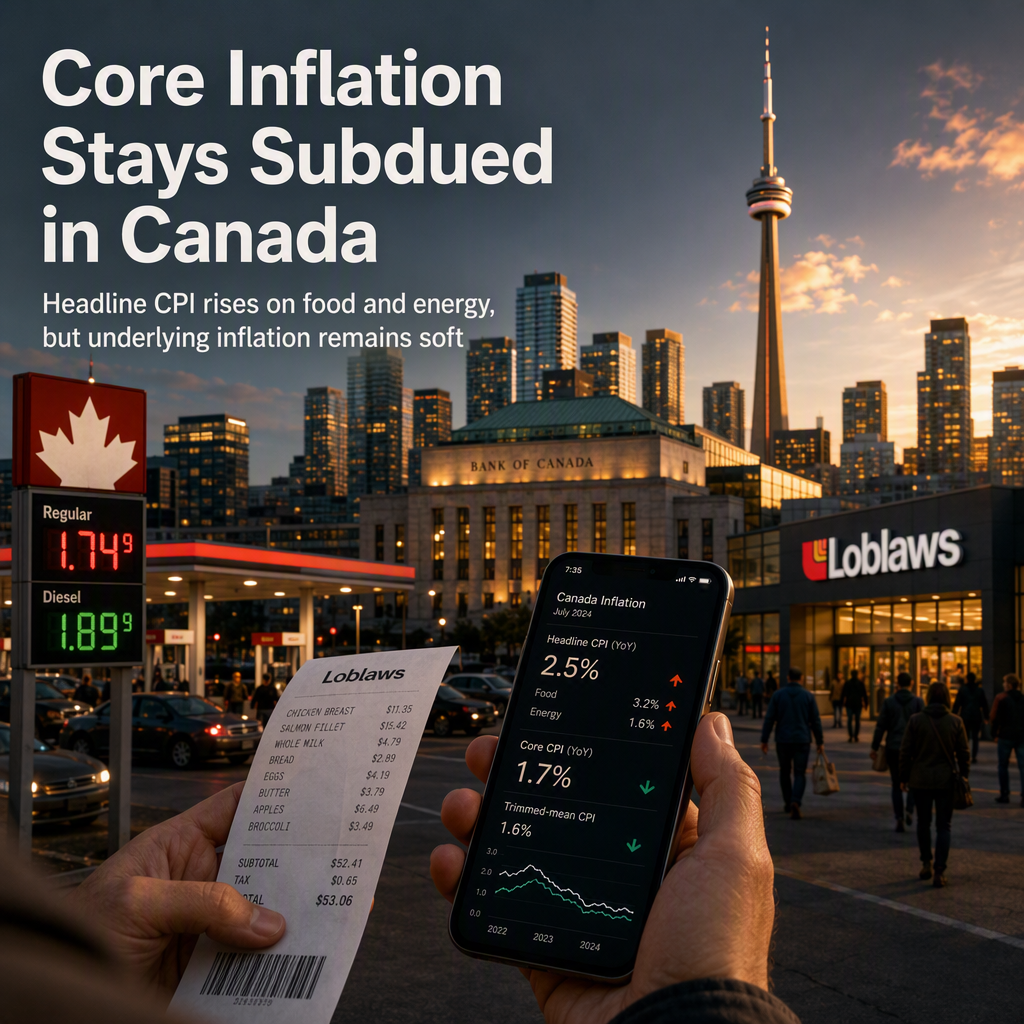
TD Securities’ Robert Both projects that Canadian headline CPI will increase to 2.9% year-on-year in July, primarily due to higher gasoline and food prices, following a sharp pullback in gasoline prices in June [1]. The monthly price rise is expected to be 0.4%, with travel services providing an offset to the upward pressure from food and energy [1]. Despite the headline CPI tracking above the Bank of Canada’s forecast of 2.5% for July, core inflation measures such as CPI-trim and CPI-median are forecasted to remain around 1.85%, which is below the Bank of Canada’s projections from the July Monetary Policy Report (2.0% over Q3) [1].
Underlying inflation pressures are described as benign, with the ex. food/energy (xFE) measure expected to hold stable at 1.7% year-on-year and CPI diffusion indicators not anticipated to show any significant increase in the breadth of inflation pressures [1]. The three-month annualized basis for CPI-trim/median is forecasted at 1.6% [1].
These figures reinforce a subdued core inflation backdrop, suggesting that the Bank of Canada will continue to focus on core inflation rather than headline moves driven by oil prices [1]. The market implication is that, despite headline inflation rising, the underlying inflation remains soft, which may influence the Bank of Canada’s policy path to remain cautious and data-dependent [1].
No forward-looking statements or analyst opinions regarding future rate decisions or market reactions are explicitly mentioned beyond the expectation that core softness will guide the Bank of Canada’s approach [1].
CONCLUSION
Canadian headline inflation is expected to rise in July, but core inflation measures remain subdued and below central bank projections. This supports a continued focus on core inflation by the Bank of Canada, suggesting a cautious approach to policy changes. The market takeaway is that underlying inflation pressures are benign, reducing urgency for aggressive monetary tightening.