Standard Chartered economists Anubhuti Sahay and Saurav Anand have revised their outlook on India’s FY27 fiscal deficit, citing a sharp decline in crude oil prices as a key factor reducing the risk of fiscal slippage. The economists now estimate the risk of slippage in the central government’s FY27 (ending March 2027) fiscal deficit at 0.2-0.3% of GDP, compared to their previous estimate of 0.5% of GDP. The government’s official target for the FY27 fiscal deficit remains at 4.3% of GDP [1].
The report highlights several factors supporting this improved outlook: the establishment of the Economic Stabilisation Fund (ESF) in the FY27 budget, a reduced subsidy burden, partial rollback of the excise duty cut, and a faster pace of divestment. The ESF is intended to serve as a buffer for unexpected expenditure increases [1].
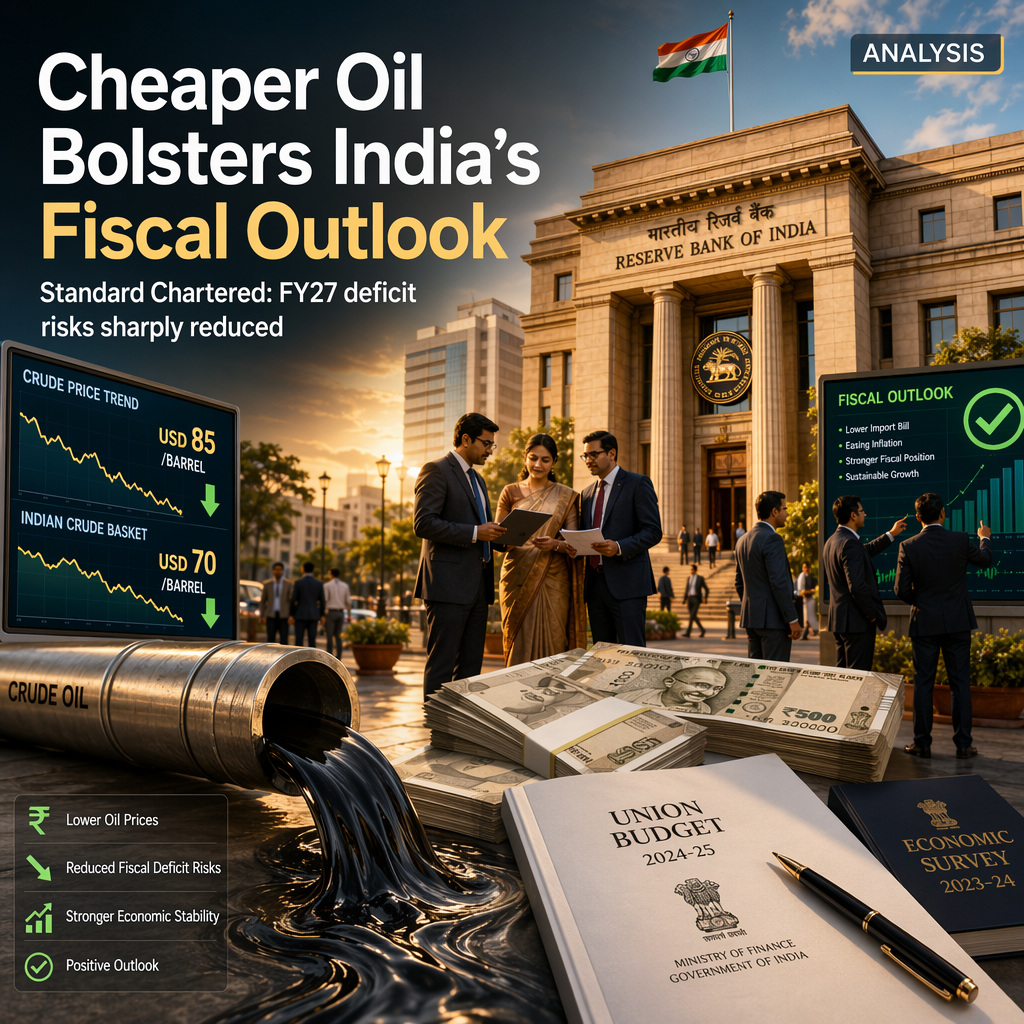
Standard Chartered has lowered its FY27 crude oil price assumption to USD 85 per barrel from USD 95 per barrel previously. The economists believe that lower crude prices will likely enable the government to reverse 40-50% of the INR 10/litre excise duty cut on diesel and gasoline announced in March 2026, probably in the second half of FY27. Additionally, they expect retail diesel and gasoline prices to be reduced by INR 2-3/litre in H2-FY27, with stable prices in the first half allowing oil marketing companies to recover most of the heavy losses incurred in Q1 [1].
While acknowledging that fiscal slippage risks remain, the economists consider them manageable. They also note that crude oil prices could fall below their current assumption, as Indian Crude Basket (ICB) prices are presently trading around USD 70 per barrel [1].
CONCLUSION
Standard Chartered’s analysis suggests that lower crude oil prices and supportive fiscal measures have significantly reduced the risk of India missing its FY27 fiscal deficit target. While some risks persist, the outlook for fiscal stability has improved, with manageable downside scenarios.