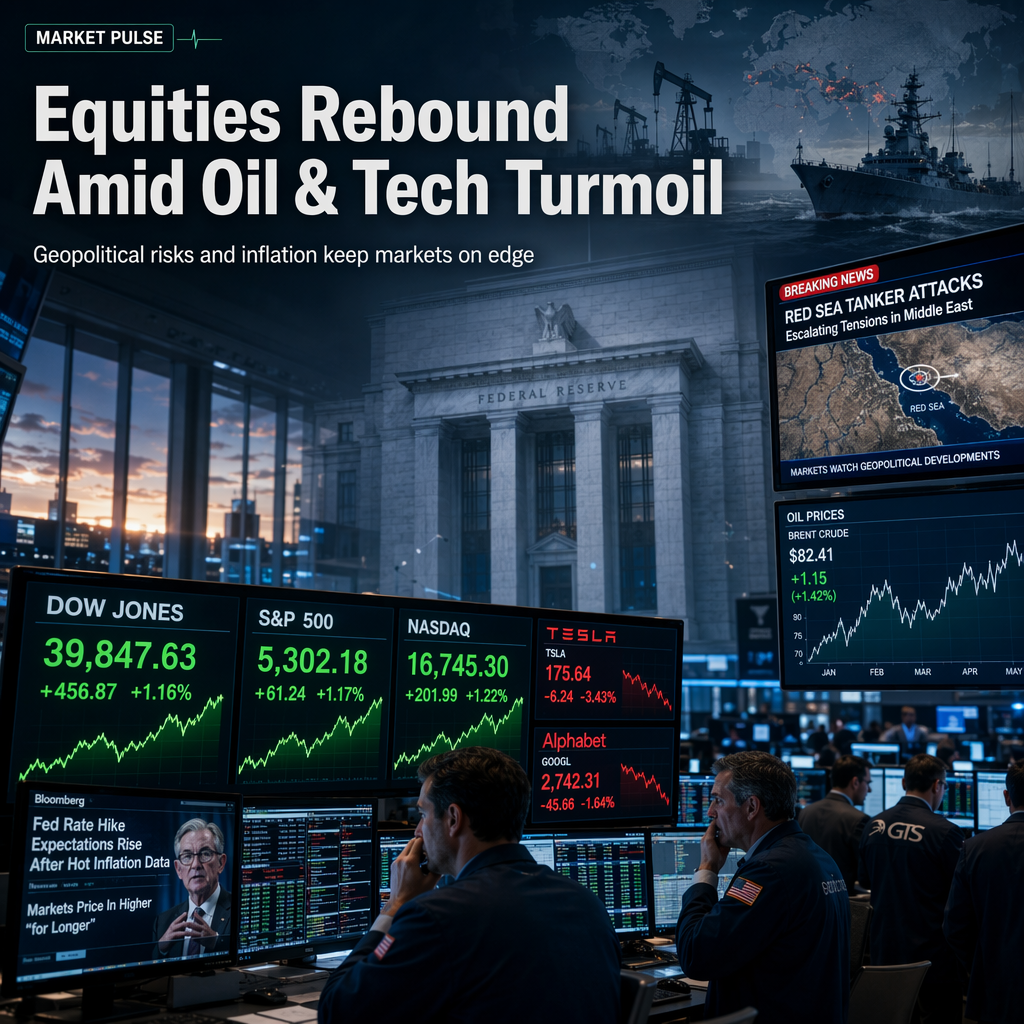
US equity futures rebounded during European trading hours on Friday, with Dow Jones futures gaining 0.35% to around 52,070, S&P 500 futures up 0.21% near 7,460, and Nasdaq 100 futures advancing 0.08% to approximately 28,650 [1]. This recovery followed a drop in oil prices after three consecutive days of gains, which had previously heightened market fears over inflation and the potential for tighter Federal Reserve policy [1]. Despite the bounce, trader sentiment remains fragile due to ongoing geopolitical tensions, particularly in the Middle East, where Yemen’s Iran-backed Houthi militants attacked two Saudi tankers in the Red Sea, prompting the US to launch its 13th consecutive night of retaliatory strikes against Iran. US President Donald Trump issued intensified warnings of unprecedented military action if hostilities persist, maintaining crude supply risks [1].
Persistent energy-driven inflation has shifted monetary policy expectations, with CME FedWatch data indicating a 31.5% chance of a Fed rate hike this month and a 78.1% probability of at least a 25-basis-point increase in September [1]. The futures rally provided brief relief after a sharp selloff in the previous session, triggered by weak earnings from major technology firms. On Thursday, the Dow Jones dropped 0.97%, the S&P 500 fell 1.2%, and the Nasdaq declined 2.2%, marking their worst single-day losses since late June [1].
Deutsche Bank strategists noted that surging oil prices and stagflation fears put significant pressure on global equities, with the S&P 500 down 1.21% and the Nasdaq off 2.15% in the previous session [2]. Tesla shares plummeted 14.52% and Alphabet fell 7.13% after disappointing earnings, dragging the Mag 7 index down 4.78%—its largest daily loss since the week of the Liberation Day turmoil in 2025 [2]. US high-yield spreads widened, and the sell-off extended to Europe, where the STOXX 600 dropped 1.18%, the CAC 40 fell 1.64%, the DAX lost 1.56%, and the FTSE MIB declined 2.80% [2].
Asian equities also suffered, with South Korea’s KOSPI leading declines at -5.62%, Japan’s Nikkei down 2.87%, China’s CSI 300 off 1.17%, Hong Kong’s Hang Seng lower by 1.27%, and Australia’s S&P/ASX 200 down 0.93% [2]. However, the tech sector saw a positive note after Intel reported strong earnings and forecast Q3 revenue of $15.8–16.8 billion, above the $15.1 billion average estimate, sending its shares up 4.5% in after-hours trading [2].
While US equity futures stabilized somewhat, with S&P 500 futures down 0.08% and Nasdaq futures off 0.34% at the time of reporting, all major US indexes remained on track for weekly losses, led by the Nasdaq [1][2].
CONCLUSION
Global equities experienced a sharp selloff driven by surging oil prices, stagflation fears, and disappointing tech earnings, but US futures showed signs of stabilization as oil prices cooled. Geopolitical risks and inflation concerns continue to weigh on sentiment, with markets closely watching Federal Reserve policy signals. Despite a brief rebound, the overall market outlook remains cautious, especially for technology stocks.