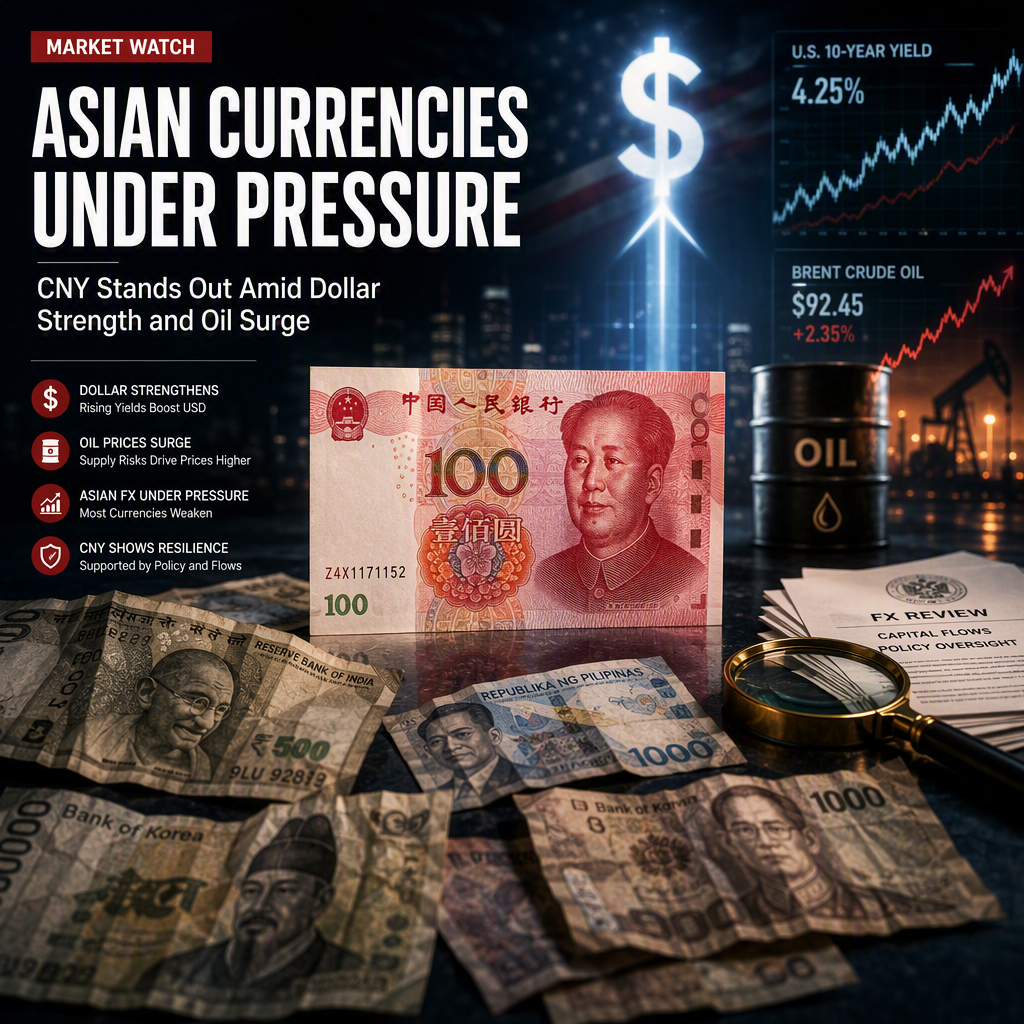
According to BNY’s Geoff Yu, Asian currencies and assets are facing significant pressure due to a stronger US Dollar (USD), elevated oil prices, and rising global bond yields [1]. The Chinese Yuan (CNY) has shown relative resilience compared to its regional peers, but this strength has attracted increased official scrutiny, as evidenced by the widening counter-cyclical factor (CCF) in daily USD/CNY fixings [1]. In contrast, the Indian Rupee (INR), Philippine Peso (PHP), Thai Baht (THB), and South Korean Won (KRW) are described as vulnerable or stretched under current market conditions [1].
Yu notes that the Asian macroeconomic calendar will be a key test for the resilience of external demand, especially as domestic economic momentum remains uneven across the region [1]. The ongoing pressures from a strong US dollar, high oil prices, and renewed foreign outflows are impacting not only currencies but also Asian equities and fixed income markets [1]. The report highlights that while differentiation among regional currencies remains a central theme, recent divergences are becoming increasingly stretched, and further depreciation is testing the limits of central-bank foreign exchange smoothing operations [1].
BNY maintains its recommendation to increase CNY hedges but cautions against chasing the recent appreciation, as the pace of CNY gains has slowed and iFlow scored holdings have moved further into underheld territory [1]. No specific market reactions or analyst forecasts beyond these recommendations are provided in the source article.
CONCLUSION
Asian currencies are under pressure from a stronger US dollar, higher oil prices, and rising global yields, with the CNY remaining relatively resilient but attracting official scrutiny. BNY advises increasing CNY hedges without chasing recent gains, as regional currency divergences become more pronounced and central banks face growing challenges in managing depreciation.