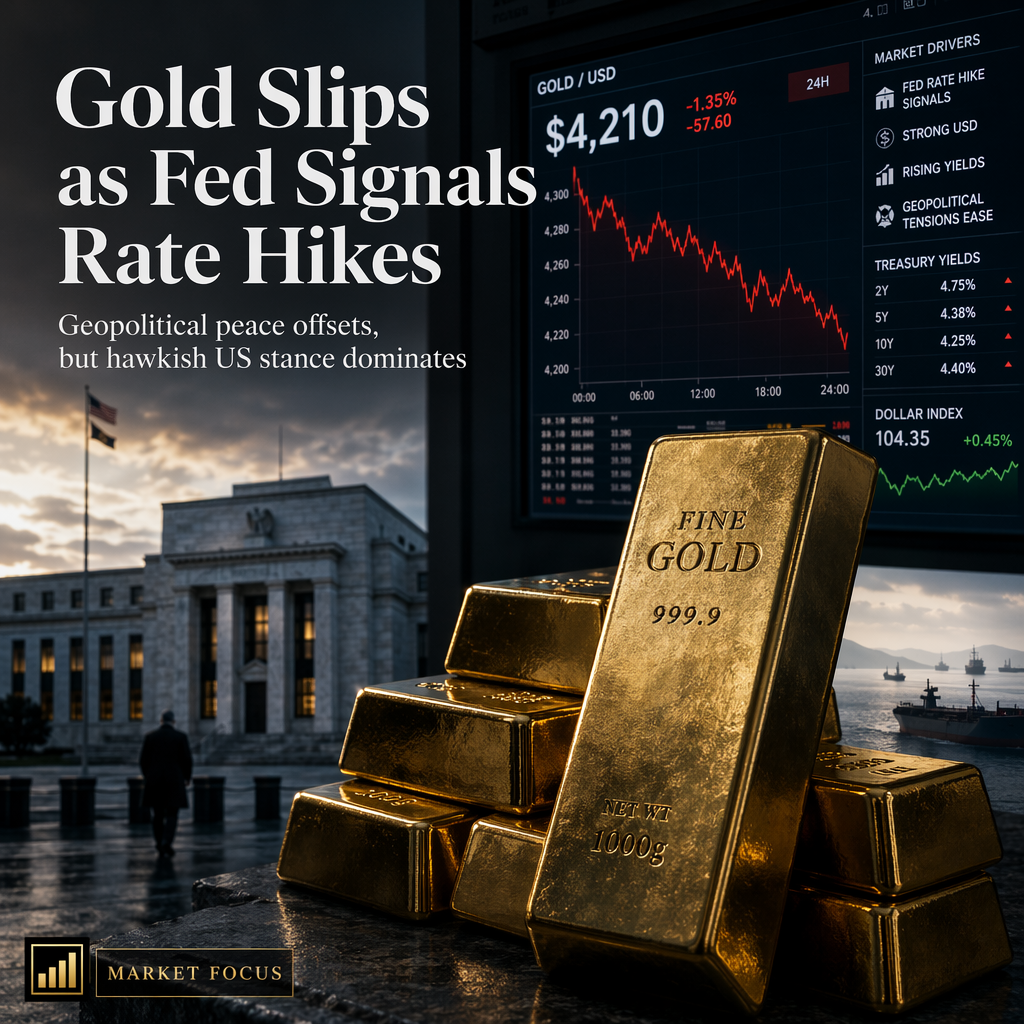
Gold prices (XAU/USD) declined to near $4,210 during the early Asian session on Friday, extending losses after the US Federal Reserve (Fed) maintained its benchmark interest rate but indicated that further rate hikes could occur this year [1]. The Federal Open Market Committee (FOMC), under new chair Kevin Warsh, unanimously voted to keep rates between 3.5% and 3.75% in its June policy meeting. This range has been in place since the Fed lowered rates by three-quarters of a percentage point in late 2025 [1]. Warsh emphasized the Fed's commitment to price stability, stating, 'Persistently high prices are a burden for the American people, but the recent past need not be prologue,' and affirmed the committee's unanimous stance on delivering price stability [1].
Gold, traditionally seen as a hedge against inflation, tends to lose appeal when interest rates are high because it does not yield interest [1]. The Fed's hawkish tone has therefore weighed on gold prices, offsetting some of the support that might have come from geopolitical developments. On the geopolitical front, an interim US-Iran peace agreement took effect, with Bloomberg reporting that shipping has resumed in the Strait of Hormuz as the US ended its blockade and began negotiations over Tehran’s nuclear program [1]. US President Donald Trump confirmed that 'oil is flowing' after signing a memorandum to extend the ceasefire and initiate negotiations to end the conflict that began with Israel at the end of February [1].
While the US-Iran peace deal could provide some support to gold, the dominant market reaction has been shaped by the Fed’s hawkish stance and the prospect of higher interest rates [1]. No analyst opinions or forward-looking statements beyond the Fed’s guidance and Warsh’s comments were provided in the article.
CONCLUSION
Gold prices have come under pressure, falling toward $4,200 as the Federal Reserve signaled the possibility of further rate hikes despite the supportive backdrop of a US-Iran peace deal. The market is currently more focused on the Fed’s hawkish outlook than on geopolitical developments. Investors are likely to monitor future Fed communications and the progress of US-Iran negotiations for further direction.