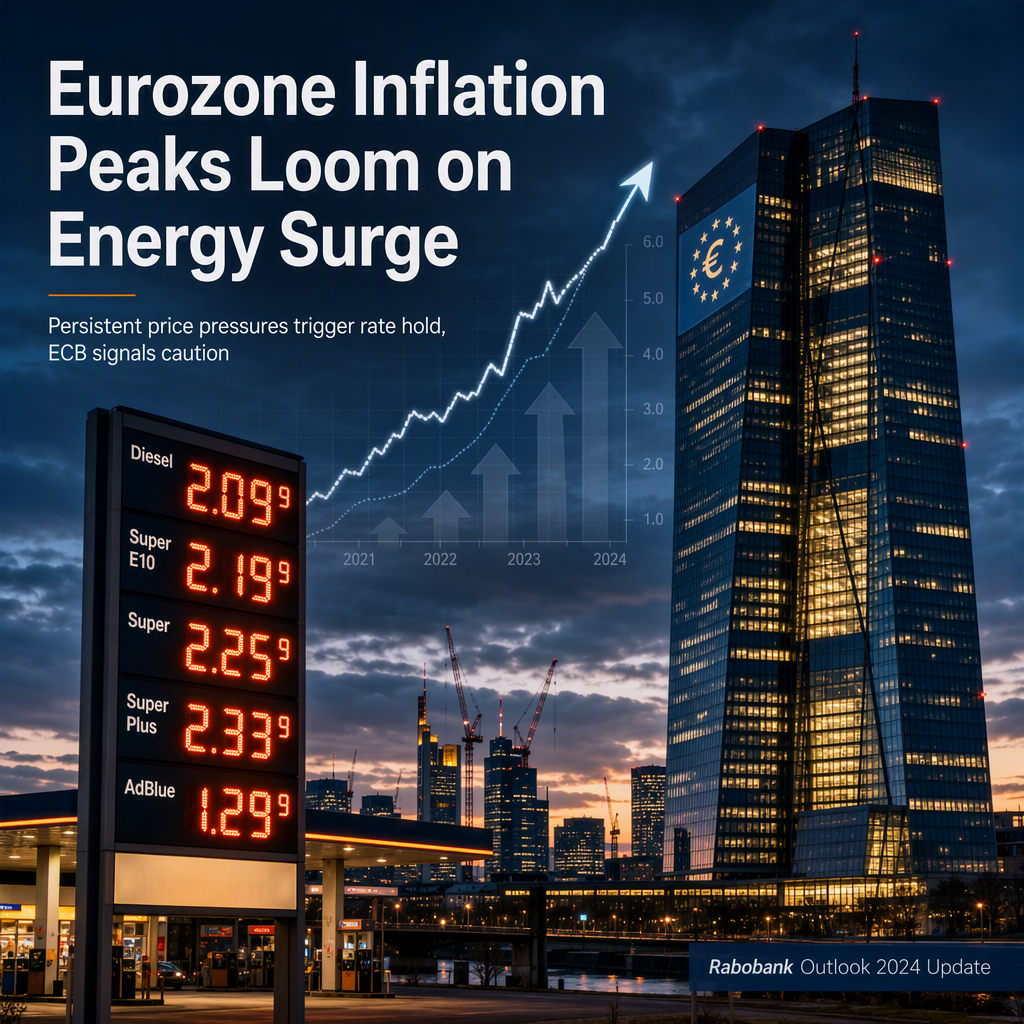
Rabobank strategists Bas van Geffen and Elwin de Groot have revised their inflation outlook for the Eurozone, citing sharply higher forecasts for oil and natural gas prices. According to their updated models, headline inflation is expected to increase by about 0.5 percentage points in both 2026 and 2027 due to these elevated energy costs [1]. The strategists now anticipate inflation peaking at 4.4% year-on-year in January and February 2027, with subsequent base effects gradually reducing the impact of energy prices on the inflation rate. Their forecasts for headline inflation are 3.1% for 2026 and 3.5% for 2027 [1].
Core inflation is projected to rise only modestly, by 0.1 percentage points, reflecting both direct and indirect effects of higher energy prices and the assumption that ongoing conflict in the Middle East may lead to increased supply chain pressures in the coming months [1]. Rabobank notes that if economic activity remains resilient in the fourth quarter and energy inflation stays elevated, employees may demand higher wage increases to offset lost purchasing power. The risk of inflation peaking around 4.5% early next year is considered non-negligible [1].
Given the sluggish disinflation expected, Rabobank believes the European Central Bank (ECB) will keep the deposit facility rate at the upper end of the neutral range for an extended period. They predict that rate cuts below 2.50% are unlikely before 2028 [1].
CONCLUSION
Rabobank's revised outlook signals persistent inflationary pressures in the Eurozone driven by higher energy prices, with headline inflation expected to peak at 4.4% in early 2027. The ECB is likely to maintain elevated deposit rates until at least 2028, reflecting concerns about sluggish disinflation and potential wage pressures. Market participants should prepare for a prolonged period of higher inflation and restrained monetary easing.