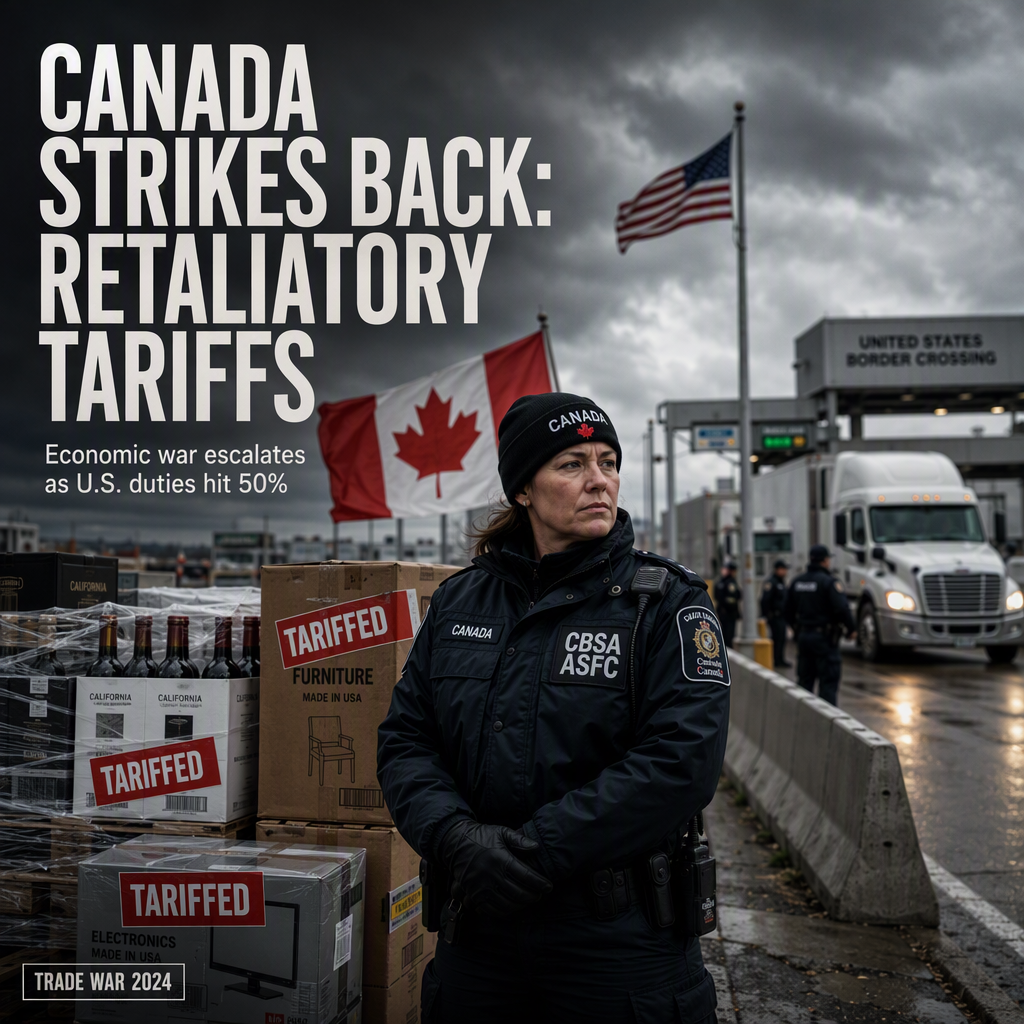
Canada is preparing to announce details of retaliatory tariffs against the United States following a sharp deterioration in relations between the two countries on Monday [1]. The escalation began after U.S. President Donald Trump warned Canadian leaders to 'fall in line' or face consequences 'far WORSE' than existing tariffs, and Canadian Prime Minister Mark Carney accused the U.S. government of attempting to subordinate Canada [1]. The U.S. imposed new 50% tariffs on Canadian goods such as wine, furniture, and dairy products, with Trump threatening that tariffs on Canadian cars, trucks, auto parts, and steel would rise to 50% beginning January 1, 2027 [1]. These tariffs affect approximately $20 billion worth of Canadian goods [1].
Prime Minister Carney responded by stating that Canada would match Washington's new tariffs 'dollar for dollar' to protect Canadian workers, farmers, families, and businesses [1]. The retaliatory tariffs on imports of U.S. steel, electronics, and other products are expected to take effect on September 8 [1]. Carney emphasized that Canada is ready to seek a solution to the trade war, but only if the U.S. approaches negotiations as between two sovereign nations, rejecting any notion that Canada is a subsidiary of the United States [1].
Ontario Premier Doug Ford, whose Progressive Conservative Party typically opposes Carney’s Liberal Party, stated that 'everything is on the table' if the trade war continues and warned Canadians that they are 'in for an economic war' and will have to make sacrifices [1]. Former U.S. Trade Representative Ron Kirk analyzed the economic impact of the proposed tariffs, noting potential retaliation from Canada and the impact on key stock sectors [1].
The forceful rhetoric and the collapse of negotiations late Friday, followed by the immediate imposition of tariffs, underscore the severity of the trade dispute. Both sides have blamed each other for the breakdown in talks, and Carney described the situation as being 'at war' after Canada was attacked with tariffs [1].
CONCLUSION
The imposition of 50% tariffs by the U.S. and Canada's planned dollar-for-dollar retaliation mark a significant escalation in the trade conflict, with both governments signaling a willingness to endure economic hardship. The market impact is expected to be high, particularly in sectors affected by the tariffs, and further developments will depend on whether negotiations resume under mutually acceptable terms.