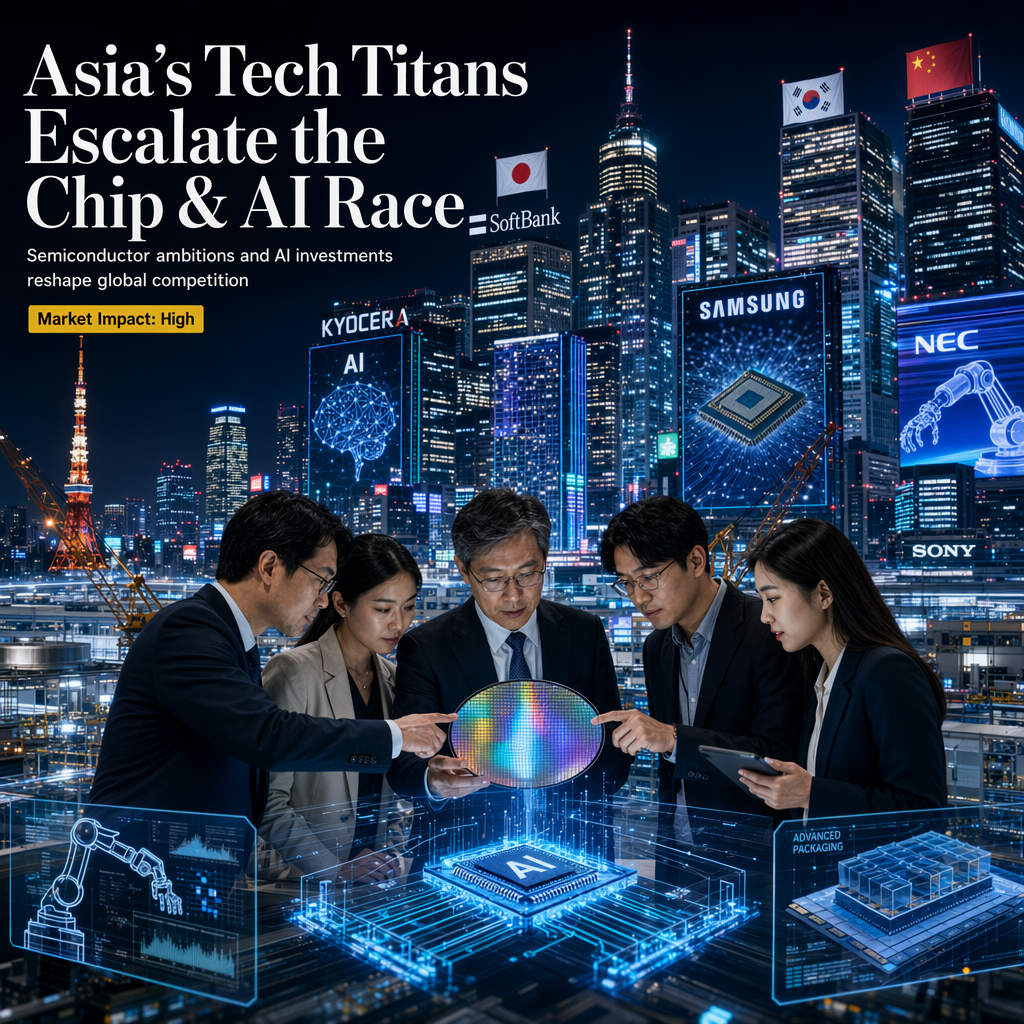
A wave of major investments and strategic initiatives is sweeping across Asia's semiconductor and artificial intelligence sectors, as Japan, China, and South Korea intensify efforts to secure leadership in these critical industries. Japan has unveiled an ambitious $2.3 trillion investment strategy targeting 17 sectors, including semiconductors, AI-powered robots, drug innovation, and autonomous driving, with the goal of fostering innovation and supporting startup growth. This plan is designed to attract international venture capital and position Japan as a leading hub for deep-tech innovation, with a particular focus on AI and semiconductor manufacturing [2].
In a related move, Kyocera announced a 650 billion yen ($4 billion) investment in its components business, concentrating on high-growth areas such as semiconductor manufacturing equipment and AI data centers. This investment aims to enhance Kyocera's technological capabilities and production capacity, positioning the company to capture greater market share amid robust demand for advanced chipmaking and data center hardware. The initiative also highlights growing competition with rivals like Toto, as both companies vie for dominance in the market for ceramic parts used in chipmaking [1].
Meanwhile, the Japanese government is backing a SoftBank-led consortium of nine companies, including Honda Motor, NEC, and Sony, with up to 1 trillion yen ($6.16 billion) to develop a domestic AI foundation model. This initiative seeks to establish Japan's technological sovereignty and close the gap with U.S. and Chinese leaders in AI foundation model development, leveraging data from Japanese companies and pooling resources from key domestic players [4].
Competition is also heating up in the chip materials market, where Chinese manufacturers such as Guangyuan New Material are ramping up production of advanced glass cloth for AI chip packaging. These efforts are part of Beijing's push for semiconductor self-sufficiency and are challenging established Japanese leaders like Nittobo, who are responding with their own technological upgrades. The global chip material market is estimated at $73 billion, and both Japanese and Chinese companies are investing heavily to capitalize on the AI-driven demand surge [3].
In South Korea, President Lee Jae Myung pledged comprehensive government support for a new chipmaking project involving Samsung Electronics and SK Hynix in the country's southwest. The initiative aims to transform the region into a semiconductor hub and maintain South Korea's competitiveness amid skyrocketing global demand for advanced memory chips used in AI computing. While Samsung and SK Hynix have been more cautious in their statements, the government is positioning the project as a transformative step for the nation's chip industry. No specific financial figures for government support were disclosed [5].
CONCLUSION
Asia's leading economies are making bold moves to secure their positions in the global semiconductor and AI markets, with Japan, China, and South Korea all announcing significant investments and strategic initiatives. The competitive landscape is rapidly evolving, with companies and governments alike racing to capture market share and technological leadership. These developments are expected to have a high market impact, driving innovation and reshaping the global tech supply chain.