
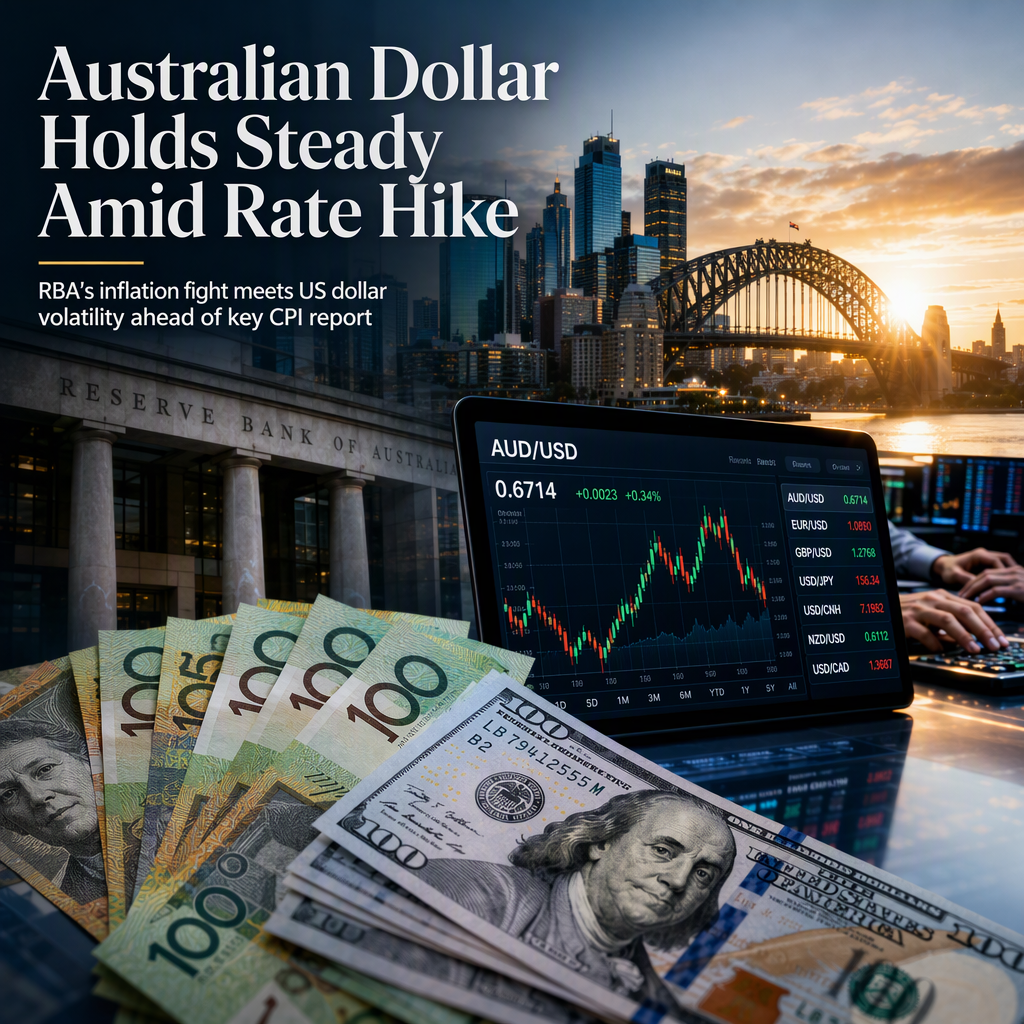
The Australian Dollar (AUD) has experienced mixed movements against the US Dollar (USD), with short-term momentum turning lower due to a stronger USD weighing on commodity currencies, according to United Overseas Bank (UOB) analysts Quek Ser Leang and Lee Sue Ann. They note that AUD/USD briefly rose to 0.6995 before pulling back sharply to a low of 0.6956, and there is potential for a test of major support at 0.6935, though a sustained break below this level is considered unlikely. Over the next 1–3 weeks, UOB maintains a neutral outlook, expecting the pair to trade between 0.6935 and 0.7020 [1].
Contrastingly, another report highlights that AUD/USD edged higher on Tuesday, trading around 0.6982 and up 0.33% on the day, as a pullback in US Treasury yields weighed on the USD. The US Dollar Index (DXY) traded near 102.25 after reaching 102.61, its highest since April 2025, while the 10-year US Treasury yield slipped below 5.20% from last week's peak of 5.36%, the highest since 2002. The decline in yields was attributed to modestly lower oil prices and a sell-off in AI-related stocks, which increased demand for government bonds [2].
On the policy front, the Reserve Bank of Australia (RBA) released its September meeting minutes, confirming a unanimous decision to raise the cash rate by 25 basis points to 4.60%. Policymakers emphasized the need to act promptly to keep inflation expectations anchored. Commerzbank analysts noted the RBA's heightened focus on inflation, citing concerns about global developments and the risk that a weaker AUD could contribute to imported inflation. The minutes also discussed the possibility that a rise in the global neutral interest rate could cause the AUD to depreciate if Australia's neutral rate did not increase similarly, though the RBA appeared to assume it had [2].
Looking ahead, market participants are focused on the upcoming US Consumer Price Index (CPI) report, which could influence expectations for the Federal Reserve's October 27-28 meeting. According to the CME FedWatch Tool, markets expect the Fed to leave interest rates unchanged this month, but there is an approximately 85% probability of a rate hike in December. Elevated oil prices and ongoing US-Iran tensions continue to pose risks to global inflation and monetary policy outlooks [2].
CONCLUSION
The Australian Dollar remains range-bound amid competing influences from a stronger US Dollar and a hawkish RBA stance. While short-term downside risks exist, the RBA's focus on inflation and recent rate hike provide underlying support. Market attention now shifts to US inflation data, which could further impact AUD/USD direction.