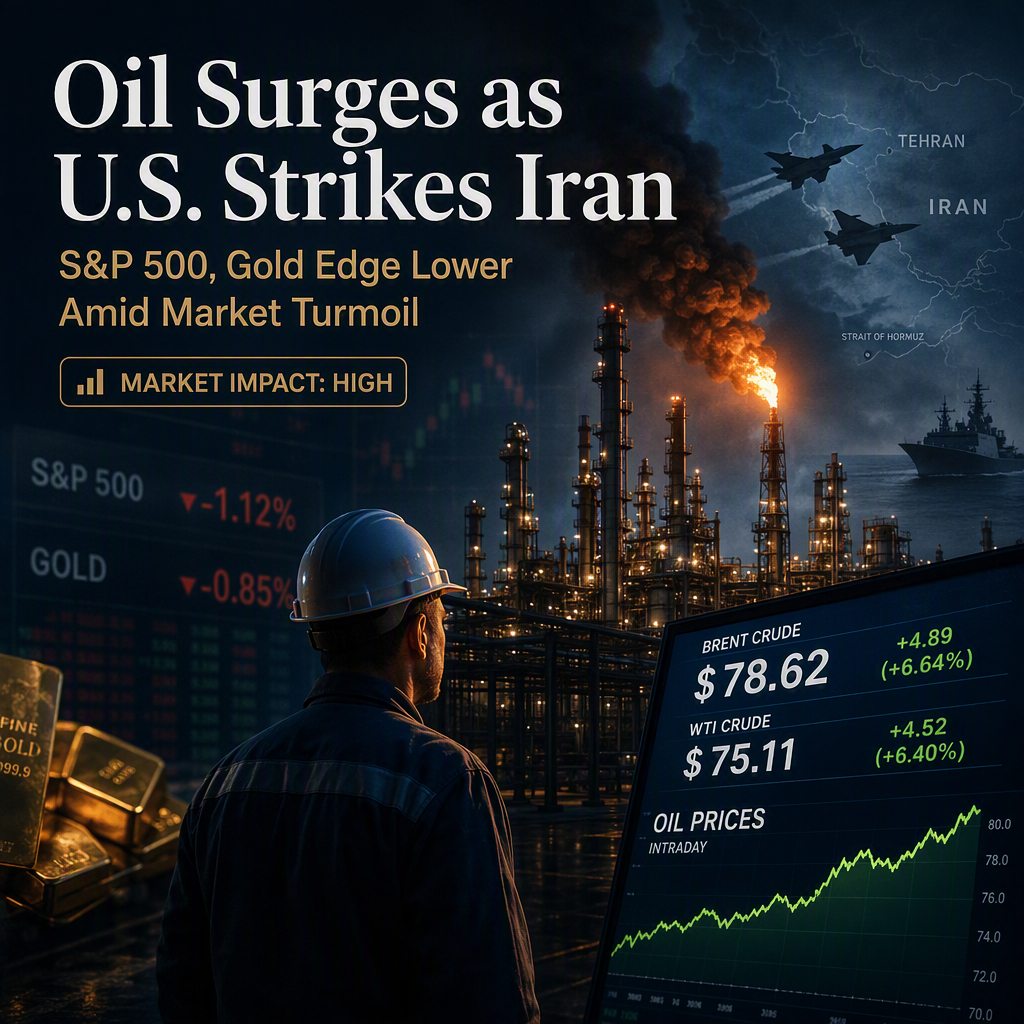
A weekend flare-up in the Middle East, marked by the first U.S. strikes on Iran in over a month, drove oil prices sharply higher at the Sunday market reopen, with crude leading the broad market and posting a gain near 1.5% [1]. This geopolitical development also reinforced last Friday’s hawkish Federal Reserve repricing, contributing to firmer U.S. 10-year Treasury yields and a mixed, net softer finish for the dollar against major currencies during a quiet month-end session [1].
The S&P 500 index spent the session drifting lower, closing near 7,690, down approximately 0.11% from the Sunday reopen. The index reached a session low near 7,666 late in the London morning before recovering somewhat in the afternoon. Higher oil prices and firmer rate expectations created an unhelpful backdrop for equities, and the transition into September—historically the weakest month for U.S. stocks—may have added to the cautious tone ahead of Friday’s payrolls report [1].
Gold traded heavy for a second consecutive session, closing lower alongside the S&P 500, while bitcoin recovered from an overnight dip to finish modestly higher. The dollar index softened during U.S. trading hours, closing near the bottom of the pack [1].
Key economic data released included Japan Retail Sales for July 2026 at 4.0% year-over-year (versus 1.0% forecast), Japan Industrial Production Preliminary at 4.1% year-over-year (versus 3.0% forecast), and Germany’s Inflation Rate Preliminary for August 2026 at 2.9% year-over-year (versus 3.0% forecast) [1]. China’s NBS General PMI for August 2026 came in at 49.5 (versus 50.2 forecast), indicating contraction, while Australia’s business inventories for Q2 2026 fell -0.2% quarter-over-quarter (versus 0.7% forecast) [1].
CONCLUSION
The U.S. strikes on Iran triggered a sharp rise in oil prices and firmer Treasury yields, while equities and gold edged lower amid a cautious market tone. The dollar softened, and key economic data from Japan, Germany, China, and Australia highlighted mixed global growth signals. Overall, the event had a high market impact, reinforcing risk aversion and hawkish Fed expectations.