
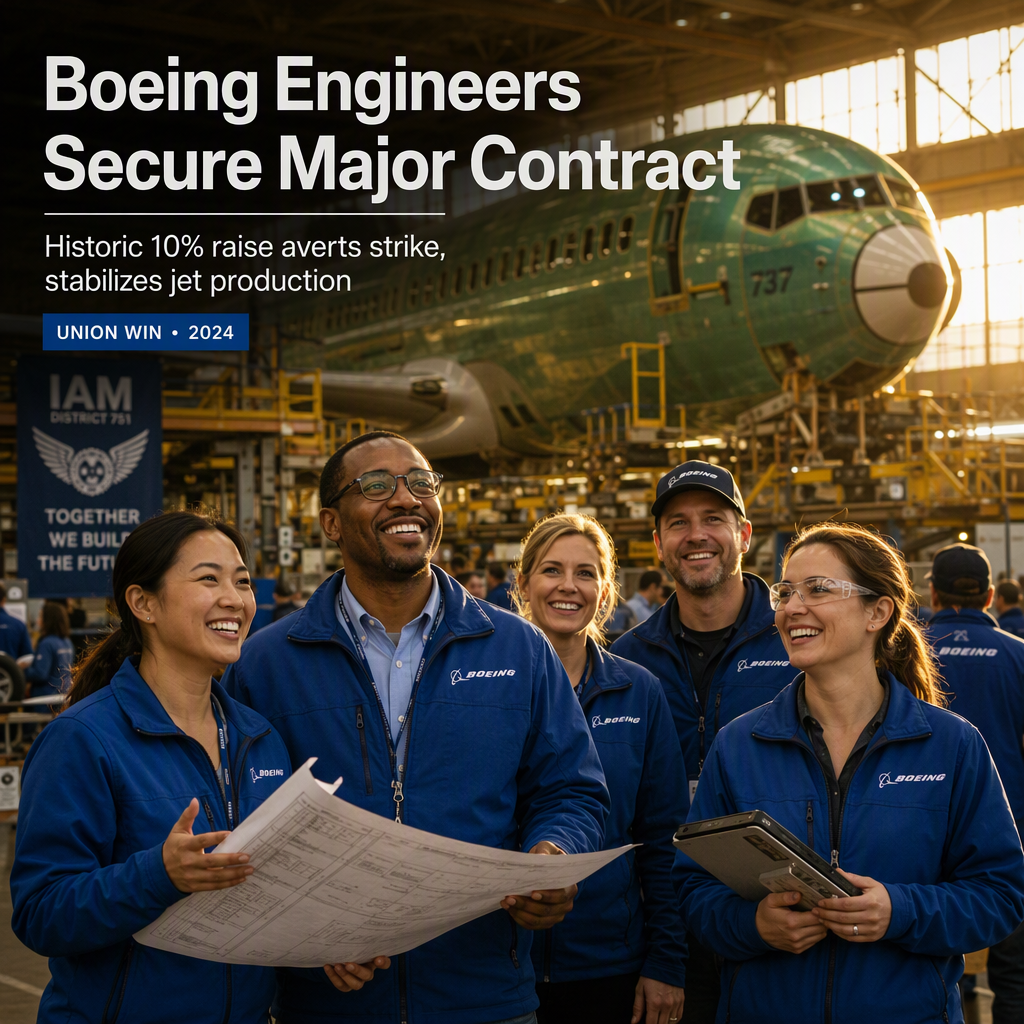
Boeing's largest white-collar union, representing approximately 17,000 engineers and technical workers, has approved a new four-year contract, thereby avoiding a potential strike at a critical time for the aerospace company [1]. The agreement includes an immediate 10% ratification wage increase and annual raises of 4%, with the possibility of up to 6% increases based on merit [1]. This deal follows Boeing's decision to improve its offer in mid-September after workers overwhelmingly rejected an earlier proposal that included only 3% annual raises [1].
The Society of Professional Engineering Employees in Aerospace, which represents about 13,000 engineers and 4,000 technical workers, announced that 67.62% of the professional unit and 53.48% of the technical unit voted in favor of the new contract [1]. Union leadership highlighted the significant gains achieved in this negotiation cycle, with one representative stating, "We secured many victories that some thought were completely out of reach when this negotiation cycle started" [1].
The contract approval comes as Boeing is seeking to stabilize and ramp up production of its popular jets and obtain federal approval for the 737 Max 10 and 777X models, both of which are years behind schedule [1]. The Federal Aviation Administration is currently assessing a software issue on the 737 Max 10 that could affect landing procedures in certain scenarios and is determining whether it poses a safety of flight issue [1].
Avoiding a strike is particularly significant for Boeing, as a machinist strike two years ago halted production until a deal was reached [1]. The resolution of this labor dispute removes a major operational risk for Boeing at a time when it is focused on increasing output and addressing regulatory challenges [1].
CONCLUSION
Boeing's successful negotiation with its engineers and technical workers eliminates the immediate threat of a strike, ensuring production continuity as the company works to resolve regulatory hurdles and boost jet output. The new contract's substantial wage increases and merit-based raises mark a notable win for union members and provide stability for Boeing's near-term operations.