
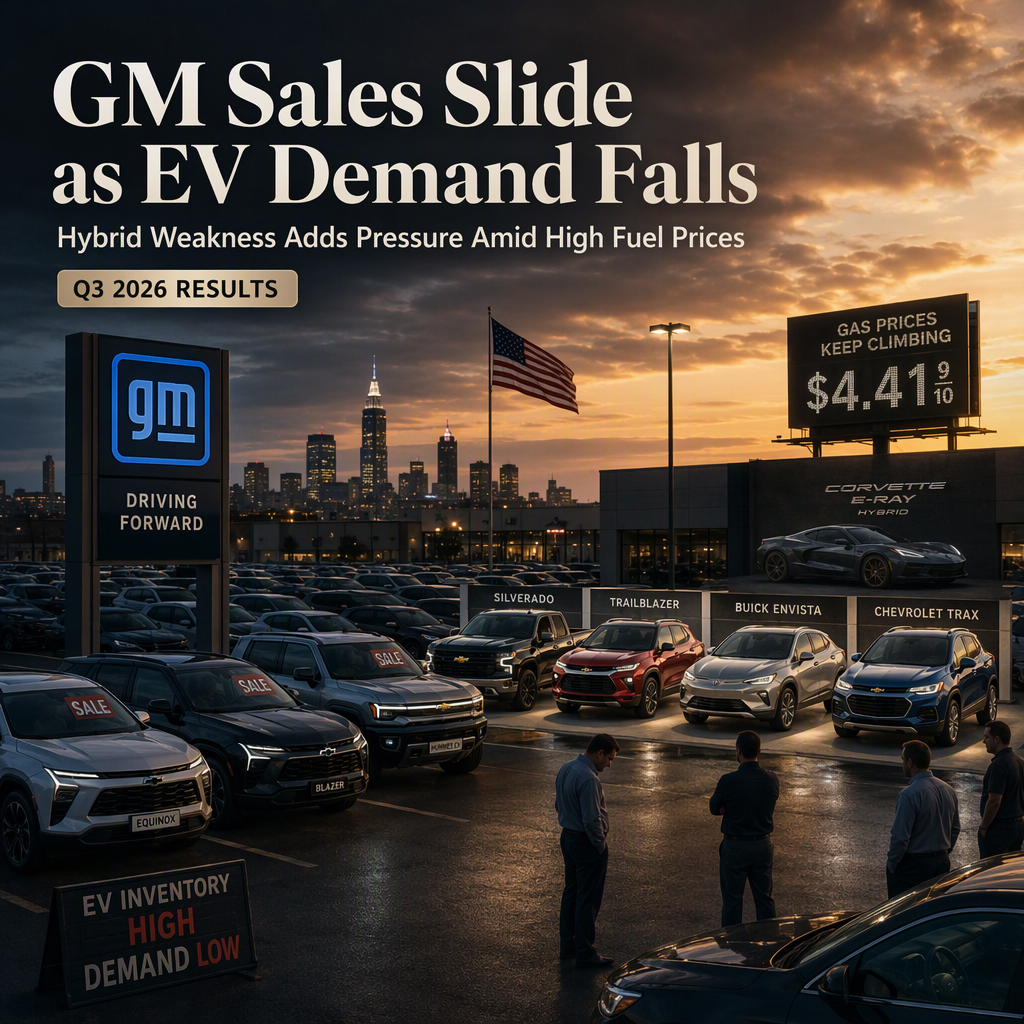
General Motors (GM) reported a 5.5% year-over-year decline in U.S. auto sales for the third quarter of 2026, with 670,974 new vehicles sold during the period [1]. The drop was driven primarily by a sharp decrease in electric vehicle (EV) sales, which had previously surged in the prior year due to the impending end of up to $7,500 in federal EV purchase incentives under the Trump administration [1]. In Q3, GM's Equinox EV sales fell 92.4% to 1,905 units, Blazer EV sales dropped 84.4%, and Hummer EV sales declined 72.9% compared to the same period last year [1].
Despite the overall sales decline, GM's lower-cost vehicles performed well, with the Silverado Trailblazer up 51%, Buick Envista up 18.4%, and Chevrolet Trax up 16.3% for the quarter [1]. However, each of GM's brands saw year-to-date declines, led by a 25% drop in Cadillac sales [1]. The company's full-size pickup sales remained relatively flat, even as high fuel prices—averaging $4.41 nationally according to AAA—were expected to impact demand for large trucks and SUVs, segments that are crucial for GM [1].
Industry-wide, Cox Automotive recently raised its 2026 new vehicle sales forecast by roughly 2% to 16.1 million units, citing stronger-than-expected sales this year [1]. Hybrid vehicles are expected to capture a growing share of the market as consumers respond to high gas prices, but GM currently offers only one hybrid model, the Corvette, which experts believe could further weaken GM's position in this segment [1].
Despite the challenges, Duncan Aldred, President of GM North America, expressed optimism about the company's future, highlighting ongoing investments in new vehicles, innovative technologies, and U.S. manufacturing, as well as the on-track launch of next-generation full-size pickup trucks [1]. Last month, GM announced additional details about its new V-8 engines for pickups as part of its strategy to maintain leadership in truck sales [1].
CONCLUSION
GM's third-quarter results highlight significant challenges in the EV segment and a lack of hybrid offerings amid shifting consumer preferences and high fuel prices. While lower-cost models provided some relief, overall sales and brand performance were down. The company remains optimistic, citing ongoing investments and upcoming product launches, but faces mounting pressure to adapt to evolving market dynamics.