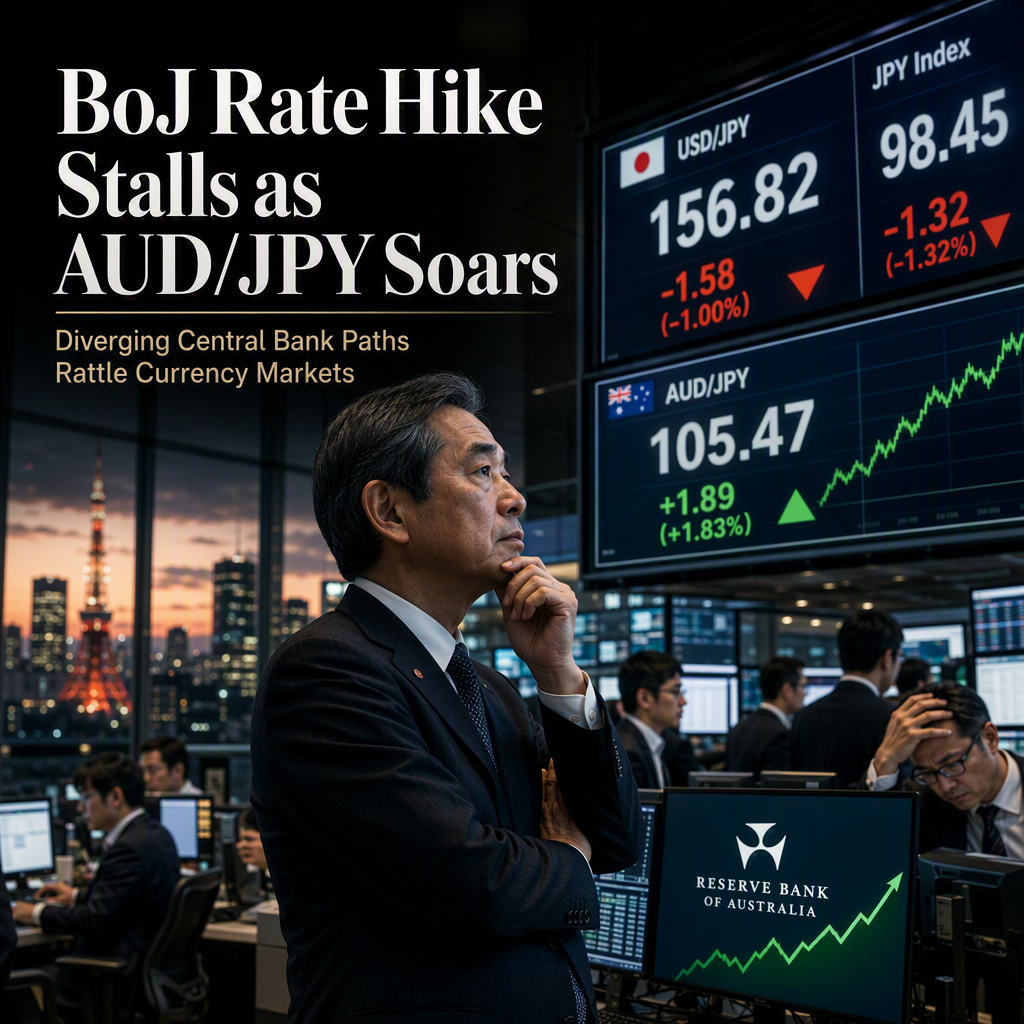
The Bank of Japan (BoJ) raised its policy rate by 25 basis points to 1.25%, marking the highest level since 1995, in line with market expectations [1][2]. The decision was approved by a seven-to-two vote, with Toichiro Asada and Ayano Sato opposing the increase [2]. Despite the hawkish framework and signals for further hikes, with the next move anticipated in December, the Japanese Yen (JPY) underperformed sharply, particularly against the Australian Dollar (AUD), which soared 1.54% to trade around 112.60 at the time of writing [1][2].
TD Securities’ Prashant Newnaha highlighted that while the BoJ's statement validated its hawkish July framework and reaffirmed the case for quarterly 25bps increases, the FX market reacted negatively, focusing on Board divisions and the risk of policy paralysis in 2027. The potential replacement of hawkish Board members Takata and Tamura, whose terms expire in July next year, could shift the Board towards a more dovish stance, undermining market confidence in future tightening [1].
BoJ Governor Kazuo Ueda reiterated the central bank's commitment to raising rates if warranted by economic and price developments, but investors remain cautious, seeking clearer signals regarding the timing and pace of additional hikes [2]. The BoJ also noted several risks, including developments in the Middle East, AI-related demand, FX volatility, and the possibility of underlying inflation overshooting its 2% target. However, Japan's National Consumer Price Index (CPI) remained unchanged in August, and underlying inflation stayed below the BoJ's 2% annual target, tempering expectations for a faster rate-hike cycle and weighing on the JPY [2].
In contrast, the Reserve Bank of Australia (RBA) kept its policy rate unchanged at 4.35% after three consecutive increases earlier this year, with markets expecting another hike to 4.6% at the next meeting. RBA Governor Michele Bullock and Deputy Governor Andrew Hauser both signaled that inflation risks remain elevated, particularly due to Middle East tensions, and further tightening may be necessary [2]. This divergence in monetary policy outlooks has favored the AUD/JPY pair, as Australia's hawkish stance contrasts with Japan's less aggressive signals and muted inflation data [2].
CONCLUSION
The Bank of Japan's rate hike, while anticipated and framed as hawkish, failed to support the Japanese Yen, which declined sharply against the Australian Dollar. Market participants remain skeptical about the BoJ's future tightening due to Board divisions and subdued inflation data, while Australia's hawkish outlook continues to bolster the AUD. The divergence in policy signals has resulted in a high-impact move in the AUD/JPY pair, reflecting broader uncertainty about Japan's monetary trajectory.