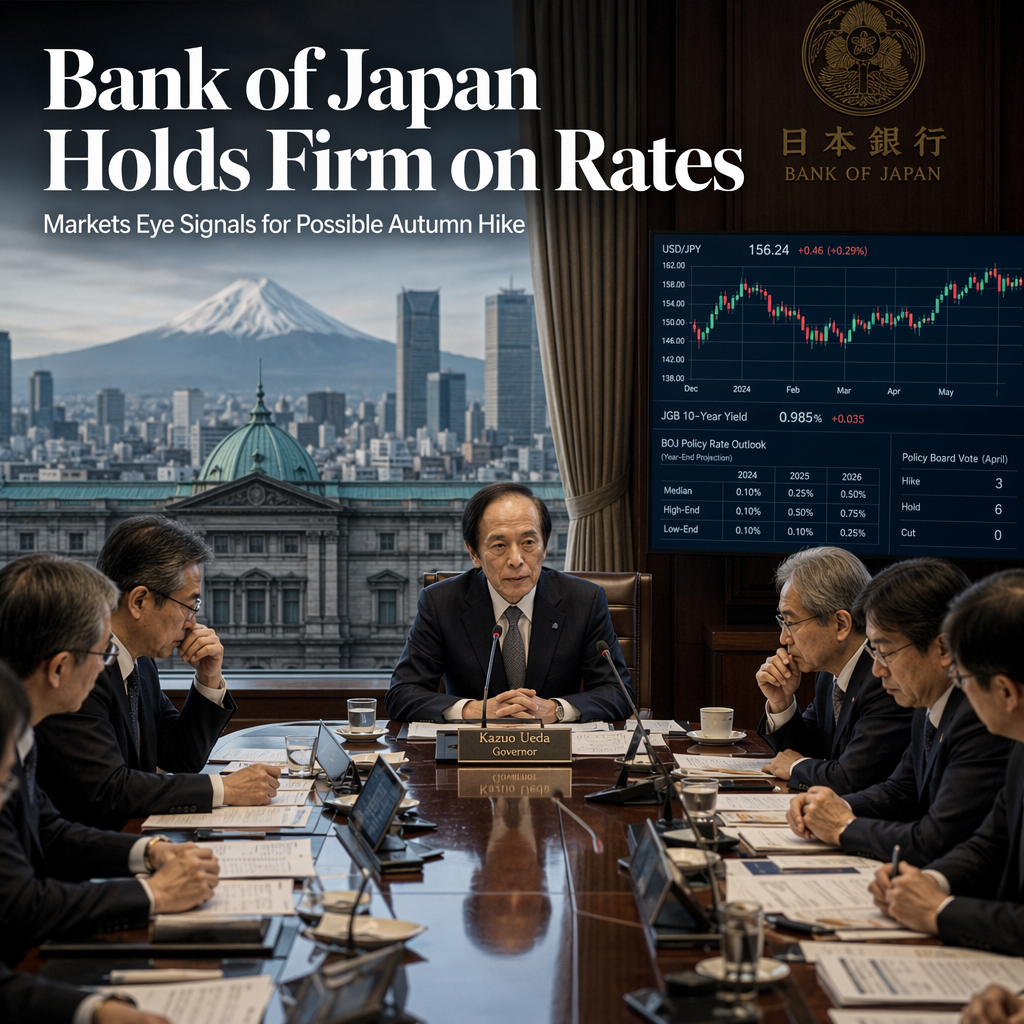
The Bank of Japan (BoJ) is expected to maintain its tightening bias following its recent move to raise the policy rate to 1.00% in June, according to ING analysts Chris Turner and Padhraic Garvey [1]. Most BoJ board members reportedly view Japan’s neutral policy rate as being near 2.00%, with the main question being the pace at which the rate will be increased to that level [1]. While some officials may favor an earlier rate hike in September or October, ING anticipates that the upcoming decision will leave policy unchanged, with market participants closely monitoring voting patterns and guidance from Governor Kazuo Ueda [1].
The yen has shown weakness after the BoJ’s foreign exchange intervention in April and May was deemed ineffective, leading to speculation that the central bank might accelerate its tightening cycle [1]. Recent reports suggest that some BoJ members could support a rate hike as early as September or October, diverging from the previously expected six-monthly schedule that would see the next hike in December [1].
Market attention is also focused on the voting behavior of the Policy Board, especially with Governor Ueda expected to return after a recent illness, restoring the board to its full complement of nine members [1]. There is particular interest in whether any members will vote for consecutive hikes, with Kajime Nakata having done so in January and possibly repeating this stance, and whether other hawkish members such as Junko Nakagawa and Naoki Tamura might join him [1].
Governor Ueda’s upcoming press conference is anticipated, but unless he signals a need for a faster tightening cycle, ING expects limited market reaction [1]. The BoJ’s minutes also reflect the Cabinet Office’s view that Japan’s transition to a growth-oriented economy is crucial, highlighting the central bank’s exposure to government oversight compared to its G10 peers [1].
CONCLUSION
The Bank of Japan is expected to keep its policy rate unchanged at 1.00%, with markets watching for any signals of an accelerated tightening path or shifts in board member voting. While some officials may push for an earlier hike, ING analysts see limited immediate market reaction unless Governor Ueda hints at a faster pace. The debate over the neutral rate and timing of future hikes remains central to market expectations.