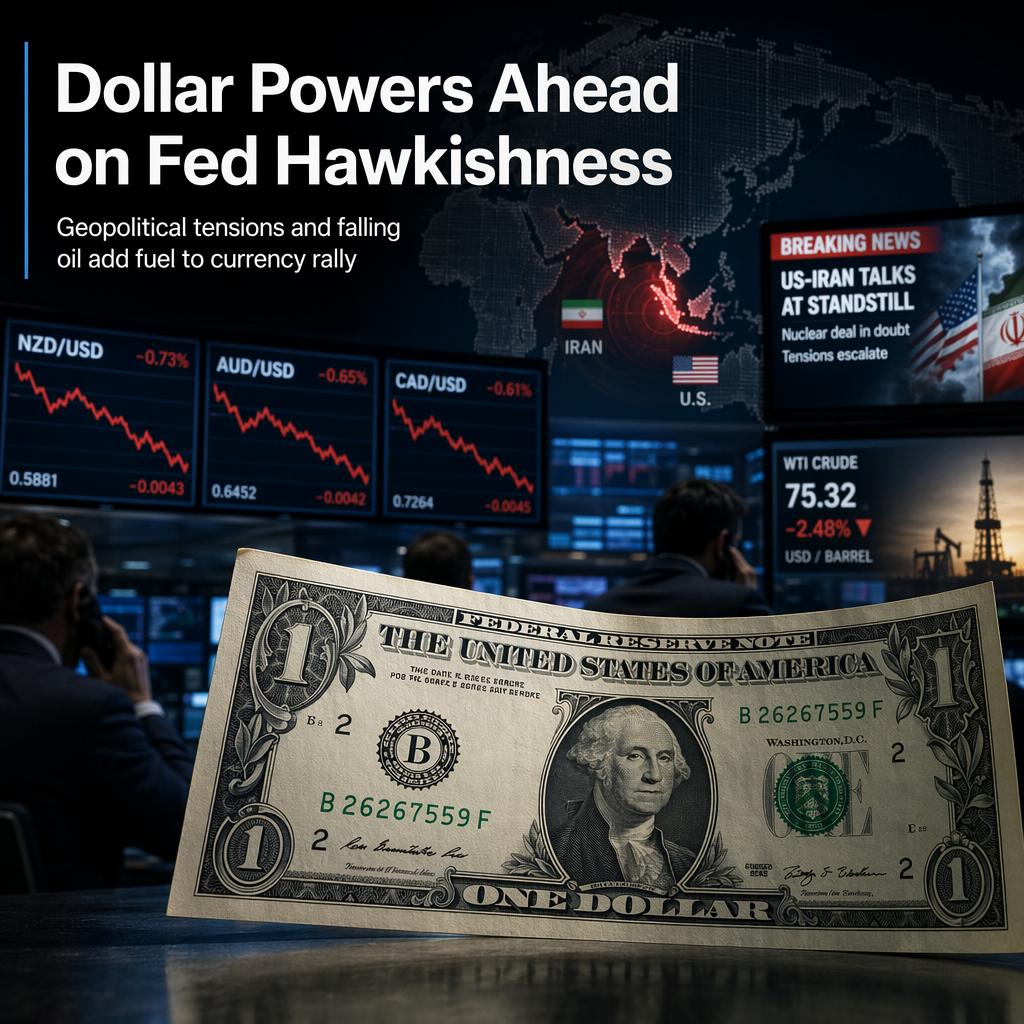
The US Dollar (USD) strengthened to its highest level since May 2025, driven by a hawkish tilt from the US Federal Reserve (Fed) and ongoing geopolitical uncertainty surrounding US-Iran relations [1][2][3]. The Fed projected the fed funds rate at 3.8% by the end of this year, up from 3.4% in March, implying at least one 25-basis-point rate hike in the coming months [1]. The Federal Open Market Committee (FOMC) voted unanimously to hold its benchmark rate steady at 3.5%–3.75%, but nearly half of officials signaled that at least one rate hike could be required later this year [3]. Newly appointed Fed Chairman Kevin Warsh emphasized that 'price stability' remains the Fed's ultimate guiding principle [3].
The New Zealand Dollar (NZD) fell to its lowest level since April 8, with NZD/USD trading just below the mid-0.5700s and poised for heavy weekly losses [1]. The USD Index (DXY) showed the US Dollar was the strongest against the British Pound this week, gaining 1.60%, and up 1.41% against the NZD [1]. The Reserve Bank of New Zealand (RBNZ) indicated the Official Cash Rate (OCR) could reach roughly 2.85% by year-end, implying up to three rate hikes, which may limit further NZD downside [1].
The Australian Dollar (AUD) also softened, with AUD/USD losing momentum near 0.7010 [2]. The cancellation of US Vice President JD Vance's trip to talks with Iran in Switzerland raised concerns about the US-Iran peace deal, contributing to risk-off sentiment and supporting the Greenback [1][2]. CNN reported that the first round of technical talks with Iran under the memorandum of understanding would not take place as planned, with Vance stating the meeting was not finalized and might occur later in the weekend [2]. Analysts noted that the combination of strong US economic data and the Fed's hawkish stance has fueled further USD upside [2].
The Canadian Dollar (CAD) declined as USD/CAD rose for the third consecutive day, trading around 1.4140 [3]. Lower oil prices, with West Texas Intermediate (WTI) slipping to around $75.10 per barrel and on track for a steep weekly loss of roughly 9.5%, weighed on the CAD [3]. The easing of shipping conditions in the Strait of Hormuz after the US and Iran signed an initial agreement to end the war contributed to the oil price decline [3]. The US military ended its blockade on Iranian ports, allowing millions of barrels to flow through the waterway again [3].
Market participants are closely monitoring developments in US-Iran relations, as any lack of progress or renewed tensions could further boost the USD as a safe-haven currency [2]. Liquidity and trading volumes may remain low due to the US bank holiday for Juneteenth National Independence Day [1].
CONCLUSION
The US Dollar's rally is underpinned by the Fed's hawkish outlook and persistent geopolitical uncertainty, pressuring major currencies such as the NZD, AUD, and CAD. Commodity-linked currencies are further weighed down by falling oil prices and risk-off sentiment. Market focus remains on Fed policy signals and US-Iran developments, which could drive further volatility in the near term.