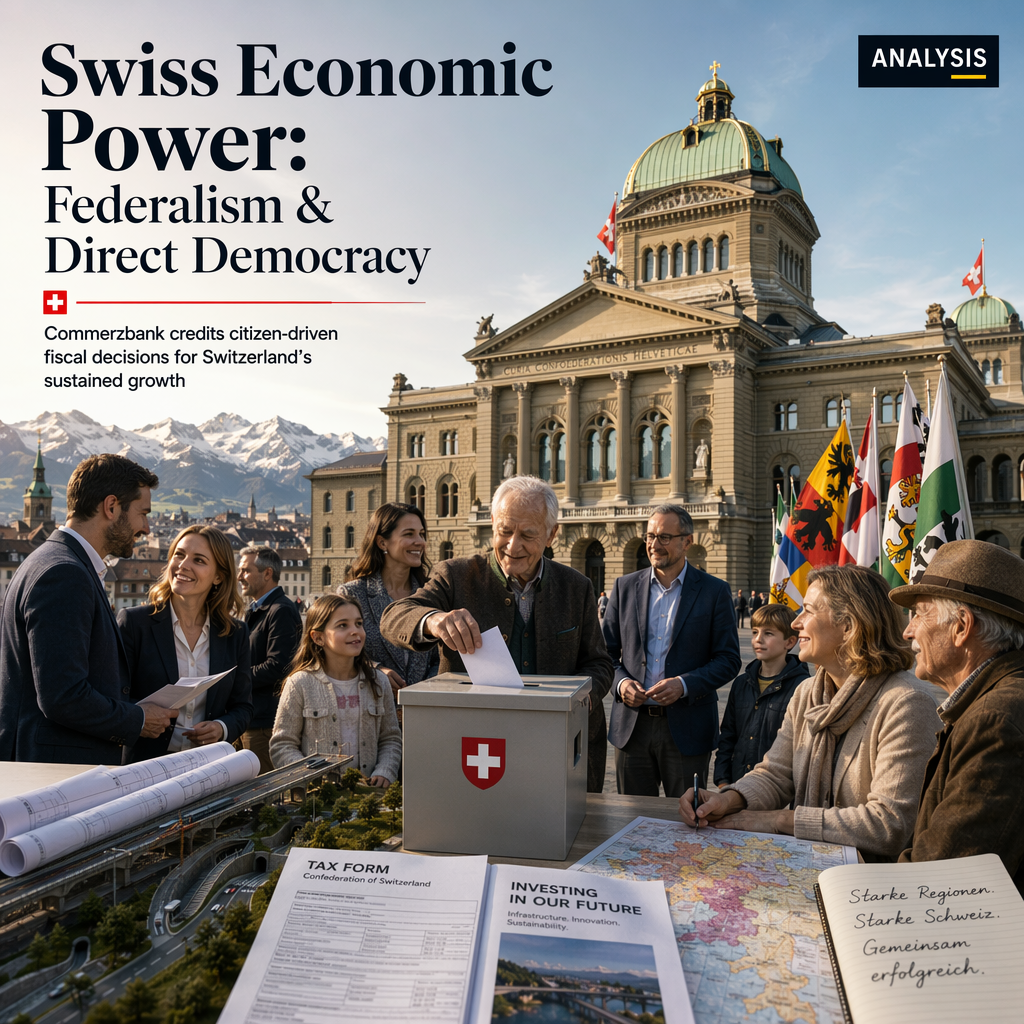
Commerzbank’s Dr. Jörg Krämer identifies Switzerland’s robust federalism and widespread use of financial referenda as central factors behind the country’s strong economic performance [1]. According to Krämer, Swiss cantons and municipalities possess significant financial autonomy, including the authority to set income tax rates and other taxes independently, unlike their counterparts in Germany [1]. This autonomy fosters competition among regions to attract taxpayers by offering efficient infrastructure and maintaining low tax rates, which in turn reduces the power of the state and encourages efficient government structures [1].
Krämer further explains that Swiss citizens regularly participate in referenda, voting not only on major investment projects but also on the loans required to finance them [1]. This process ensures that voters are fully aware of both the benefits and costs associated with public projects [1]. Additionally, citizens have the right to decide on tax rates at both the local and federal levels, making it more challenging for politicians to implement high spending and high taxes [1].
The combination of competitive federalism and direct democracy acts as a restraint on government size, keeping public expenditure and indebtedness lower than in countries like Germany, and supporting a more dynamic economy [1]. Krämer concludes that these institutional features prevent the state from becoming too large, which could otherwise deprive citizens and companies of resources and weaken economic growth [1].
CONCLUSION
Commerzbank’s analysis underscores Switzerland’s unique blend of federalism and direct democracy as key drivers of its economic resilience. The country’s decentralized fiscal structure and active citizen participation in financial decisions are seen as effective mechanisms for maintaining efficient government and supporting sustained economic growth.