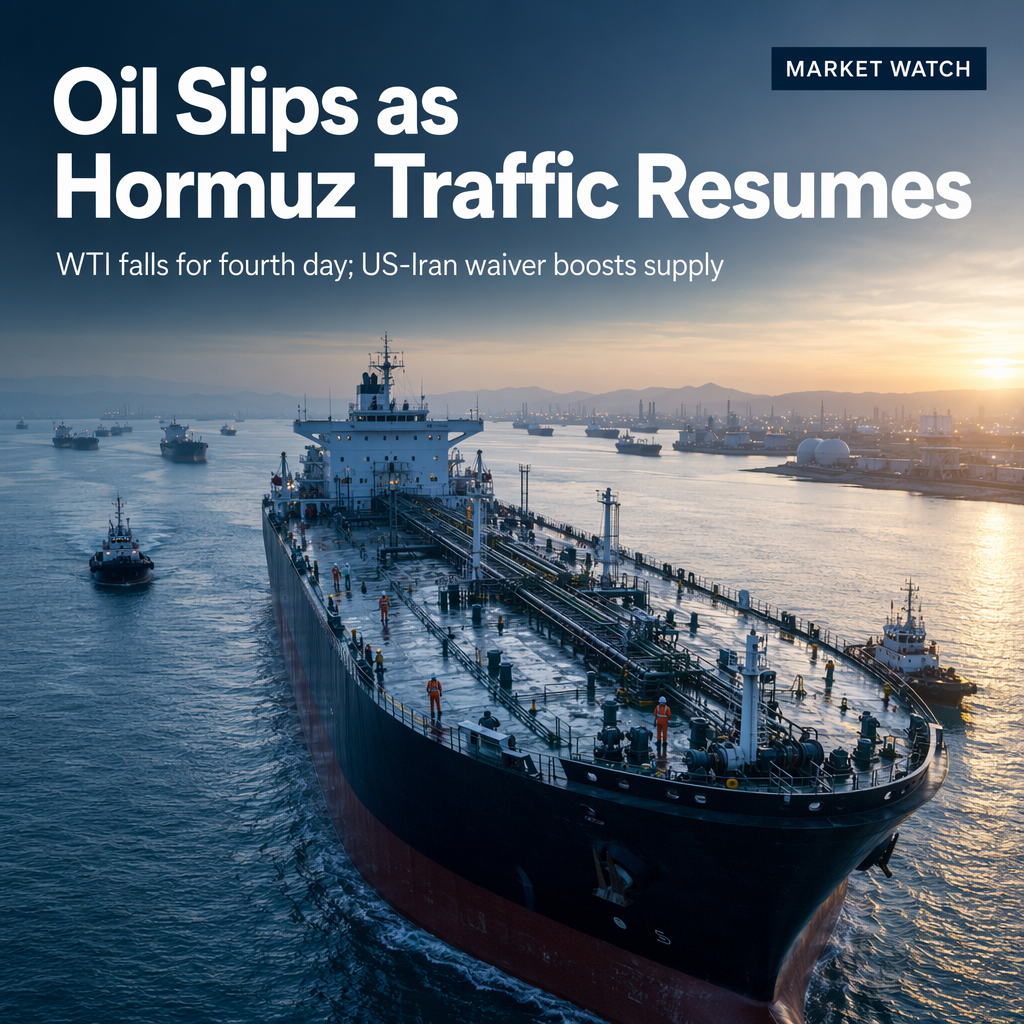
West Texas Intermediate (WTI) crude oil prices declined for the fourth consecutive day, trading around $69.30 and down 0.65% on Thursday, as a combination of supply-side developments reshaped market expectations [1]. The main driver behind this downward move is the normalization of maritime traffic through the Strait of Hormuz, a critical chokepoint for global energy flows. According to US Energy Secretary Chris Wright, approximately 20 million barrels of oil transited the strait within a 24-hour period, signaling a return to normal operations [1]. Shipping tracking data confirmed that an interim deal on Wednesday allowed three previously stranded tankers, carrying a total of 5 million barrels of crude, to resume passage through the Gulf. The International Maritime Organization (IMO) also reported receiving guarantees for hundreds of vessels to exit the Persian Gulf [1].
Additionally, the US government's decision to grant a temporary waiver permitting buyers to take delivery of already-loaded Iranian cargoes has increased Iran's sales volumes on international markets, further pressuring global crude prices [1]. Structural tensions within OPEC are also contributing to market uncertainty. A senior Iraqi Oil Ministry official stated that Iraq may consider all options, including a potential exit from OPEC, if its production quota is not raised, especially after the United Arab Emirates' surprise departure from the group earlier this year [1].
Despite these bearish factors, analysts remain divided on the long-term impact. Goldman Sachs, as cited by Reuters, does not anticipate a significant or sustained increase in Iranian oil production, even if the US waiver is extended beyond its current August 21 expiration date [1]. This introduces uncertainty regarding the durability of the current downward trend in oil prices as the market assesses the evolving Middle Eastern supply situation [1].
CONCLUSION
WTI oil prices are under pressure due to normalized Hormuz traffic and increased Iranian supply following a US waiver, compounded by OPEC's internal tensions. However, analysts such as Goldman Sachs caution that the supply boost may not be sustained, leaving the market's longer-term direction uncertain.