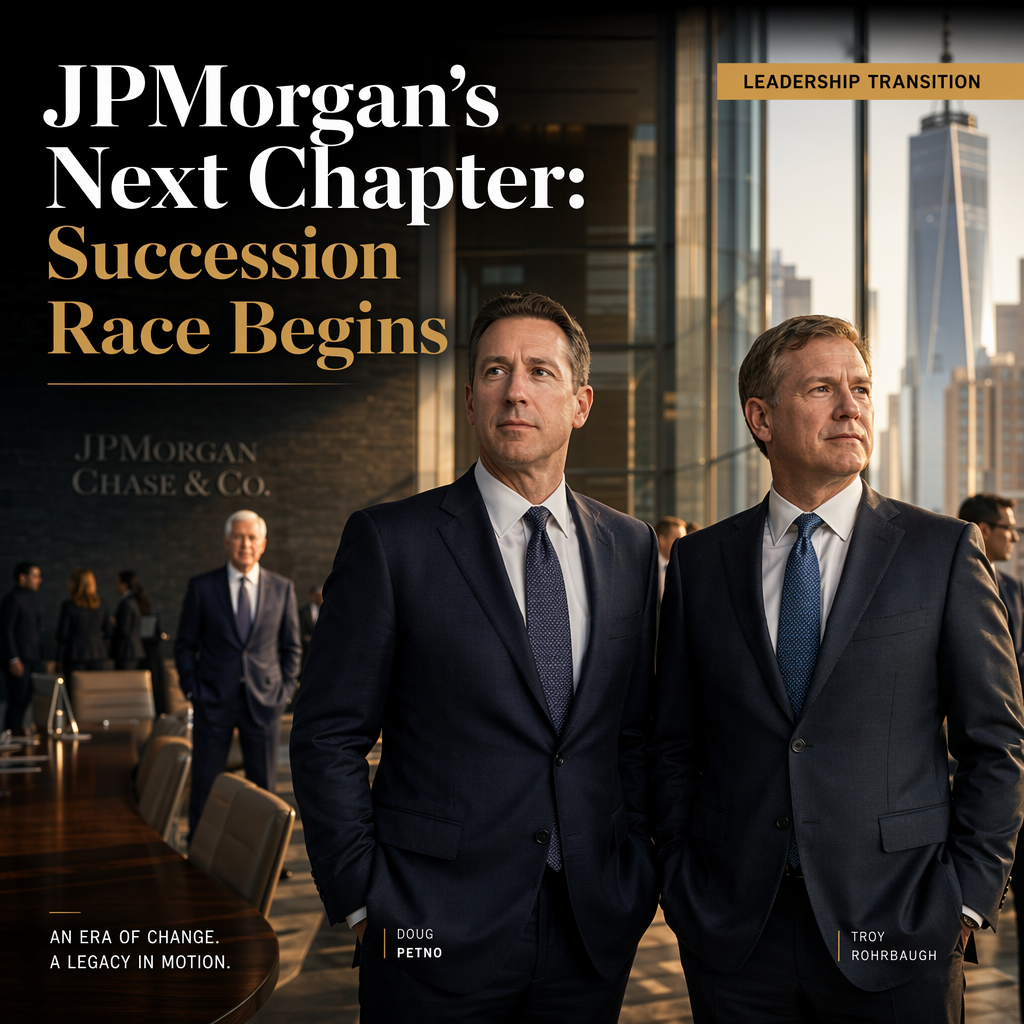
JPMorgan Chase has announced the appointment of Doug Petno and Troy Rohrbaugh as co-presidents, a move that insiders say sets up a competitive process to determine who will succeed Jamie Dimon as CEO of the nation's largest bank [1]. Dimon, who has served as CEO since 2006 and is widely regarded as America's top banker, is expected to begin transitioning out of his role as CEO as early as this year, though he has not specified a definitive timeline and may remain as chairman indefinitely [1].
The succession plan also includes significant leadership changes. Marianne Lake, previously seen as a frontrunner for the CEO position and head of the consumer and community banking division, has decided to retire from the bank, with sources noting her apparent dissatisfaction at being passed over for the top job [1]. Jenn Piepszak, the chief operating officer, and Mary Erdoes, head of asset and wealth management, are also no longer considered candidates for the CEO role, according to people inside the bank [1].
Dimon stated, "The changes announced today mark an important step in our board’s thoughtful process around succession planning and development of our top leaders," emphasizing the strength and depth of JPMorgan's senior leadership team [1]. The creation of the co-president roles is seen as a deliberate move to foster competition between Petno and Rohrbaugh for the eventual CEO position [1].
JPMorgan Chase, under Dimon's leadership, has navigated multiple financial crises and remains a systemically important institution with a broad range of operations, including consumer lending, investment banking, and complex derivatives trading [1]. The leadership transition is viewed as a pivotal moment for the bank, with significant implications for its future direction and market positioning [1].
CONCLUSION
JPMorgan Chase's appointment of Doug Petno and Troy Rohrbaugh as co-presidents marks a critical step in the bank's CEO succession process, with Jamie Dimon expected to begin transitioning out of his role. The leadership changes signal a new era for the institution, with market participants closely watching the outcome of this high-stakes succession race.