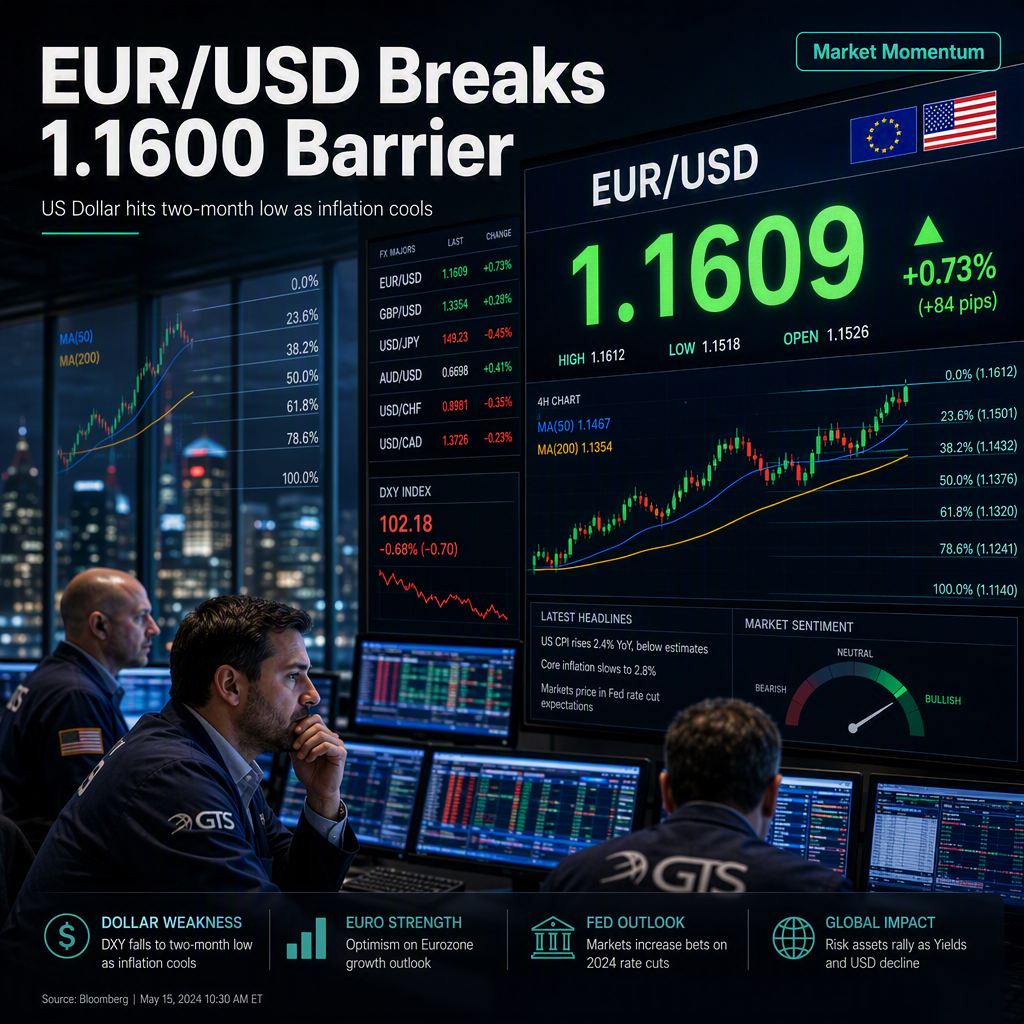
The EUR/USD currency pair extended its upward momentum on Monday, building on last week's rebound from the 1.1500 psychological mark and breaking decisively above the 1.1600 level during the first half of the European session [1]. This move was fueled by a broadly weaker US Dollar, which reached an over two-month low after recent data indicated cooling inflation and a slowdown in consumer spending. As a result, traders reduced their expectations for an immediate interest rate hike by the US Federal Reserve [1].
From a technical standpoint, EUR/USD confirmed an intraday breakout through the 100-day Simple Moving Average (SMA) and the 50% Fibonacci retracement level of the April-June decline. The Relative Strength Index (RSI) stood firm near 67, and the Moving Average Convergence Divergence (MACD) histogram showed a mildly rising trend, suggesting buyers maintain control [1]. However, risks of overextension may cap gains near the 200-day SMA at 1.1630 and the 61.8% retracement at 1.1645, with further upside potential toward the 78.6% retracement at 1.1732 and the cycle high near 1.1843 if these levels are breached [1].
On the downside, initial support is seen at the 50% retracement at 1.1584, followed by the 100-day SMA at 1.1569. A deeper pullback could expose the 38.2% Fibonacci level at 1.1522 and the 23.6% retracement at 1.1447, with the broader bullish structure only seriously threatened if the pair drops toward the 1.1324 swing low [1].
The US Dollar was the strongest against the Canadian Dollar today, but weakened against the Euro by 0.23%, reflecting the ongoing shift in market sentiment [1].
CONCLUSION
EUR/USD's breakout above 1.1600 signals bullish momentum driven by a weaker US Dollar and reduced Fed rate hike expectations. Technical indicators suggest buyers remain in control, though resistance levels may limit further gains. The market is responding positively to signs of cooling US inflation and consumer spending, supporting the Euro's advance.