
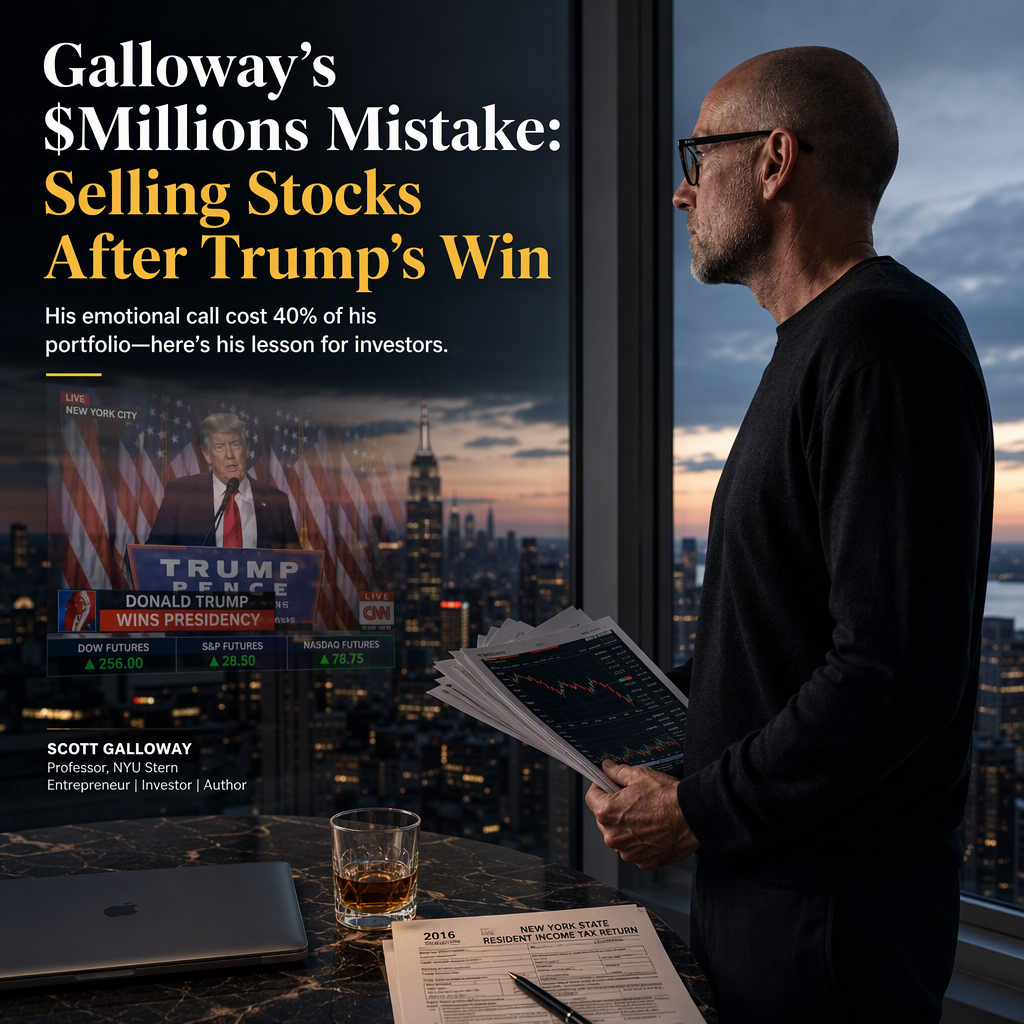
NYU professor Scott Galloway admitted on 'The Prof G Pod' that he sold all his stocks in an emotional reaction to President Donald Trump’s 2016 election victory, a move he described as his 'biggest investment mistake' and estimated cost him 40% of his liquid net worth in stocks [1]. Galloway explained that the selloff triggered significant capital gains taxes while he was living in New York, and he bought back into the market about six months later after stocks had risen between 10% and 20%, further compounding his losses [1].
Galloway emphasized that the market surged following Trump’s win, noting that 'the market ripped for the next year' and that 'the fear had been priced in' before the election, leading to substantial gains after the results [1]. According to the federal government's 2017 Economic Report of the President, the S&P 500 climbed 3.4% in November 2016 and reached a record high later that month, with the 2018 report stating the index gained 19.4% in 2017, posting increases in 11 of the year's 12 months [1].
He warned listeners against letting emotions drive investment decisions and recommended staying invested rather than attempting to anticipate political or economic turning points. Galloway also advised diversification in light of current elevated valuations, cautioning that 'trying to guess when the top happens is dangerous' [1].
Galloway criticized Trump’s economic and foreign policies, expressing concerns that they could ultimately damage the U.S. economy and cause long-term structural harm [1]. White House spokesman Davis Ingle responded by characterizing Galloway’s continued criticism of Trump as an obsession [1].
CONCLUSION
Scott Galloway’s experience highlights the risks of emotionally driven investment decisions, especially in response to political events. The market’s strong performance after Trump’s 2016 victory underscores the importance of staying invested and diversifying, rather than attempting to time the market. Galloway’s story serves as a cautionary tale for investors seeking to avoid costly mistakes.