
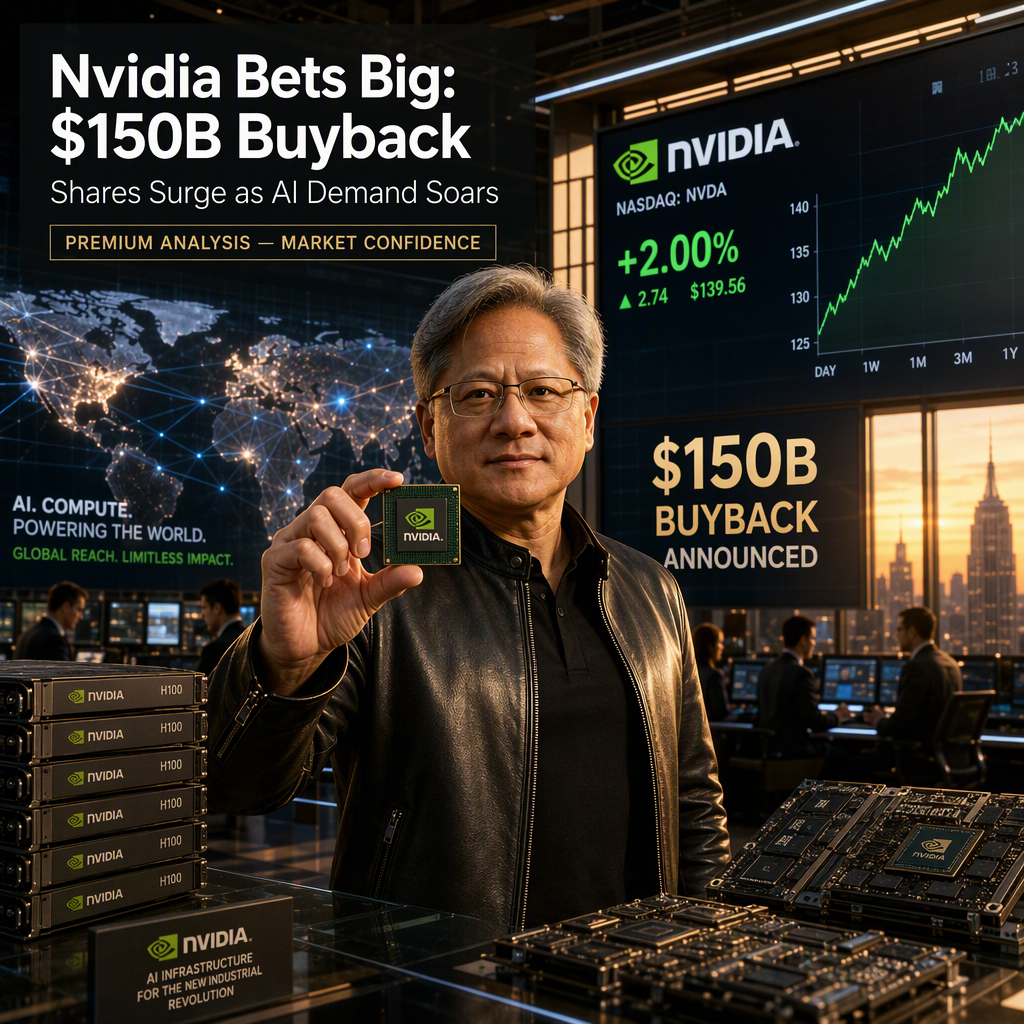
Nvidia has authorized a record $150 billion addition to its stock buyback program, signaling strong confidence from CEO Jensen Huang and the company's management in the chipmaker's future prospects and current valuation [1]. This new authorization comes on top of an $80 billion repurchase plan announced in May, when Nvidia also increased its quarterly cash dividend to 25 cents per share from 1 cent [1]. The announcement was made at a time when Nvidia's price-to-earnings ratio for fiscal 2028 is just 14.5, significantly below its five-year average of 62.9 and lower than all its megacap peers except Micron, suggesting the stock is undervalued relative to its earnings growth [1].
The company's market capitalization now exceeds $5.5 trillion, and its stock has risen 23% this year, outperforming the Nasdaq, though not keeping pace with its expected earnings growth [1]. Analysts project Nvidia's net income to reach nearly $385 billion in fiscal 2028, representing a 60% increase from the prior year and more than a fivefold increase over three years [1]. Karan Ramchandani, managing director at Post Oak Group, described the buyback as a 'clear-cut message' that management believes the stock is undervalued, emphasizing that the company's earnings are scaling up faster than its share price [1].
On the day of the announcement, Nvidia's stock rose almost 2% [1]. The company also introduced new software and hardware solutions to control AI agents, further reinforcing its leadership in the artificial intelligence sector [1]. Nvidia has indicated continued growth through early 2028, telling investors in August that it expects 70% sales growth in its fiscal 2028 [1].
The buyback and capital return plans are being stepped up as Nvidia's revenue and cash flow surge due to unprecedented demand for its graphics processing units, which are essential for building and running AI models and services [1].
CONCLUSION
Nvidia's record $150 billion stock buyback underscores management's confidence in the company's undervalued shares and robust growth prospects, driven by strong AI demand. The market responded positively, with shares rising nearly 2% on the announcement. Analysts and company guidance point to continued rapid earnings and sales growth through 2028.