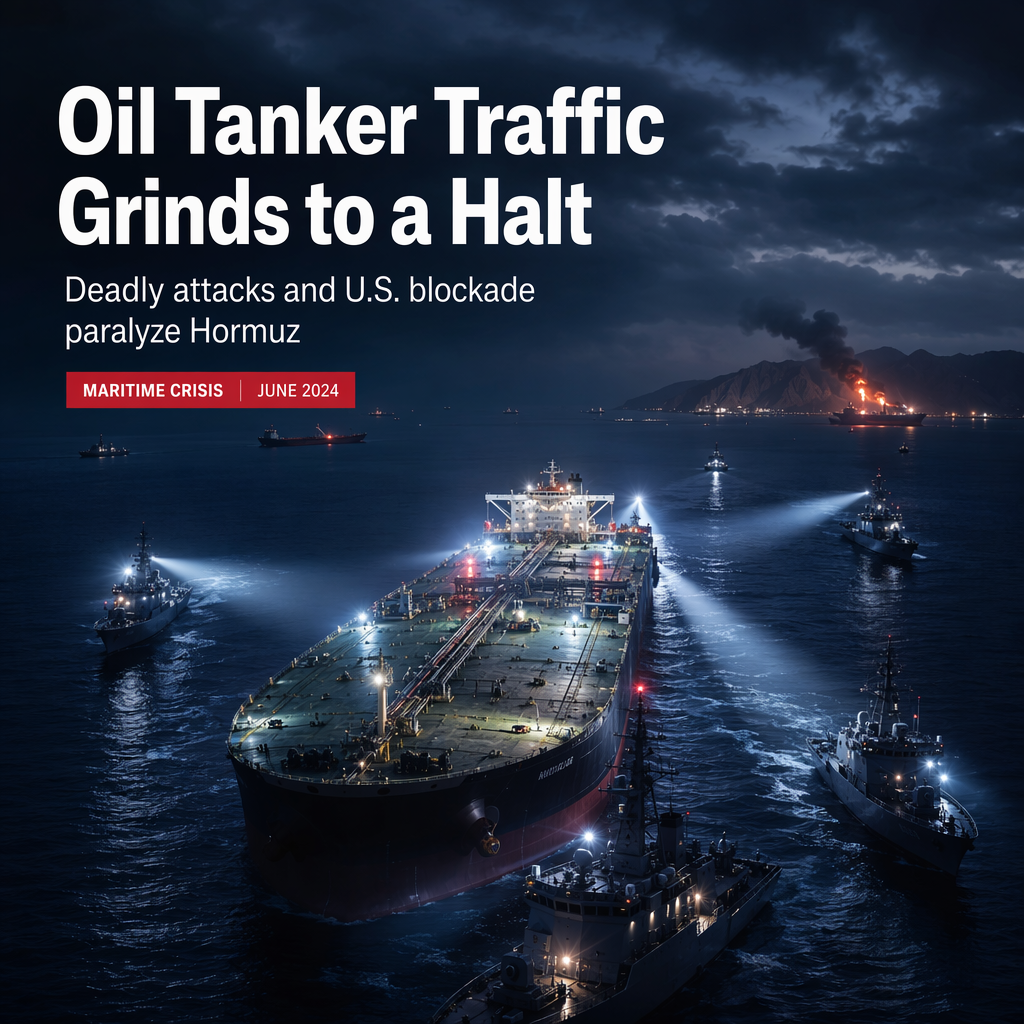
The security situation for oil tankers transiting the Strait of Hormuz has sharply deteriorated, with shippers facing what Dimitris Maniatis, CEO of maritime risk service Marisks, described as a 'worse-case scenario' during a Lloyd's List Intelligence briefing [1]. Since July 6, at least nine ships have been attacked as Iran attempts to force vessels to navigate Hormuz through its territorial waters, rather than the route along Oman's coast protected by the U.S. military [1]. Maniatis emphasized that crews are now more fearful than ever, stating, 'Nobody is willing to move,' and that decision-making is now governed by fear rather than financial incentives [1].
According to data from the International Maritime Organization (IMO), recent attacks have resulted in casualties: one seafarer was killed and three injured in an attack on the crude oil tanker Al Bahyah off Oman's coast, while eleven mariners were injured the same day in an attack on the Mombasa B, another crude oil tanker near Oman [1]. Iranian attacks have reportedly involved anti-ship missiles, further heightening the risk for vessels in the region, as noted by Jakob Larsen, chief security officer at BIMCO [1]. The threat of mines also persists, making the traditional traffic separation scheme through the middle of Hormuz too dangerous, with Larsen warning of the extreme danger posed by mine detonations under ships [1].
The U.S. military has responded by disabling an unladen oil tanker on Wednesday after reimposing its naval blockade against Iran this week. The Curacao-flagged M/T Belma was disabled after ignoring multiple warnings while transiting international waters toward Iran's Kharg Island, according to U.S. Central Command [1]. President Donald Trump stated that Hormuz is open to all ships except those of Iran following the blockade, saying, 'It's open if people want to go through it. We're not opening it for Iran. That's the only one it's closed for. It's closed for Iran, both in and out, but it's open now' [1].
Despite these assurances, ship tracking firms have observed a steep drop in traffic, with Hormuz largely closed again and only a trickle of ships crossing, often with their tracking systems turned off [1]. The combination of Iranian attacks, casualties, missile and mine threats, and the U.S. blockade has led to a significant reduction in oil tanker transits, raising concerns about global oil supply and maritime safety [1].
CONCLUSION
The Strait of Hormuz is experiencing a severe disruption in oil tanker traffic due to escalating Iranian attacks and the reimposition of a U.S. naval blockade. With casualties reported and heightened risks from missiles and mines, market participants face increased uncertainty and fear, leading to a steep decline in vessel transits. This situation poses significant risks to global oil supply and maritime security.