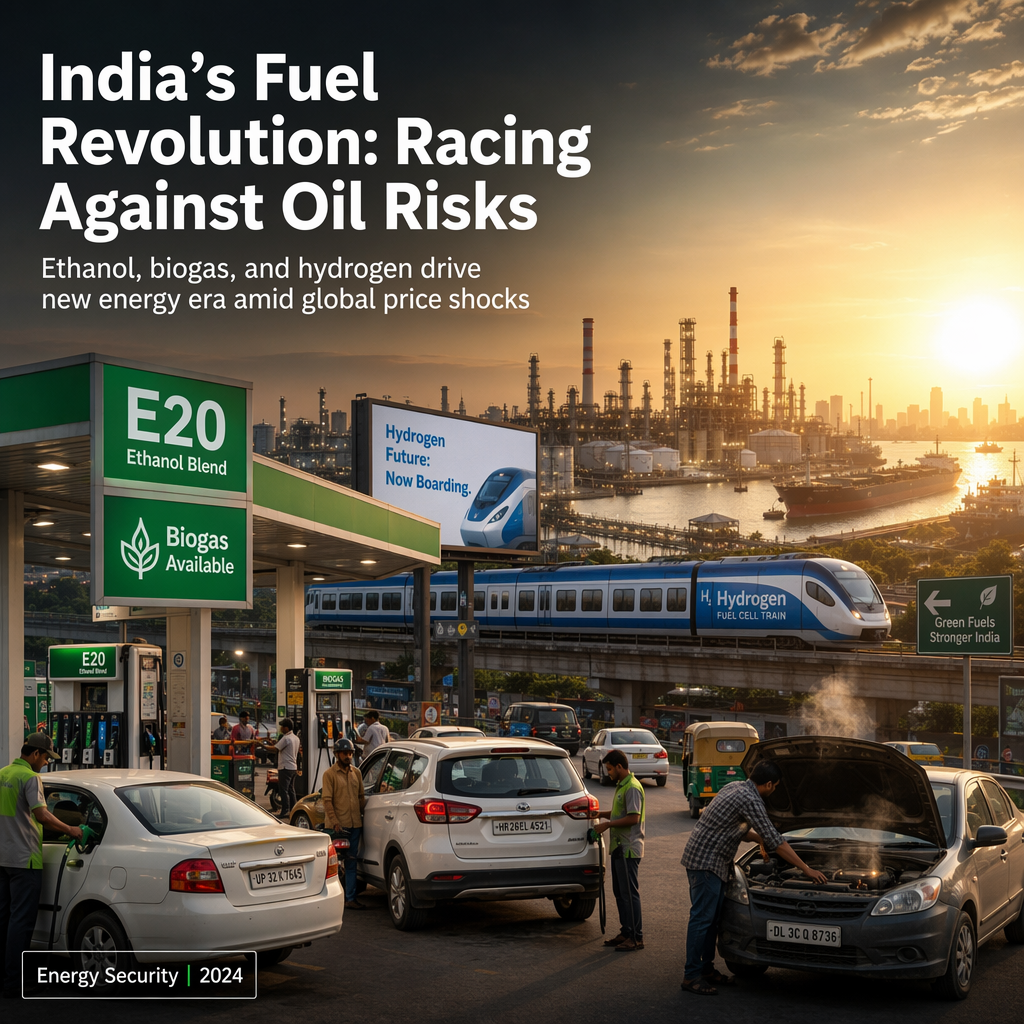
India is intensifying its shift towards alternative fuels as it faces mounting energy supply disruptions due to the ongoing war in Iran and the threat of U.S. tariffs on Russian oil importers [1]. The government has made 20% ethanol blending in petrol mandatory since April, five years ahead of schedule, marking ethanol blending as the most effective crude oil substitution strategy. This move could potentially save India $4 billion annually until 2030 [1]. However, most petrol-powered vehicles manufactured before 2023 are not compliant with the higher ethanol blend, leading to consumer reports of engine damage and reduced mileage [1].
India, the world's third-largest crude consumer, is also testing biogas as a replacement for compressed natural gas and has successfully trialed its first hydrogen-cell-powered train. The government is considering mixing 15% isobutanol in diesel and plans to scale up production of compressed biogas, which could serve as a substitute for compressed natural gas and liquefied natural gas [1]. These efforts are part of a broader strategy to diversify energy sources amid rising global oil prices and potential curbs on Russian supplies, which threaten the country's energy security [1].
According to Kpler, Russian oil accounted for more than 50% of India's crude imports in June, with India purchasing 2.6 million barrels of Russian oil daily in the first half of July. This heavy reliance on Russian oil exposes India to potential U.S. sanctions, which propose 100% tariffs on buyers of Russian oil unless peace is achieved with Ukraine by September [1]. The geopolitical tensions have driven oil prices up by over 25% this month, and Kpler warns that prices could exceed $100 a barrel if both the Red Sea and the Strait of Hormuz are closed [1].
High oil prices have already impacted India's public finances, pushing consumer inflation above 4%, the highest in 27 months [1]. Industry experts, such as Diwakar Murugan from Omdia, emphasize that energy diversification is now essential, prompting automakers to invest in compressed natural gas, hybrids, flex-fuel platforms, and hydrogen-powered commercial vehicles [1].
CONCLUSION
India's aggressive push towards alternative fuels is a direct response to rising oil prices and geopolitical risks threatening its energy security. While the shift promises significant cost savings and diversification, it also presents challenges for consumers and automakers. The market impact is high, with inflation and public finances already affected, and further volatility expected if geopolitical tensions escalate.