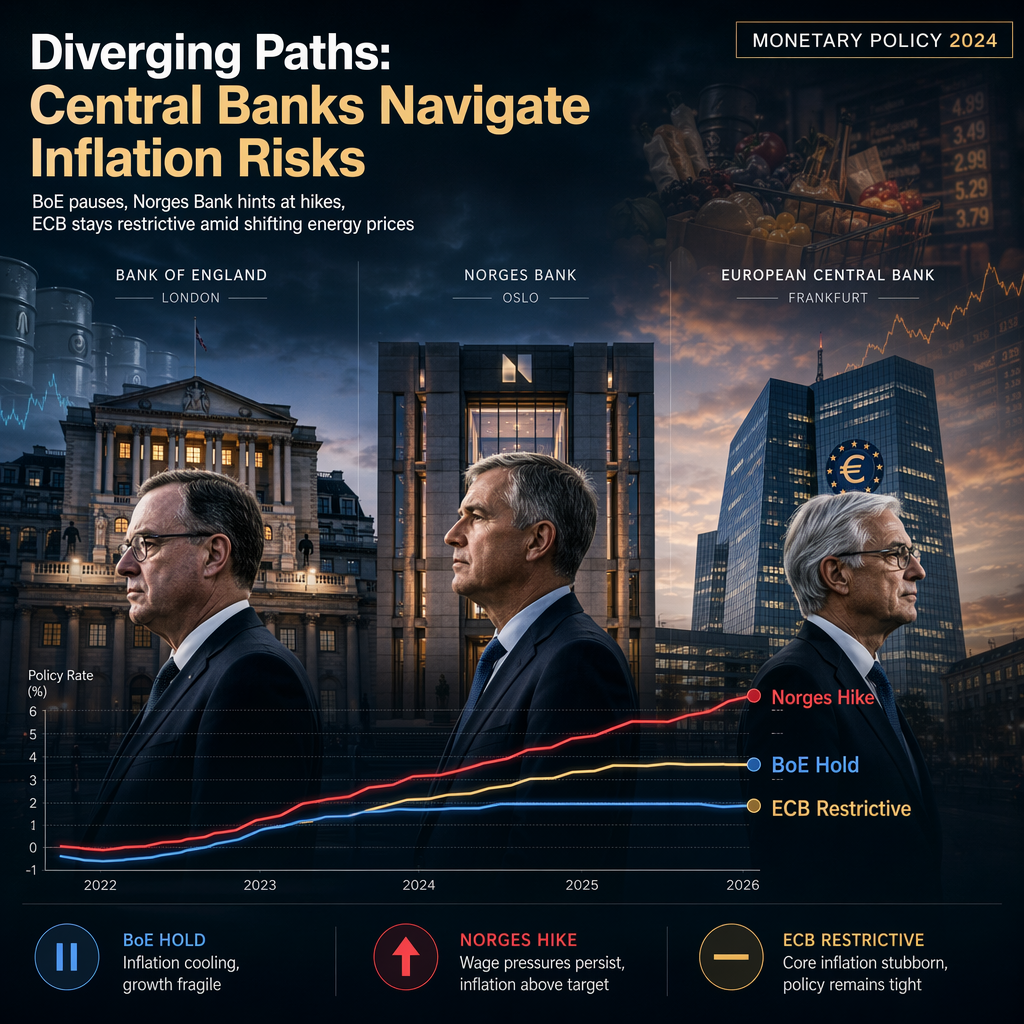
Recent central bank communications from the Bank of England (BoE), Norges Bank, and the European Central Bank (ECB) highlight differing approaches to monetary policy in response to evolving inflation and energy price dynamics. The BoE opted to keep its Bank Rate unchanged at 3.75% with a 7–2 vote split, as two members favored a 25 basis point hike. The decision was influenced by a sharp decline in energy prices, which has increased the likelihood that inflation will peak below earlier projections. Despite this, the Monetary Policy Committee (MPC) remains cautious due to upside risks to energy prices and potential second-round effects, though current economic conditions do not appear conducive to such effects. RaboResearch now expects no further rate hikes in 2024, with the market pricing in 31 basis points of tightening by year-end, but the base case is for rates to remain on hold for the rest of the year [1].
In contrast, Norges Bank maintained its policy rate at 4.25% in June but delivered hawkish guidance, indicating that further rate hikes are likely at upcoming meetings. The bank's updated projection implies a 25 basis point hike to 4.50% in the third quarter, with Nomura economists now expecting this move in August rather than September. The projection peaks at 4.55% in late 2026 and early 2027, suggesting the possibility of an additional hike this year. Policymakers' concerns about sticky inflation and the willingness to act decisively following hawkish projections underpin this outlook. However, a potential risk to this forecast is the recent decline in energy prices, though Norges Bank stated that this would not have materially changed the overall policy outlook. Looking further ahead, Nomura expects a gradual easing of rates from September 2027, as the current restrictive stance is seen as exerting downward pressure on economic activity and inflation [2].
Meanwhile, the ECB, through comments by Chief Economist Philip Lane, reaffirmed its commitment to a restrictive monetary policy stance to contain the inflationary impact of the energy shock, even under a milder economic scenario. Lane stated that further rate hikes remain justified and that the ECB is open to looking through temporary shocks if they are not long-lasting. He also noted that while oil prices are falling, food prices are expected to continue rising, and the primary aim of rate hikes is to contain the spread of the energy shock. Despite these remarks, markets largely ignored Lane's comments, with EUR/USD trading around 1.1470, down 0.28% on the day [3].
CONCLUSION
Central banks in the UK, Norway, and the Eurozone are responding to shifting inflation and energy price dynamics with varying degrees of policy tightening. While the BoE signals a pause, Norges Bank leans hawkish with a likely hike in August, and the ECB maintains a restrictive stance. Market reactions have been muted, reflecting a cautious outlook amid persistent inflation risks.