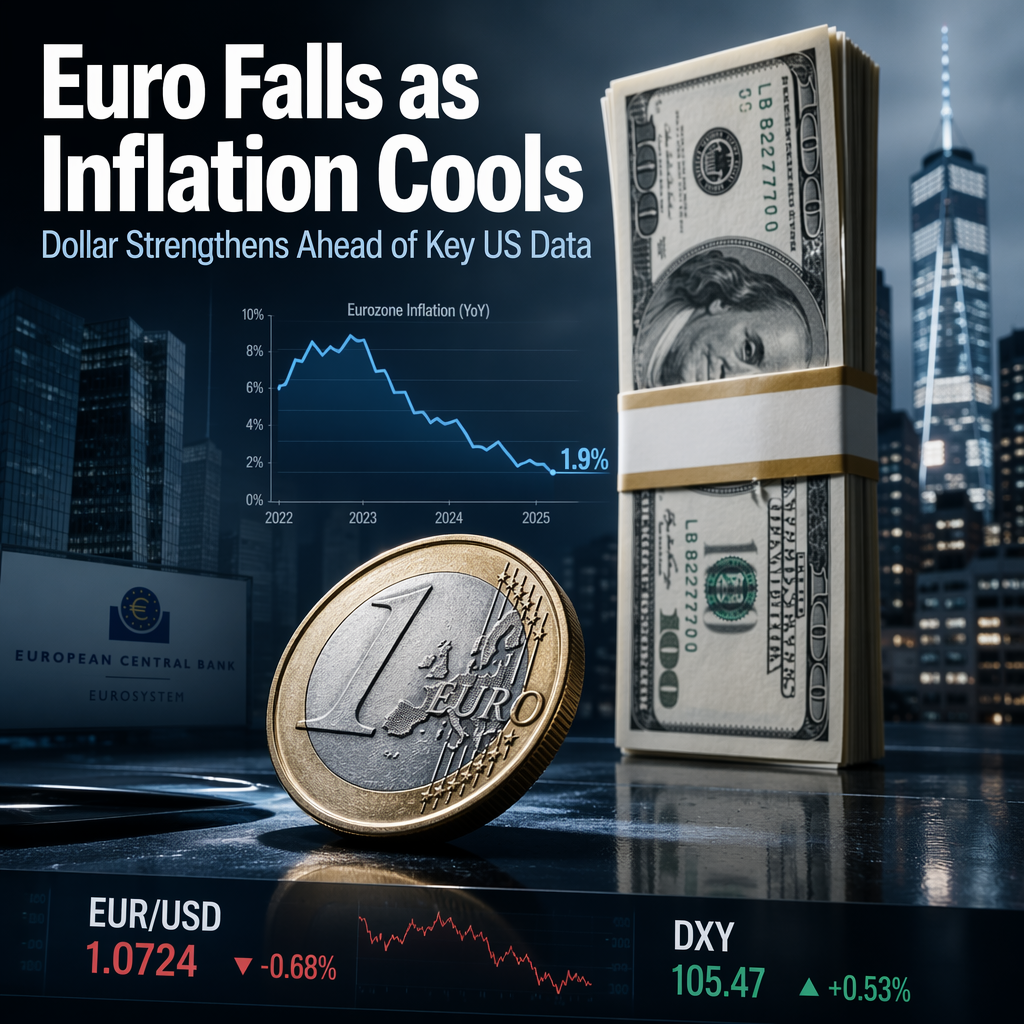
The Euro (EUR) declined against the US Dollar (USD) during European trading hours on Wednesday, with EUR/USD trading around 1.1390 after flattening the previous day [1]. This weakness in the Euro comes ahead of the release of the Eurozone Harmonized Index of Consumer Prices (HICP) inflation data, as inflation in major Eurozone economies such as Germany, France, and Italy has cooled faster than expected. Specifically, Germany's June inflation dropped to 2.3% from May's 2.6%, below the market's anticipated 2.5% rate [1]. This has reduced the likelihood that the European Central Bank (ECB) will maintain high interest rates, putting further pressure on the Euro [1].
Meanwhile, the US Dollar has strengthened broadly, supported by rising US Treasury yields and hawkish sentiment regarding the Federal Reserve's (Fed) policy outlook. The US Dollar Index (DXY) traded 0.2% higher near 101.36 during European trade, while 10-year US Treasury yields rose 0.1% to approximately 4.67% after a 2% surge on Tuesday [2]. The CME FedWatch tool indicated that fed funds futures are pricing in nearly a 67% chance of a Fed interest rate hike by September [1]. Cleveland Fed President Beth Hammack also maintained a moderately hawkish tone, stating that "inflation is still too high, Fed may need to consider rate hikes," and highlighting that core and services inflation remain elevated and broad-based [3].
Market participants are closely watching upcoming US economic data, including the ADP private employment report, ISM Manufacturing PMI, and Thursday's Nonfarm Payrolls (NFP) figures, as these releases could further influence expectations for Fed policy [1][2][3]. Additionally, speeches from major central bank leaders, including Fed Chair Kevin Warsh, ECB President Christine Lagarde, and others at the ECB Forum in Sintra, Portugal, are being monitored for policy signals [1][2][3]. However, the impact of Warsh’s commentary is expected to be limited, as he previously indicated that forward-looking guidance is not feasible in the current policy environment [2].
Geopolitical tensions, particularly surrounding US-Iran relations and the lack of direct talks in Doha, have also contributed to market caution and supported the Greenback's safe-haven appeal [1].
According to the latest currency heat maps, the US Dollar was the strongest against the Australian Dollar and Japanese Yen this week, while the Euro and British Pound also weakened against the USD [2][3].
CONCLUSION
Cooling Eurozone inflation and rising US yields have driven the Euro lower against the US Dollar, with markets increasingly expecting a Fed rate hike by September. Investors are now focused on upcoming US labor data and central bank speeches for further direction. The overall sentiment remains cautious, with the US Dollar benefiting from both economic and geopolitical factors.