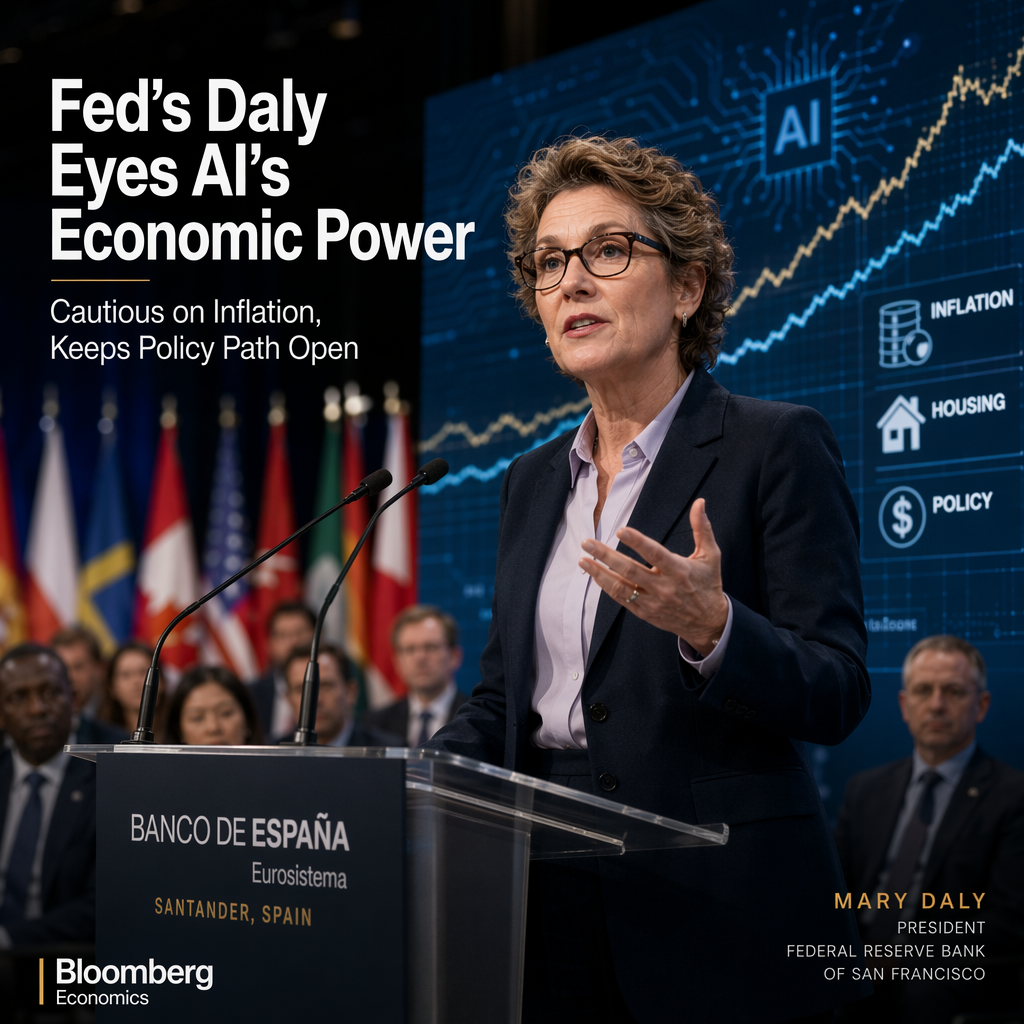
San Francisco Federal Reserve President Mary Daly, speaking at a Banco de España conference in Santander, Spain, emphasized that the US economy remains resilient despite inflation running above the Fed's target. Daly noted that there are no signs of a lack of economic resiliency in the US, citing strong investment growth and a stabilized labor market as key factors supporting the current economic environment [1].
Daly addressed the potential impact of artificial intelligence, describing the US as being in the early stages of a possible exponential rise in productivity gains from AI. She acknowledged that the 'AI investment shock' has raised questions about its inflationary effects, but also suggested that technology could serve as a disinflationary force over time [1].
On inflation, Daly pointed to recent increases driven by tariffs and oil price shocks, but highlighted that oil prices have since come down, which could provide relief for consumers and the broader economy. She also mentioned that housing inflation in the US has been declining. Daly described US monetary policy as 'slightly restrictive,' which she believes should help bring inflation down further [1].
Daly maintained a cautious and balanced tone regarding future policy moves, stating that acting too quickly could stifle growth, while acting too slowly could be unwelcome for citizens. She stressed the uncertainty of future scenarios, including the possibility that the Fed may need to fight inflation or that economic growth may not continue. Daly refrained from providing explicit guidance on interest rates, emphasizing the importance of responding to incoming data and geopolitical developments, such as the situation in the Strait of Hormuz [1].
Market sentiment, as measured by the FXS Speechtracker score, registered at 6/10—slightly above the historical average—while the FXS Fed Sentiment Index edged up by 0.25 points to 123.89. These indicators suggest that markets perceive the Fed as remaining firmly in hawkish territory, prepared to address inflation if necessary, but also attentive to potential disinflationary trends and risks [1].
CONCLUSION
Mary Daly's remarks reinforce the Fed's cautious approach, balancing the need to fight inflation with the potential for AI-driven productivity gains and easing oil prices to lower inflation naturally. Markets are likely to remain sensitive to economic data and geopolitical developments, as the Fed keeps its policy options open.