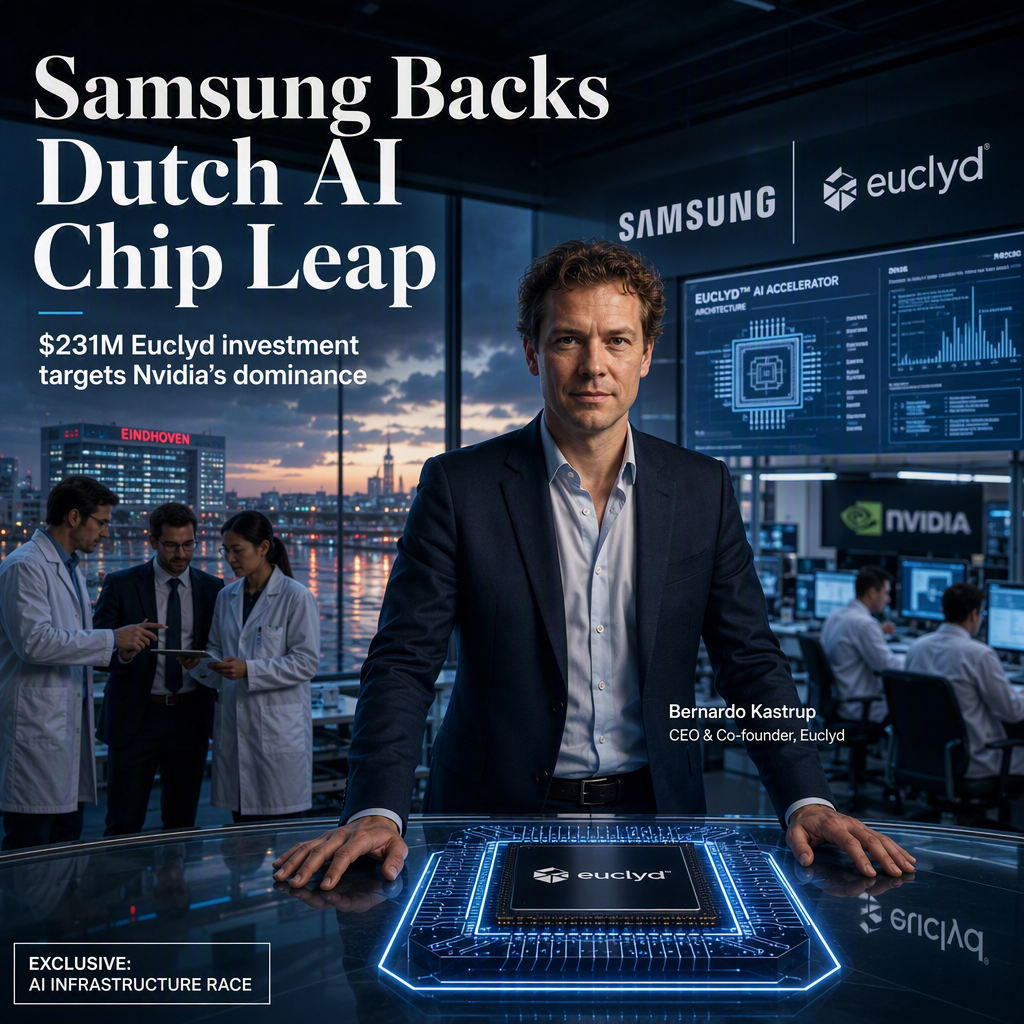
Dutch AI chip startup Euclyd has secured a $231 million funding round, co-led by Samsung, Somerset Capital Partners, the Scaleup Europe Fund managed by EQT, and Innovation Industries, as investors seek alternatives to Nvidia's dominant position in the AI chip market [1]. Euclyd, founded in 2024, is developing a novel AI inference chip system with a processor and memory architecture distinct from traditional GPUs, aiming to rival Nvidia's offerings [1].
Euclyd CEO Bernardo Kastrup stated that the company's 200-million-euro Series A round attracted significant backing from major investors, highlighting the growing interest in AI chip startups as hyperscalers and other companies look to develop their own processors for AI workloads [1]. Kastrup emphasized the need to fundamentally change the infrastructure supporting AI, noting, "AI is becoming a foundation of economic growth, scientific discovery and national competitiveness, but its potential will remain constrained unless we fundamentally change the infrastructure beneath it" [1].
The company has not yet proven its systems at scale in commercial deployments, but claims its silicon systems for foundational models will reduce the energy needs and costs of AI data center infrastructure, an area currently experiencing a funding boom [1]. Euclyd plans to generate revenue through both hardware sales to enterprise customers seeking secure, self-hosted AI inference and by licensing its intellectual property to companies developing their own chips [1].
Kastrup highlighted Samsung's strategic value beyond capital, citing the company's expertise in memory manufacturing, engineering, supply chain, and its extensive network as key advantages for Euclyd's growth [1]. Euclyd aims to begin rolling out its physical chip systems in 2028, with a goal of serving thousands of enterprise customers by 2030 [1].
CONCLUSION
Euclyd's successful $231 million funding round, led by Samsung and other major investors, underscores the growing demand for alternatives to Nvidia in the AI chip market. While Euclyd's technology is not yet commercially deployed at scale, the company's ambitious roadmap and strategic partnerships position it as a notable challenger in the evolving AI infrastructure landscape.