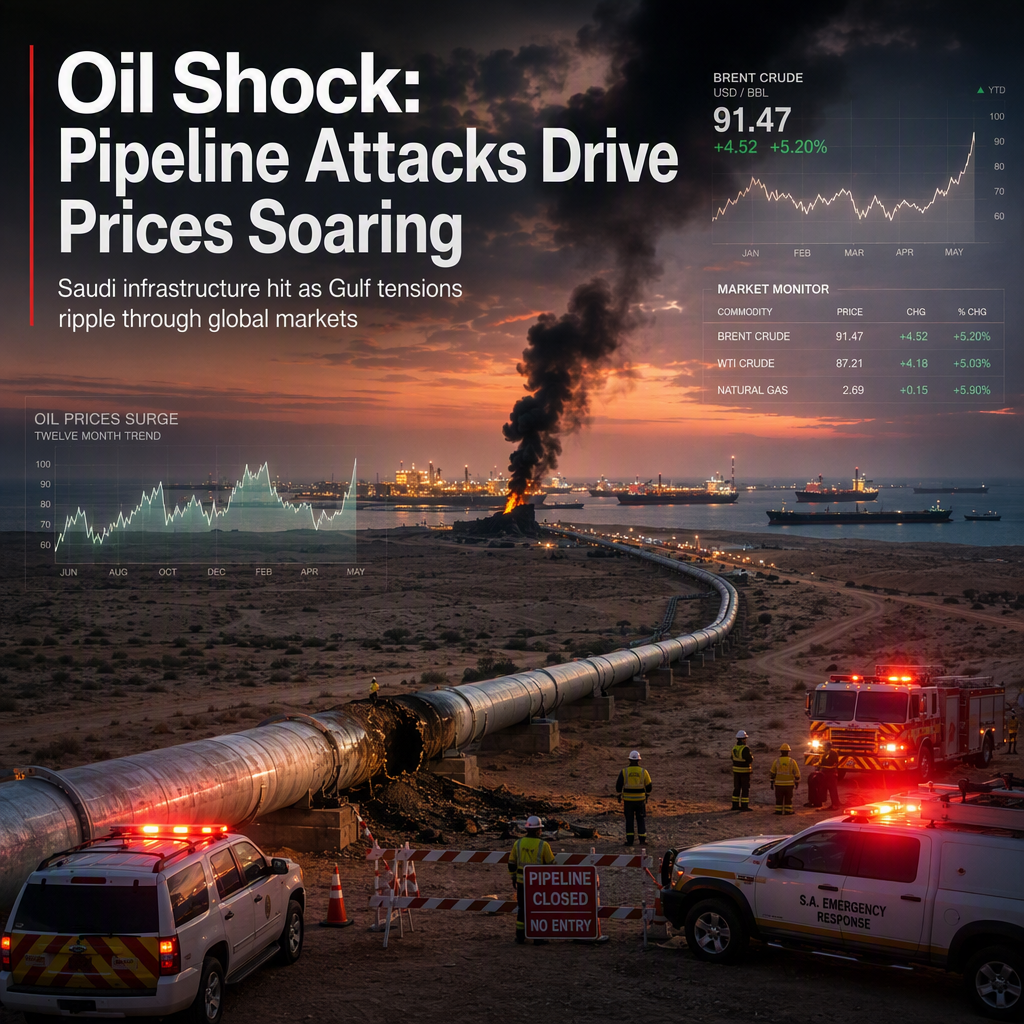
West Texas Intermediate (WTI) oil prices extended gains for the second consecutive day, trading around $98.60 per barrel during Asian hours on Tuesday, amid heightened uncertainty over global supply disruptions [1]. U.S. WTI futures for October advanced 1.27% to $102.68 per barrel, while Brent crude for November delivery rose 1.25% to $107.00 a barrel [2]. The surge in prices follows the closure of Saudi Arabia’s critical East-West pipeline, which bypasses the Strait of Hormuz, after drone attacks launched from Iraq damaged the infrastructure. There is no clear indication of when operations will resume [1][2].
The supply disruption was compounded by fresh Houthi strikes on Saudi Arabia, with Al Jazeera reporting that 13 civilians were injured after a wave of ballistic missile and drone attacks into Saudi territory [2]. Additionally, Iran claimed a supertanker exploded after striking mines in the Strait of Hormuz, while the U.S. Central Command disputed Iran's assertion, stating that the Panama-flagged oil tanker El Gaia was actually struck by an Iranian missile last month and rendered inoperable [2]. The IRGC's claim was labeled as false by U.S. officials, highlighting ongoing tensions and conflicting narratives in the region [2].
Diplomatic efforts to address the situation have stalled, as a meeting between Iran and Gulf Arab states to discuss the Strait of Hormuz was abruptly postponed. Iran also stated it would not engage in talks with the U.S. until its demands are met [1]. In Eastern Europe, President Volodymyr Zelenskyy said Ukraine is prepared to halt attacks on Russian energy targets if Russia reciprocates, contradicting U.S. President Donald Trump's claim that both sides had already agreed to suspend strikes [1].
Market participants remain heavily committed to the energy complex, with TD Securities noting that commodity trading advisors (CTAs) are 'max long' across crude oil, diesel, and gasoline markets, constrained only by volatility levels [1]. Komal Sri-Kumar, president of Sri-Kumar Global Strategies, commented on CNBC that inflation is expected to pick up due to pipeline attacks and the Saudi closure, alongside an accelerating tariff war, which will put upward pressure on prices and bond yields [2].
CONCLUSION
The closure of Saudi Arabia’s East-West pipeline and escalating attacks in the Gulf have driven oil prices sharply higher, with both WTI and Brent futures posting significant gains. Market sentiment is bullish, as supply fears and geopolitical tensions intensify, and analysts warn of rising inflation and bond yields. The situation remains fluid, with no clear timeline for pipeline reopening and ongoing regional instability.