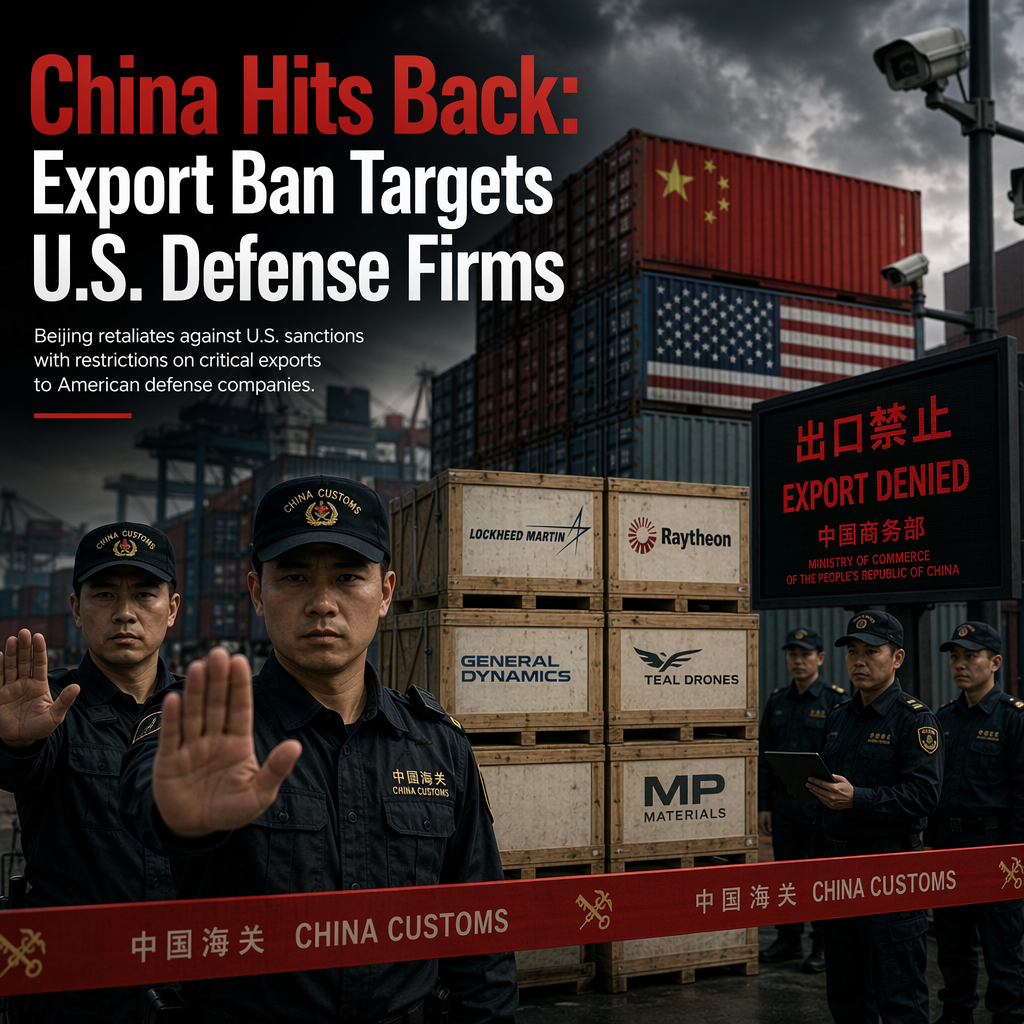
China announced sanctions on 10 American military-related companies in response to recent U.S. actions that bar leading Chinese tech companies from defense contracts [1]. The Chinese Commerce Ministry stated that these companies, which include military drone makers and rare earth mining firms, will be blocked from receiving 'dual-use' items—goods with both military and non-military applications—from Chinese exporters [1]. The affected companies are AVEOX, Red Cat Holdings, Teal Drones, IMSAR, Jaia Robotics, Ball Aerospace & Technologies, Oshkosh Defense, L3Harris Maritime Services, MP Materials, and USA Rare Earth [1].
Additionally, China's Finance Ministry prohibited government entities from purchasing products from 46 American companies, including multiple units of Lockheed Martin, Raytheon, and General Dynamics. The ministry did not provide a reason for this prohibition [1]. The export ban is intended to safeguard China's national security and is a direct response to the U.S. government's expansion of its 'List of Chinese Military Companies' [1].
Earlier this month, the U.S. Defense Department added several Chinese tech companies, including Alibaba and Baidu, to its list of firms allegedly linked to the Chinese military, preventing them from securing U.S. military contracts. Baidu publicly refuted the designation, calling it 'totally baseless' [1]. The Chinese Commerce Ministry criticized the American sanctions, stating they run counter to the consensus reached between Chinese leader Xi Jinping and U.S. President Donald Trump during Trump's visit to China in May [1].
China's announcement also included a provision prohibiting companies or individuals in third countries from transferring dual-use items from China to the sanctioned American firms. However, Chinese companies may apply for export approval if goods are 'genuinely necessary' [1].
CONCLUSION
China's retaliatory sanctions and export restrictions on key American defense firms mark a significant escalation in the ongoing U.S.-China trade and technology dispute. The measures are likely to impact supply chains and procurement for both countries' defense sectors, with broader implications for global technology and rare earth markets. The market sentiment is negative, reflecting heightened tensions and uncertainty.