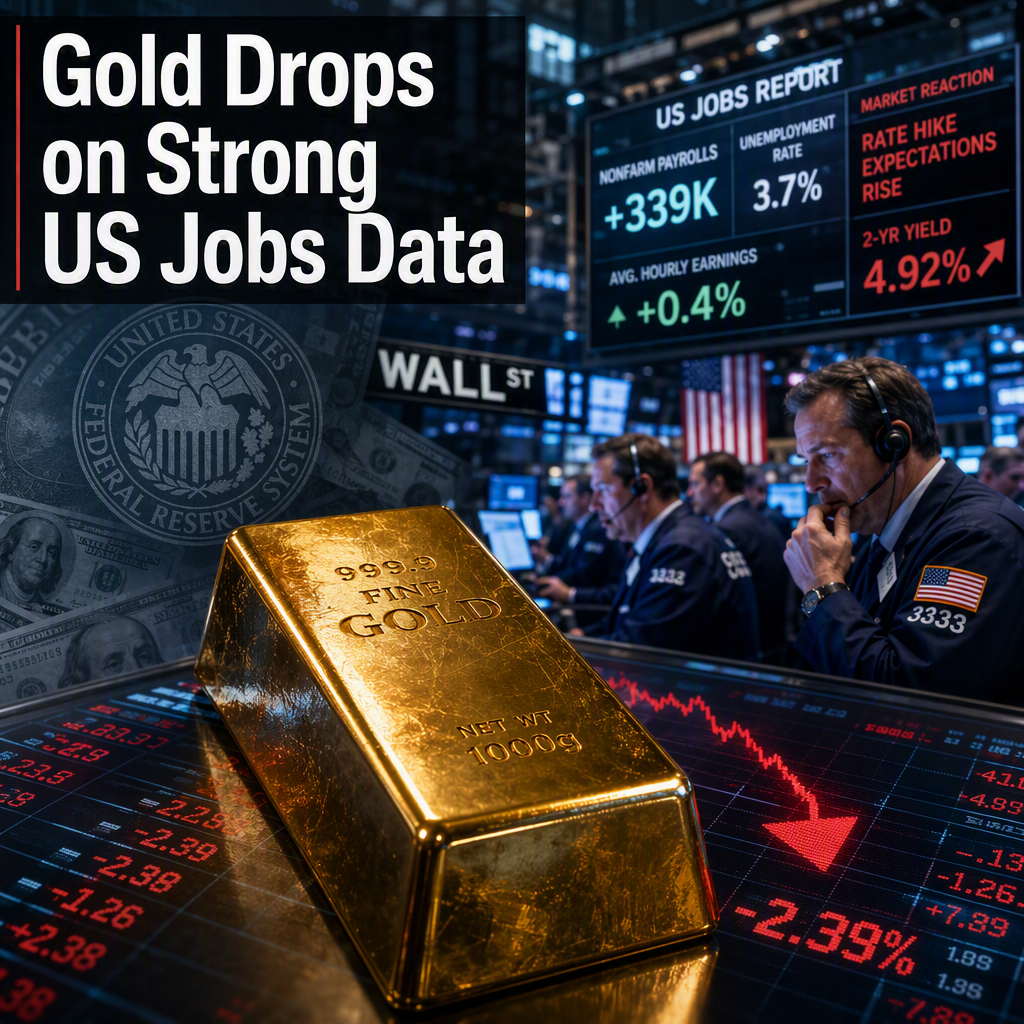
Gold (XAU/USD) prices fell over 0.40% on Monday, trading at $4,412 after reaching a daily high of $4,435, as investors reacted to last Friday’s robust US Nonfarm Payrolls (NFP) report [1]. The August NFP figure came in at 162K, significantly surpassing the forecast of 56K, while July’s number was revised upward from -23K to 21K. The unemployment rate remained steady at 4.1% [1]. This strong labor market data prompted a rise in US Treasury yields and strengthened the US Dollar, with the US Dollar Index (DXY) down 0.25% at 98.91 [1].
Money markets responded by increasing the probability of a Federal Reserve interest rate hike at the September 15-16 meeting to 60%, according to Prime Terminal [1]. The focus now shifts to upcoming US economic data releases, including the Producer Price Index (PPI) on Thursday and the Consumer Price Index (CPI) on Friday, which could further influence Fed policy expectations [1].
Geopolitical tensions also featured, as the US conducted strikes on three Iranian tankers following an IRGC missile attack on US Navy ships. Iran’s navy claimed it targeted oil vessels using unauthorized routes in the Strait, as well as three other US-flagged ships elsewhere [1]. Additionally, US President Donald Trump increased pressure on the Federal Reserve, threatening to halt trade with countries running deficits with the US unless the Fed cuts interest rates, a demand he has made previously [1].
From a technical perspective, gold is currently supported at the 100-day Simple Moving Average (SMA) at $4,350, with further support at $4,300 and the September 2 swing low of $4,282. Resistance levels are noted at $4,500 and the 200-day SMA at $4,535, with a potential move to $4,600 if these are breached. The Relative Strength Index (RSI) is neutral to downward-trending, suggesting a possible further decline in the near term [1].
CONCLUSION
Gold prices declined as strong US jobs data increased expectations for a Federal Reserve rate hike, pressuring the yellow metal. Market participants are now closely watching upcoming inflation data and Fed policy signals for further direction. Technical indicators suggest gold may face additional downside risk in the near term.