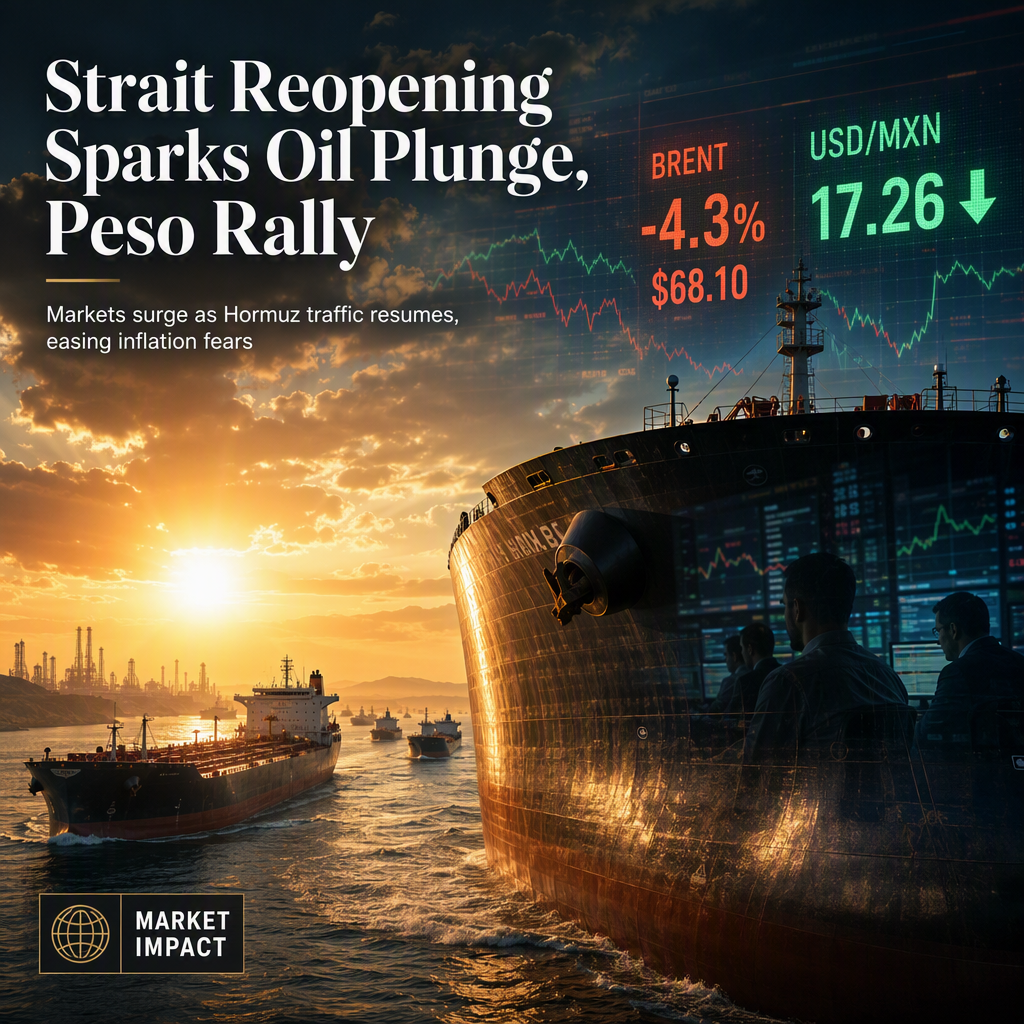
Oil prices continued their sharp decline on Tuesday following reports that an announcement regarding the reopening of the Strait of Hormuz could be imminent. Al Arabiya and Al Hadath, citing high-level sources, indicated that communications are ongoing and progress has been made, though no official confirmation has been issued yet [1]. This potential reopening is seen as a significant development, as it would ease global inflationary pressures by allowing freer ship traffic, particularly impacting energy prices [2].
The Mexican Peso rallied to a one-month high, with the USD/MXN pair trading at 17.26 after reaching a high of 17.33. The surge was attributed to speculation about a possible interim deal between the US and Iran, which could reopen the Strait of Hormuz. US Treasury Secretary Scott Bessent and US Secretary of State Marco Rubio both stated that a deal could be reached as soon as today or tomorrow [2]. The Peso also benefited from the interest rate differential between the US and Mexico, favoring the latter [2].
Market reactions extended beyond oil and currencies. The US Dollar Index (DXY) eased by around 0.10% to trade near 99.90, following softer-than-expected US labor demand data. The JOLTS Job Openings fell to 7.359 million in June from 7.537 million, missing the forecast of 7.4 million and indicating a further loosening in hiring appetite [1][2]. EUR/USD advanced around 0.20% to trade near 1.1530, while GBP/USD added around 0.10% to trade near 1.3450. USD/JPY rose about 0.40% to 157.80, with the Japanese Yen being the only major currency weakening against the US Dollar [1].
In Mexico, June’s Consumer Confidence improved for the second consecutive month on a monthly basis, though it retreated for the nineteenth straight month annually [2]. Attention is now focused on the Bank of Mexico’s Interest Rate Decision scheduled for August 6, with a 93% probability that rates will remain at 6.50% and only a 7% chance of an increase, according to Prime Terminal data [2]. Technical analysis suggests USD/MXN retains a bearish near-term bias, with resistance at 17.4149 and support at 15.7289 [2].
Federal Reserve Bank of Philadelphia President Anna Paulson commented that underlying inflation remains too high and that policy needs to stay mildly restrictive, adding that current settings likely meet that description [1].
CONCLUSION
Speculation about a US-Iran deal to reopen the Strait of Hormuz has triggered a sharp drop in oil prices and a rally in risk-sensitive currencies like the Mexican Peso. The market is responding to easing geopolitical tensions and softer US labor data, with attention now turning to upcoming central bank decisions and further jobs reports. Overall, the event has had a high impact across energy and currency markets, signaling increased optimism and risk appetite.