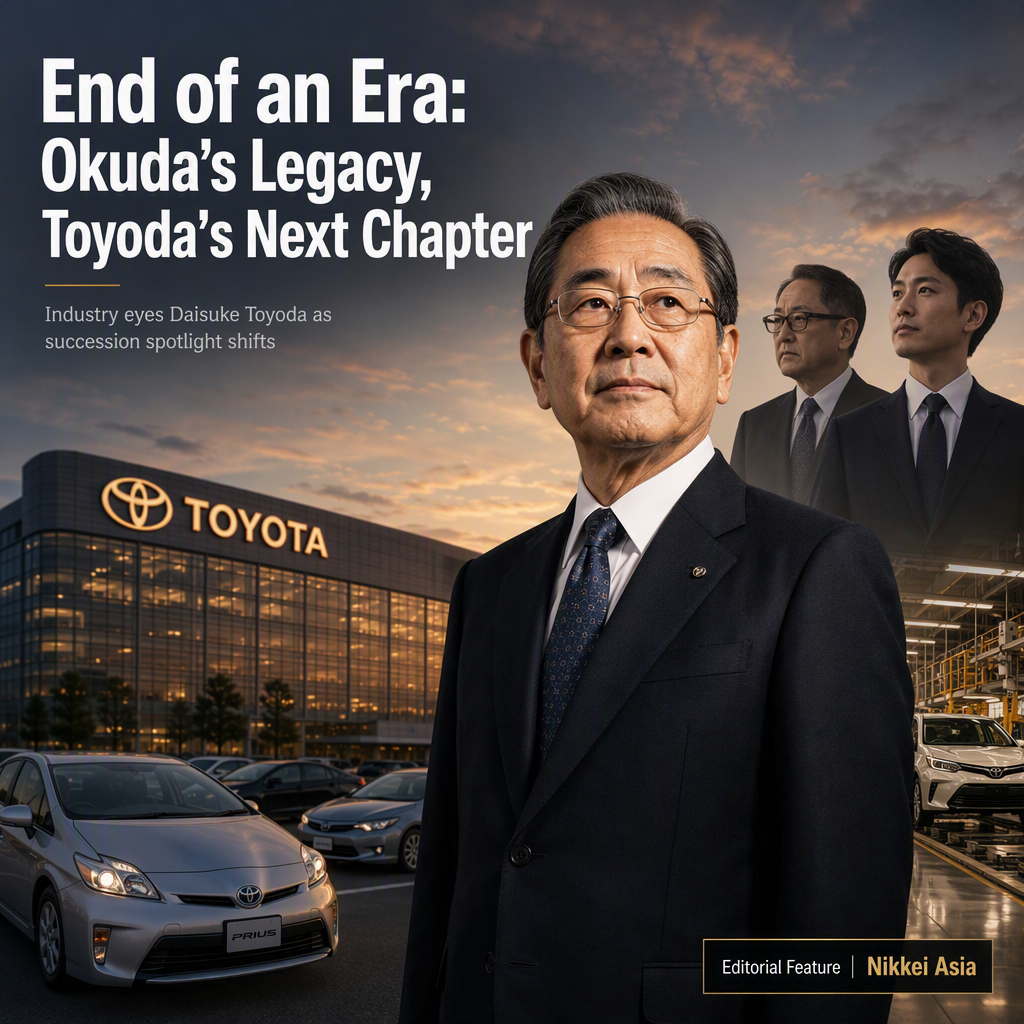
Hiroshi Okuda, the former president of Toyota Motor, has died. Okuda was notable for being the first leader from outside the Toyoda family to head Toyota in 28 years when he became president in 1995 [1]. He is credited with spearheading Toyota's globalization drive, laying the foundation for the company's global production network, and championing the development and commercialization of hybrid technology, including the Prius, which became a global success as an environmentally friendly vehicle [1].
Toyota's governance model shifted under Okuda, with three successive nonfamily presidents following his tenure. However, in 2009, leadership returned to the founding Toyoda family when Akio Toyoda, the founder's grandson, became president at age 53 [1]. Akio Toyoda's presidency lasted over 13 years, during which Toyota expanded significantly and reinforced its position as the world's leading automaker [1].
Currently, Akio Toyoda remains chair, but day-to-day management has again been entrusted to nonfamily executives. Koji Sato, formerly head of Lexus, became president in 2023, and earlier this year, Kenta Kon succeeded Sato [1]. Despite these changes, Akio Toyoda continues to be Toyota's most visible public face, while the new nonfamily presidents have maintained a lower profile compared to Okuda and his immediate successors [1].
There is growing speculation within the industry that Toyota and the Toyoda family's succession plan is taking shape, with Daisuke Toyoda, Akio's eldest son, seen as the likely next-generation leader [1]. Nikkei Asia has published an in-depth feature examining the evolving relationship between Toyota and the Toyoda family [1].
CONCLUSION
The passing of Hiroshi Okuda marks the end of an era for Toyota, highlighting his pivotal role in the company's global expansion and technological innovation. As Toyota's leadership transitions once again, industry attention is focused on the Toyoda family's succession plans, with Daisuke Toyoda emerging as a potential future leader. Market implications center on the continuity of Toyota's long-term vision and governance structure.