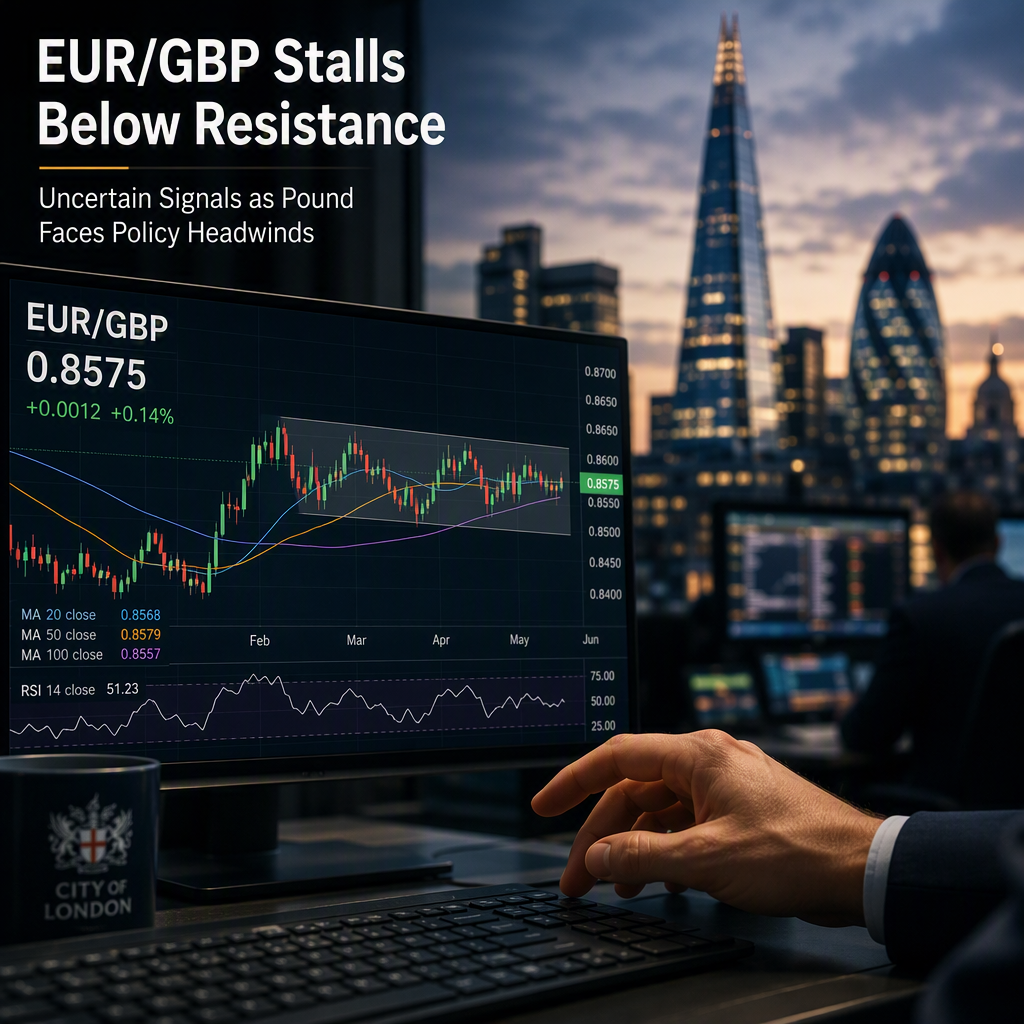
The Euro (EUR) edged higher against the British Pound (GBP) on Friday, but trading remained confined to a narrow range over the past ten sessions, indicating that the mid-July rebound from below 0.8500 is losing momentum beneath a dense cluster of moving averages [1]. At the time of writing, EUR/GBP was trading around 0.8575 [1].
Strategists at Rabobank highlighted a recent shift in market expectations toward 'steady policy from the BoE this year' and noted increased 'nervousness ahead of the October budget,' both of which could create downside pressure on the pound as summer ends [1]. In this context, Rabobank favors buying EUR/GBP on dips to the 0.8550 area and suggests that a break above the recent high near 0.8588 could increase upside potential [1].
From a technical perspective, the 50-day Simple Moving Average (SMA) at 0.8584 is capping the immediate upside, with further resistance at the 100-day SMA (0.8630) and the 200-day SMA (0.8675) [1]. Momentum indicators are mixed: the Relative Strength Index (RSI) stands at 54, reflecting a modest bullish bias, while the Moving Average Convergence Divergence (MACD) remains positive, though the fading green histogram signals that the recent recovery lacks enough momentum to decisively clear the moving averages for now [1].
On the downside, immediate support is at 0.8550, followed by the psychological level of 0.8500. A decisive break below 0.8500 would expose the year-to-date low near 0.8455 [1]. No specific market reactions or analyst forecasts beyond Rabobank's comments were provided in the article.
CONCLUSION
EUR/GBP remains in a consolidation phase, with mixed technical signals and key resistance levels capping upside potential. Rabobank sees scope for further downside in GBP due to steady BoE policy and budget-related nervousness, favoring EUR/GBP on dips. Overall, the market impact is limited as traders await a decisive breakout.