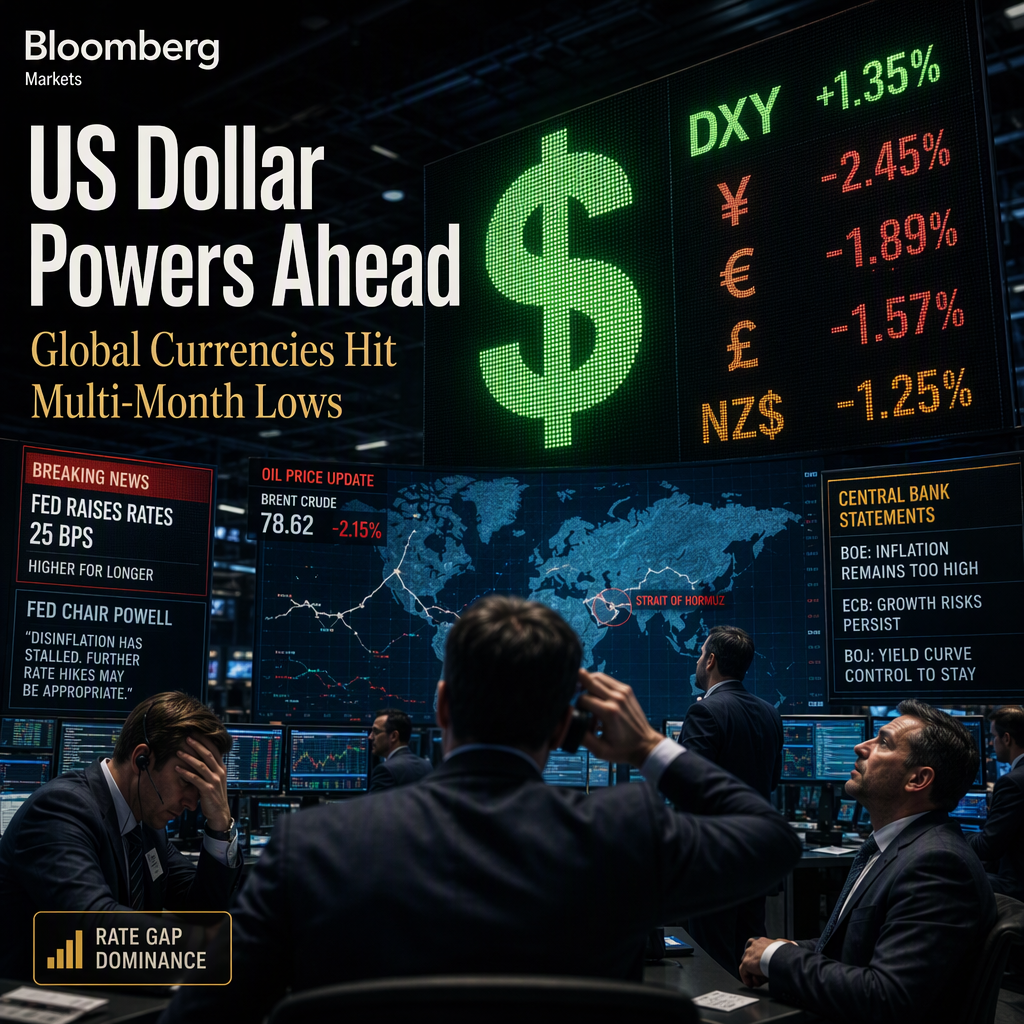
The US Dollar continued its ascent against major global currencies, with the New Zealand Dollar, Japanese Yen, Euro, and British Pound all reaching multi-month lows as investors responded to rising US interest rate expectations and shifts in global energy markets. The NZD/USD pair dipped below 0.5700 for the first time since early July before rebounding into the 0.5700-0.5800 range, despite New Zealand's Q2 GDP growth of 0.2% beating forecasts and annual growth reaching 2.6% versus 2.2% expected. The Reserve Bank of New Zealand's Official Cash Rate remains at 2.75%, with Governor Breman indicating another hike is likely but with uncertain timing, while the Fed's midpoint rate stands at 3.875%, maintaining a significant rate differential in favor of the Dollar [1].
The Japanese Yen also experienced volatility, briefly strengthening as Iran offered to reopen the Strait of Hormuz, which led to a drop in crude oil prices. However, the USD/JPY pair quickly reversed, trading near 157.50 as traders refocused on the persistent interest rate gap. The Bank of Japan's rate is at 1.25% following a 7-2 vote, with two members opposing the latest hike. Boston Fed President Collins reiterated her support for another US rate increase before year-end, aligning with the Fed's median projection of a 4.1% rate by December, while futures suggest a slightly higher 4.2% [2].
The Euro fell to its lowest level since July, with EUR/USD dipping under 1.1450 before stabilizing. The decline was attributed to a weaker consumer confidence survey (September reading at -16.5 versus -16 expected) and the Dollar's strength amid rising US rate expectations. The European Central Bank raised its deposit rate to 2.50% on September 10, but both President Lagarde and Vice-President Vujčić cautioned that market expectations for further hikes may be excessive. Futures traders anticipate three or four more ECB hikes, but softening economic data could temper those expectations [3].
Similarly, the British Pound set a new September low just above 1.3300, its weakest since late July, as the Dollar gained on hawkish Fed commentary. The Bank of England's rate remains at 3.75%, with a 6-3 vote to hold at the last meeting. Sixteen of the Fed's 18 officials expect at least one more hike this year, while only three BoE members support an increase. Upcoming UK PMI data and speeches from BoE officials may influence future rate expectations, but for now, the interest rate gap continues to favor the Dollar [4].
Across all markets, the prospect of cheaper crude oil—driven by Iran's conditional offer to reopen Hormuz—provided temporary relief for oil-importing currencies like the Yen and Kiwi, but did not fundamentally alter the prevailing trend of Dollar strength. Upcoming economic data releases and central bank communications are expected to further shape currency movements in the near term [1][2][3][4].
CONCLUSION
The US Dollar's dominance is being reinforced by rising US interest rate expectations and persistent rate differentials, pushing major global currencies to multi-month lows. While temporary factors like cheaper oil have provided brief support to some currencies, the overarching trend remains in favor of the Dollar. Market participants are closely watching upcoming economic data and central bank signals for any shift in this dynamic.