
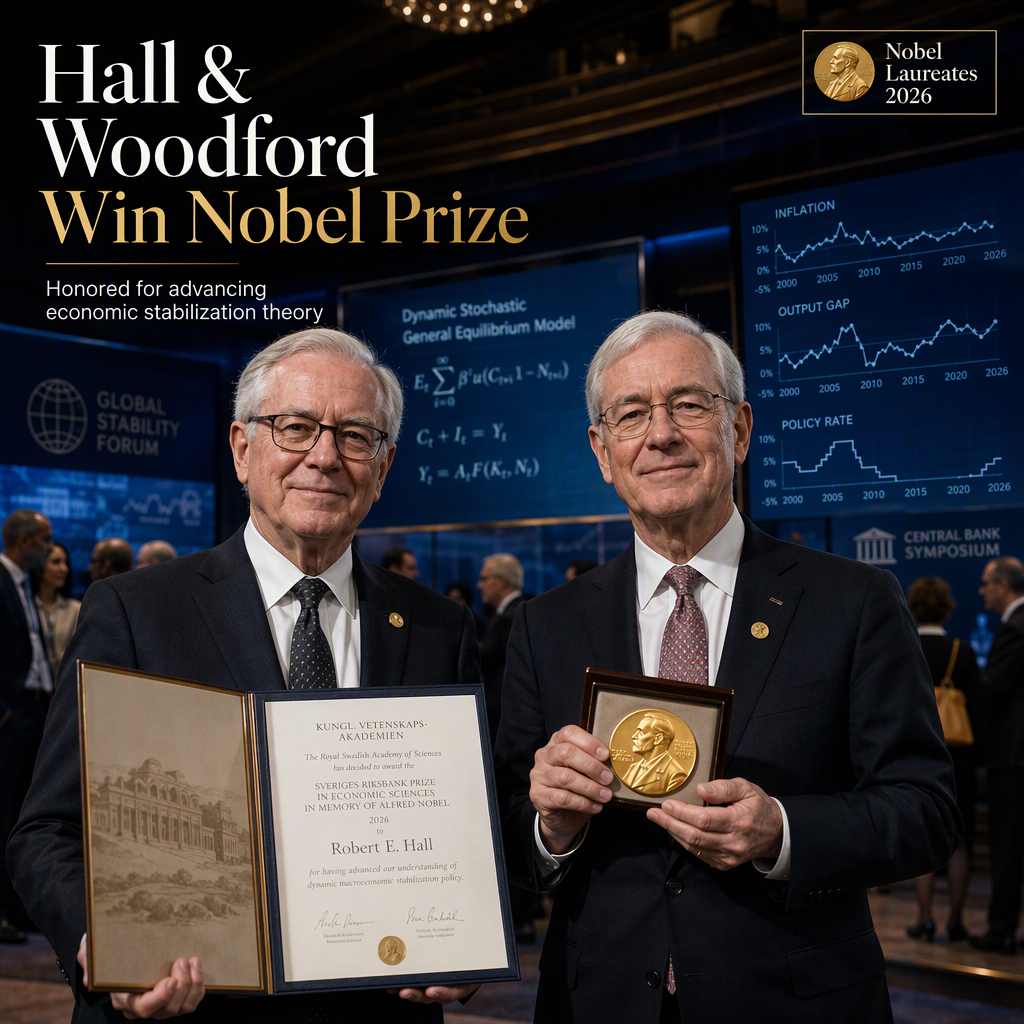
On October 12, 2026, U.S. economists Robert E. Hall and Michael Woodford were jointly awarded the Nobel prize in economics for their work on the microeconomic foundations of macroeconomic stabilization [1]. The award, officially known as the Sveriges Riksbank Prize in Economic Sciences in Memory of Alfred Nobel, comes with a monetary prize of 12 million Swedish kronor, equivalent to $1.19 million, which the laureates will split [1].
According to John Hassler, Chair of the Committee for the Prize in Economic Sciences, the contributions of Hall and Woodford have provided a stable theoretical foundation for models now used by central banks and governments globally [1]. Hassler emphasized that their research equips policymakers to better handle economic shocks, such as energy crises or abrupt changes in household consumption patterns [1].
While the article does not mention specific market reactions or analyst opinions, the recognition of Hall and Woodford's work underscores the importance of robust economic models in guiding policy responses to macroeconomic volatility [1].
CONCLUSION
The Nobel prize awarded to Robert E. Hall and Michael Woodford highlights the significance of their research in strengthening the theoretical underpinnings of macroeconomic stabilization. Their work is credited with enhancing the ability of policymakers to respond effectively to economic shocks, reinforcing the value of sound economic modeling in global economic management.