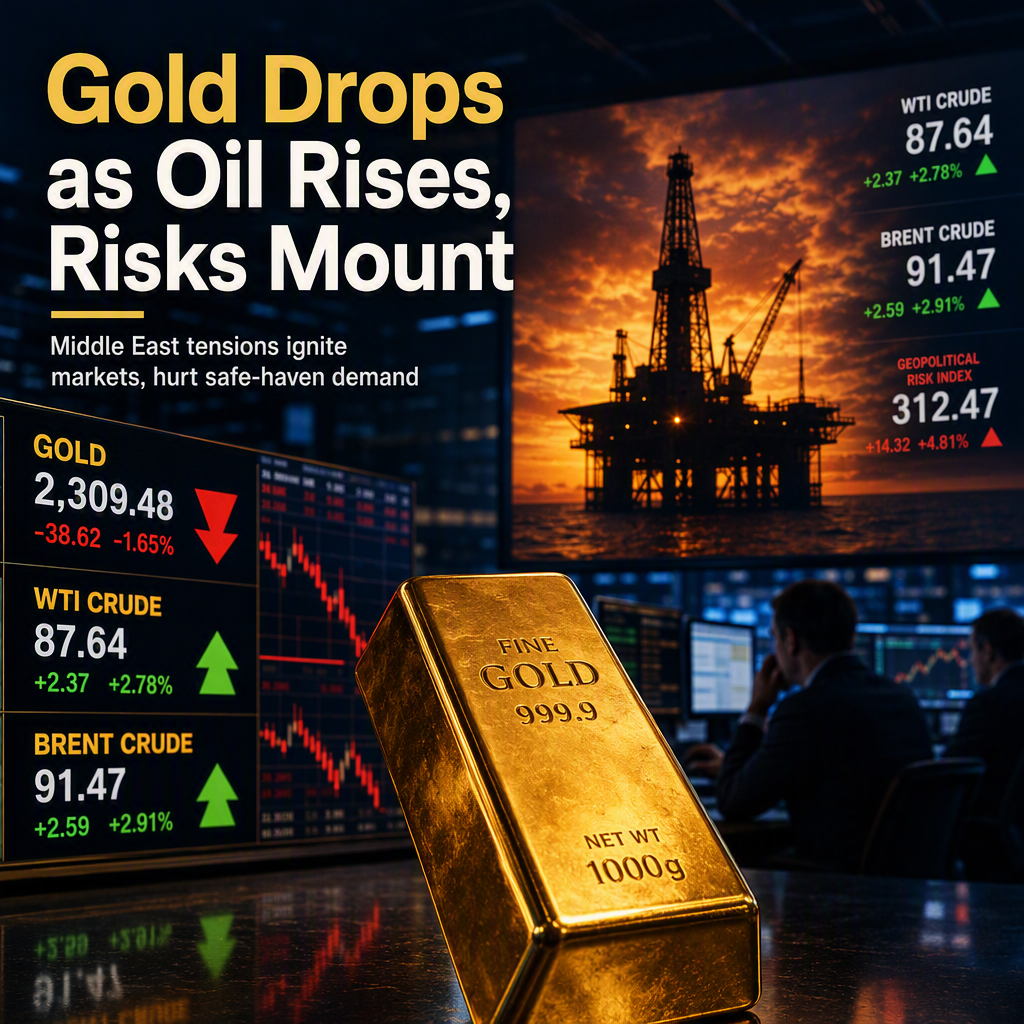
Gold (XAU/USD) registered losses of over 0.44% on Tuesday, trading at $4,393, as the market narrative was dominated by the US-Iran conflict, rising oil prices, and anticipation of upcoming US inflation data releases. West Texas Intermediate (WTI) crude oil climbed 1% to $92.10 per barrel amid ongoing attacks in the Middle East, intensifying concerns about energy-driven inflation and prompting traders to brace for the US Producer Price Index (PPI) on Thursday and the Consumer Price Index (CPI) on Friday [1].
The market is particularly focused on the July CPI, expected at 0.4% month-over-month or 3.4% year-over-year, with core CPI seen at 0.2% MoM and 2.4% YoY. If these figures exceed expectations, it could open the door for further Federal Reserve tightening, which typically pressures gold prices lower due to the metal's sensitivity to interest rate changes [1]. Money markets have priced in a 63% chance of a 25-basis-point rate hike by the Fed at next week's meeting, according to Prime Terminal [1].
Despite gold's decline, US bond yields and the dollar have remained relatively stable, with the US 10-year Treasury yield flat at 4.788% and the US Dollar Index (DXY) down 0.04% at 98.86 [1]. Technical analysis indicates gold is extending its losses for the third consecutive day, approaching the 100-day Simple Moving Average (SMA) at $4,346, with the next downside target at $4,300. The Relative Strength Index (RSI) has turned downward, suggesting further downside risk [1].
Key support levels are identified at $4,300, $4,282, $4,254, and $4,200, while resistance levels are at $4,400, $4,450, $4,500, and $4,535. A break below $4,300 could lead to further declines, while a move above $4,400 could open the way to higher targets [1].
CONCLUSION
Gold prices are under pressure due to rising oil prices and geopolitical tensions, which have heightened expectations for a Federal Reserve rate hike. With key US inflation data on the horizon, the market remains cautious, and further downside in gold is possible if inflation readings exceed forecasts. Technical indicators suggest continued weakness in the near term.