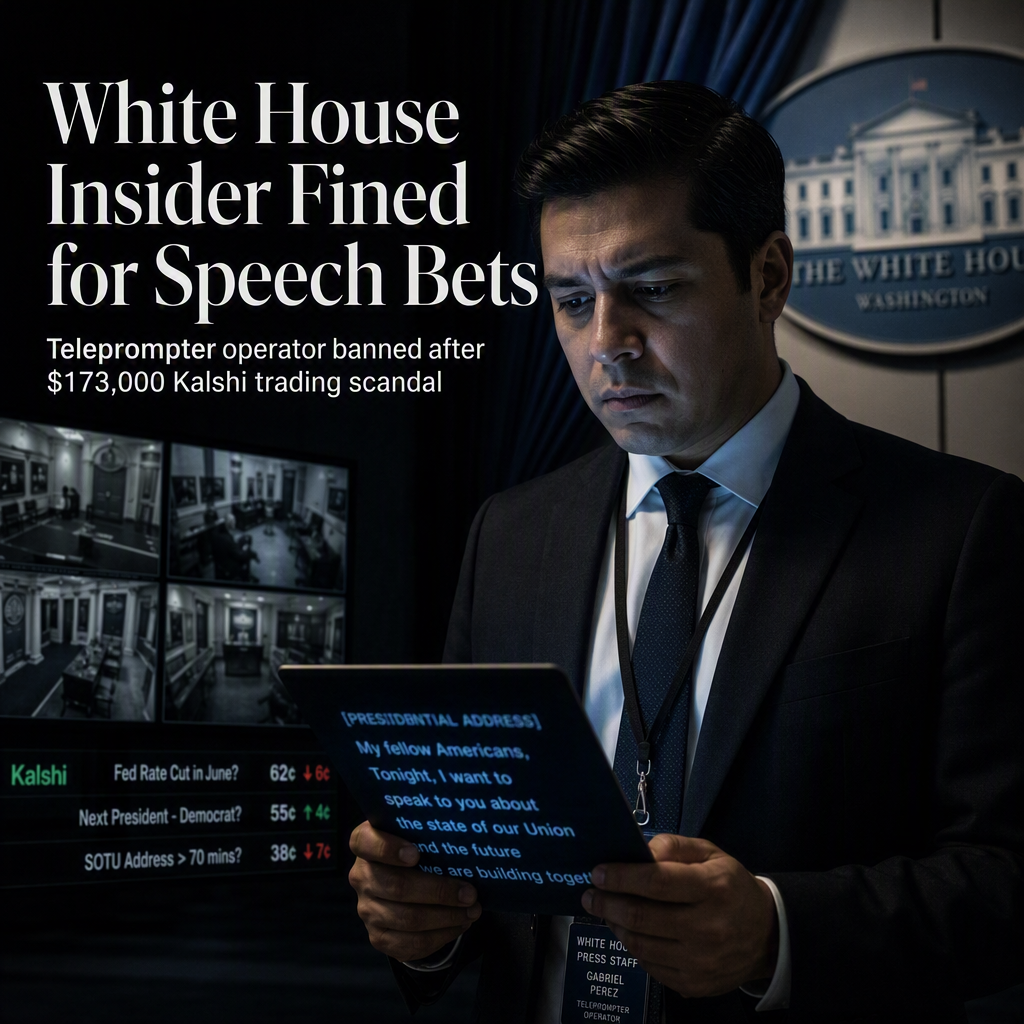
Gabriel Perez, a White House teleprompter operator for President Donald Trump since 2016, has been ordered by the Commodity Futures Trading Commission (CFTC) to pay nearly $173,000 and is banned from trading for three years after using advance access to presidential speeches to profit on Kalshi, a prediction market platform [1]. The CFTC found that between December 2025 and February 2026, Perez misappropriated nonpublic information from his government position to trade 'presidential mention market contracts,' which paid out based on whether Trump used specific words or phrases during his speeches [1]. Perez generated more than $107,500 in profits from these trades, was ordered to surrender $107,539 in trading profits, and pay a $65,000 civil penalty—a penalty the CFTC described as a 'substantial discount' due to his 'exemplary cooperation' with the investigation [1].
Perez was placed on paid administrative leave in July during the investigation. The CFTC also imposed a three-year trading ban and ordered him to cease and desist from further violations of federal commodities laws and regulations [1]. The suspicious trading activity was initially flagged by Kalshi's surveillance systems, which noticed unusual trades in markets tied to words and phrases expected in Trump's public remarks. These trades did not follow typical patterns and prompted complaints from market makers through Kalshi's whistleblower channels [1].
Kalshi identified Perez as the trader, froze his account before most profits could be withdrawn, and referred the matter to federal regulators [1]. Robert DeNault, Kalshi's head of enforcement, emphasized that the exchange holds all traders accountable, stating, 'It doesn’t matter who you are: violate our rules or federal law and you will face the consequences' [1].
The enforcement action underscores the effectiveness of Kalshi's surveillance and whistleblower systems, as well as the CFTC's commitment to policing insider trading in event markets. No specific market reaction or analyst opinions were discussed in the article [1].
CONCLUSION
The CFTC's enforcement against Gabriel Perez highlights the risks and consequences of insider trading in event-based prediction markets. Kalshi's detection and cooperation with regulators demonstrate robust compliance measures. The case serves as a warning to market participants about the importance of adhering to both exchange rules and federal law.