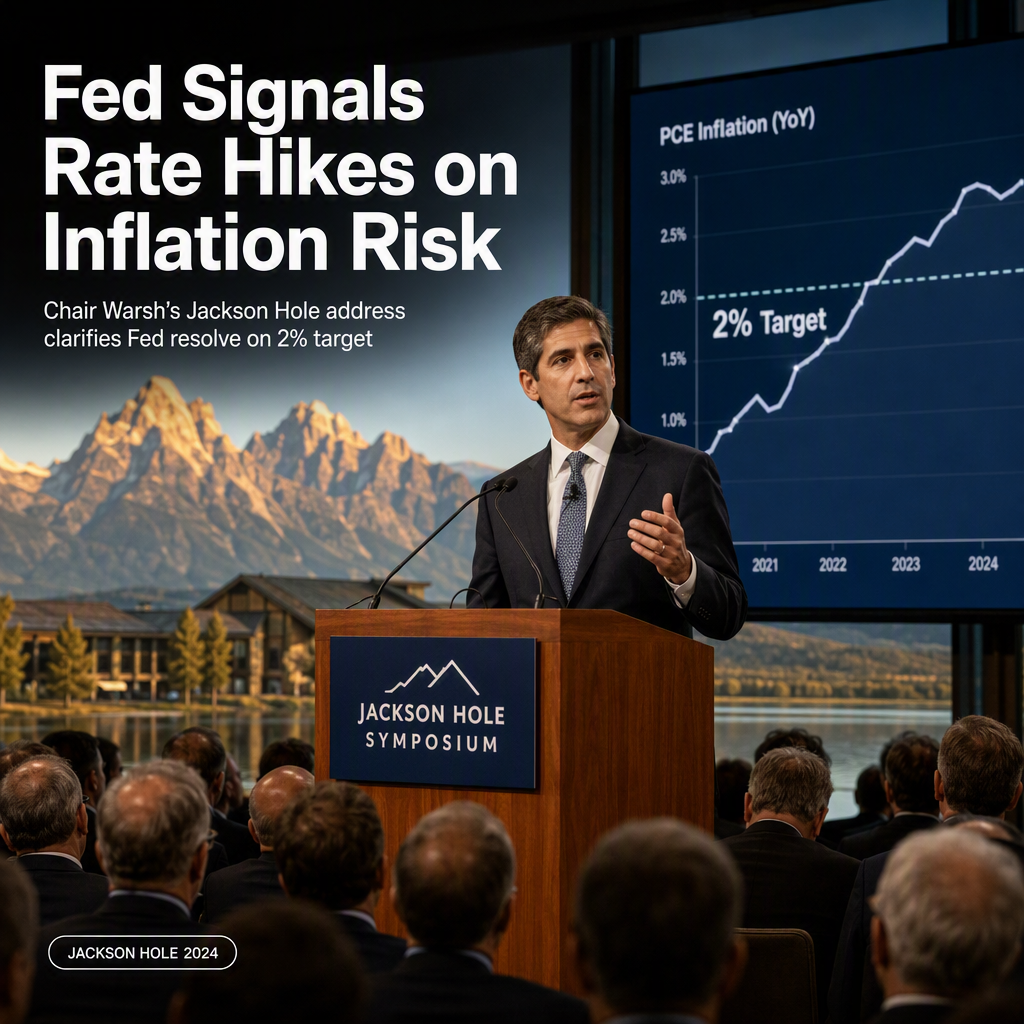
Federal Reserve Chair Kevin Warsh delivered his first keynote address at the annual Jackson Hole Symposium, focusing on the central bank's commitment to returning inflation to its 2% target and clarifying his stance on forward guidance for monetary policy decisions [1]. Warsh described the current personal consumption expenditures (PCE) inflation rate as 'concerning,' noting that it remained at 3.7% year-over-year in July, and emphasized that achieving the 2% PCE target is a 'firm, fixed target' for policymakers [1].
On the labor market, Warsh stated that limited growth in labor supply is contributing to lower monthly jobs figures, but overall labor market data remains 'broadly consistent with full employment' [1]. He also addressed criticism regarding his reluctance to provide forward guidance, asserting that such guidance should be reserved for times of economic or financial crisis, a position that his speech helped clarify for some market participants [1].
Seema Shah, chief global strategist for Principal Asset Management, commented that Warsh's speech provided much-needed clarity, highlighting the Fed's focus on inflation and its preparedness to raise rates if progress toward the 2% target stalls. Shah noted that the risk of a rate hike in September has increased, but the market responded positively to the policy clarity, even though the message was more hawkish [1].
Gregory Daco, chief economist at EY-Parthenon, observed that Warsh's address came at a time when the Fed's credibility was under scrutiny due to his resistance to forward guidance. Daco praised Warsh for delivering a clear, fact-based assessment of the economy, reaffirming the use of PCE inflation and the fed funds rate as policy tools, and signaling readiness to tighten policy if inflation does not move quickly enough toward the target [1].
CONCLUSION
Chair Warsh's Jackson Hole speech clarified the Fed's commitment to its 2% inflation target and signaled a willingness to raise rates if necessary. While the risk of a September rate hike has increased, markets responded positively to the increased policy clarity. Analysts noted that Warsh's approach restored some confidence in the Fed's resolve and communication.