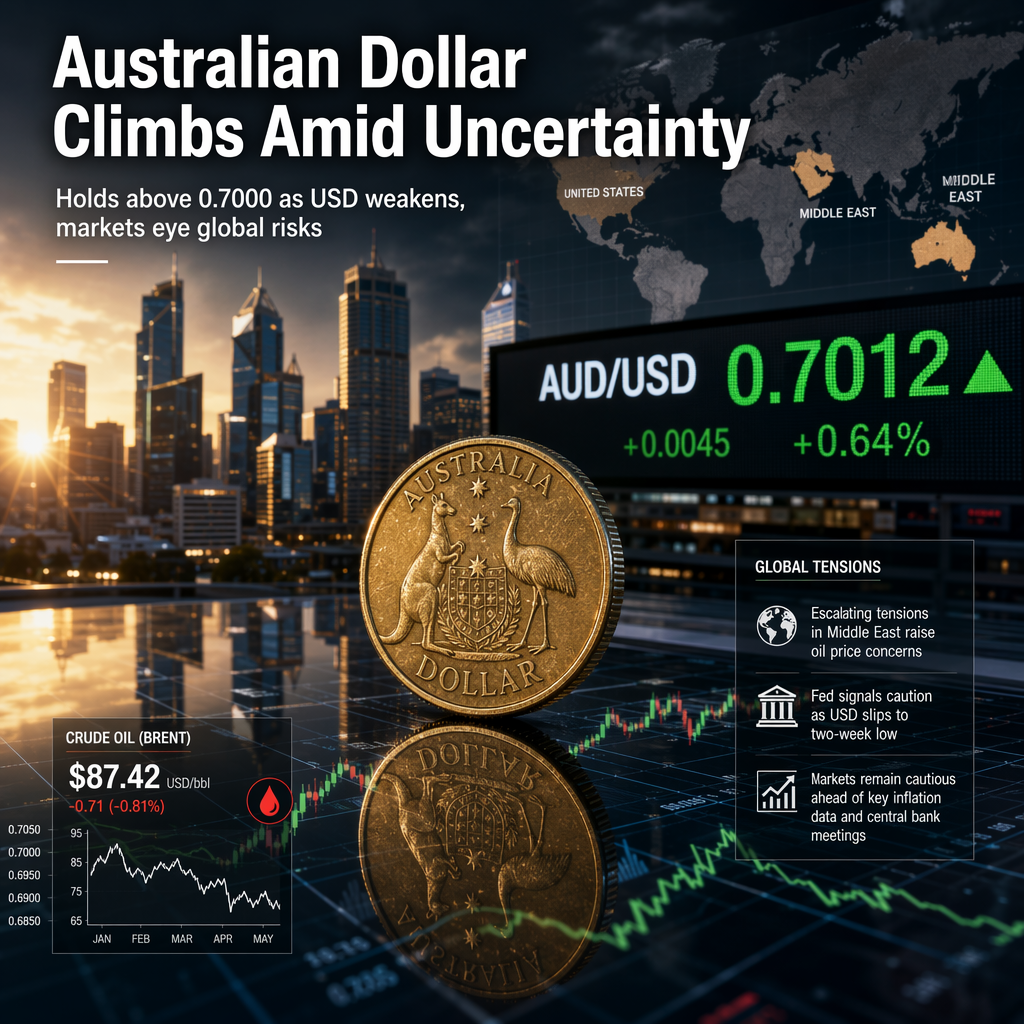
The Australian Dollar (AUD) strengthened against the US Dollar (USD), with the AUD/USD pair reaching a fresh daily high above the 0.7000 psychological level during early European trading on Monday. This move was supported by a weaker USD, which faced selling pressure due to a slight improvement in global risk sentiment and a positive tone in European equity markets, despite escalating tensions between the US and Iran. The US Dollar's safe-haven appeal was limited as the US completed a ninth consecutive night of strikes against Iran, and Iran responded with ballistic missiles and attack drones targeting US allies, raising concerns about a broader regional conflict and supporting elevated crude oil prices [1][4].
The AUD drew additional support from the Reserve Bank of Australia's relatively hawkish stance and steady economic data from China. However, traders appeared cautious, refraining from aggressive bets on the AUD/USD pair as they awaited further developments in the Middle East and in the absence of significant US economic data on Monday [1]. According to United Overseas Bank (UOB), the AUD/USD pair remains in an uptrend as long as it holds above 0.6950, with the upside scenario toward 0.7045 still valid. However, momentum has faded somewhat, and a breach of 0.6950 would shift focus to lower targets at 0.6835 and 0.6707 [2].
Currency heat maps from multiple sources confirm the AUD's relative strength, with the AUD up 0.22% to 0.26% against the USD on the day [1][3]. The US Dollar Index (DXY) traded 0.1% lower near 100.65, reflecting the broader weakness in the USD as market participants scaled back expectations for further Federal Reserve rate hikes following softer US inflation data [4].
While the AUD/USD pair benefited from the current environment, persistent geopolitical uncertainties and revived hawkish Fed expectations—driven by inflationary concerns from higher crude oil prices—could limit further USD depreciation. Analysts note that the AUD's longer-term structure remains negative, with downside risks if key support levels are breached [1][2].
CONCLUSION
The Australian Dollar's advance above 0.7000 is underpinned by a weaker US Dollar and supportive risk sentiment, but ongoing geopolitical tensions and shifting Fed expectations may cap further gains. Analysts highlight that the uptrend remains intact above 0.6950, though momentum is fading and downside risks persist. Market participants are likely to remain cautious, awaiting further developments in the Middle East and central bank signals.