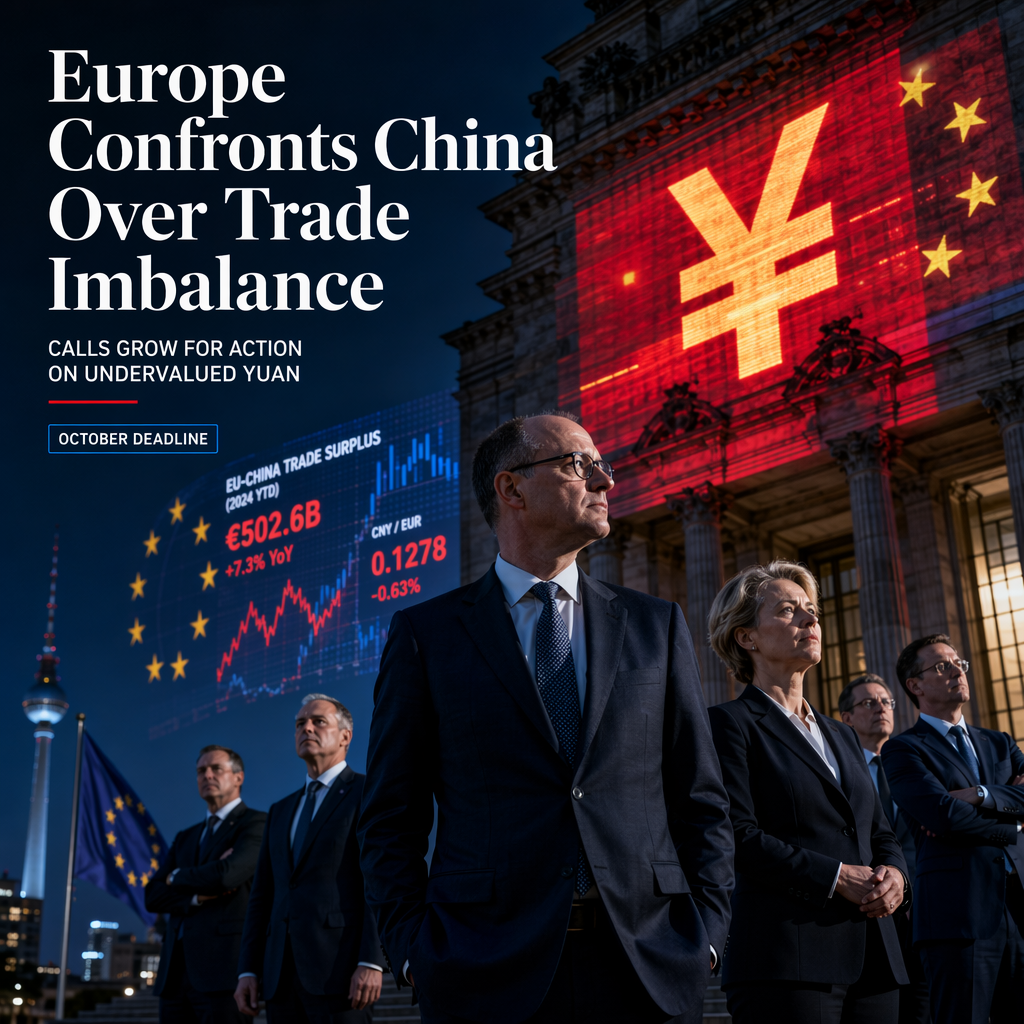
Rabobank's Michael Every reports that Chancellor Merz has called for a dialogue with China regarding its monetary and foreign exchange policy, specifically highlighting concerns that the Chinese Yuan (CNY) is 20–30% undervalued and should be allowed to float more freely to reach a fairer level [1]. Merz argued that the EU cannot compete effectively against a bloc that manipulates its currency, suggesting that the undervaluation gives China an unfair trade advantage [1]. Every notes that China is unlikely to accept a Plaza Accord-style agreement, and Europe lacks the leverage to impose such a deal on China [1].
The article underscores the urgency of addressing the surging Chinese trade surplus with the EU, which has now surpassed the surplus with the US and is close to doubling since 2020 [1]. Europe has set an October deadline for resolving this imbalance, hinting at possible solutions such as increased Chinese purchases of EU soybeans or Airbus aircraft, though skepticism remains about China's intentions [1]. If no progress is made, Europe may be forced to adopt US-style high tariffs, a move it has previously criticized as disruptive [1].
Recent Chinese trade data shows imports up 36% year-on-year versus an expected 26.1%, and exports up 27% versus an expected 19% [1]. While the breakdown of EU-specific numbers is not yet available, the results are unlikely to satisfy Brussels' concerns about the trade gap [1].
No forward-looking analyst opinions beyond Rabobank's commentary are provided, but the tone suggests escalating trade tensions and potential for significant policy shifts if dialogue fails [1].
CONCLUSION
Europe is intensifying pressure on China over the undervaluation of the Yuan and a rapidly growing trade surplus, raising the possibility of US-style tariffs if negotiations do not yield results. The latest Chinese trade data reinforces concerns about the imbalance, signaling heightened risk of trade friction between the EU and China. Market participants should monitor developments closely as policy responses could have substantial global implications.