
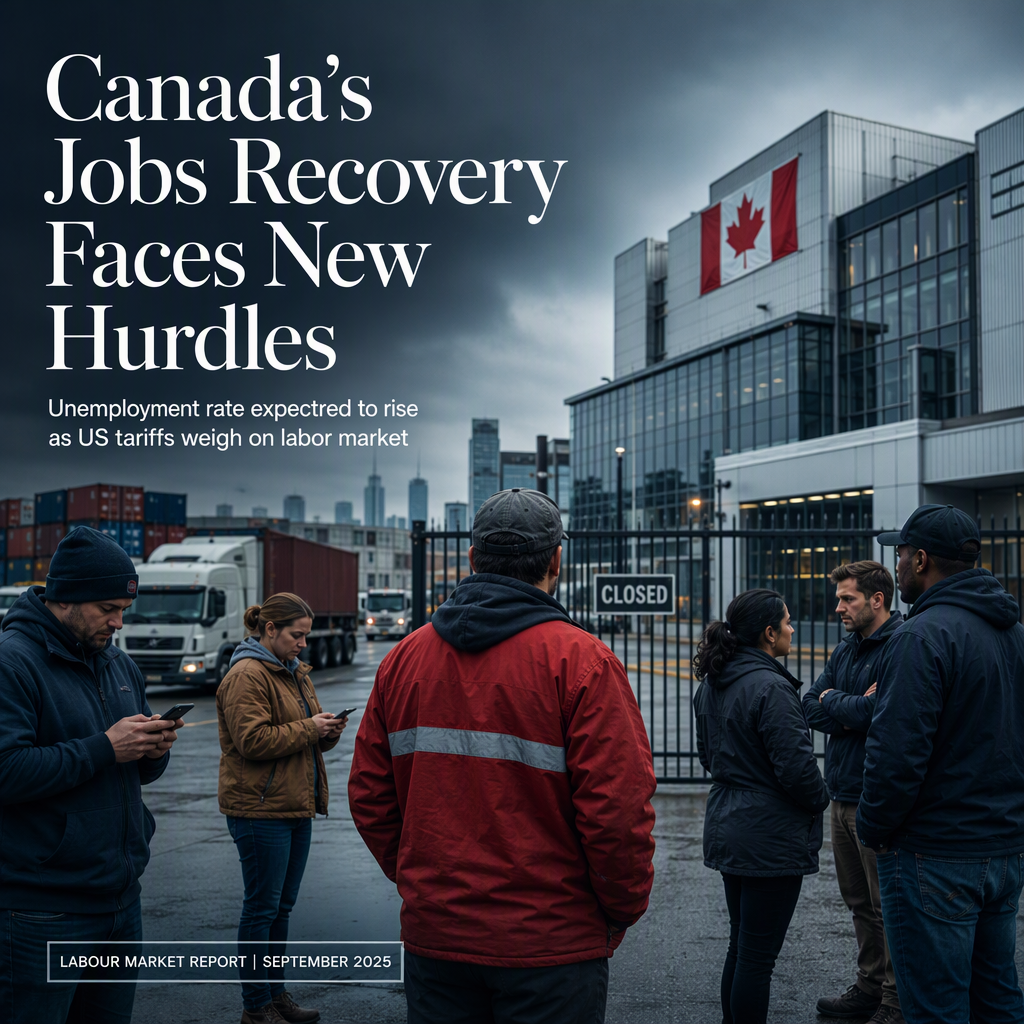
Statistics Canada is set to release its September Labour Force Survey on Friday, with analysts closely watching for signs of recovery in the Canadian labor market following a sharp employment decline in August. The report is particularly significant as it will be the first to fully reflect the impact of new United States tariffs implemented on August 22, which are expected to weigh on hiring, especially in export-oriented sectors [1].
Royal Bank of Canada (RBC) projects a modest employment increase of 5,000 jobs for September, with the unemployment rate remaining unchanged at 6.4%. In contrast, Canadian Imperial Bank of Commerce (CIBC) forecasts the unemployment rate to rise to 6.5%, aligning with market consensus, and warns that ongoing trade tensions could continue to pressure manufacturing employment [1]. Overall, analysts expect the economy to add around 7,000 jobs, partially offsetting the significant 41,700 job loss recorded in August [1].
The labor market data could influence expectations for the Bank of Canada (BoC), which has kept its policy rate at 2.25% since October 2025. The central bank is expected to maintain a cautious stance at its upcoming October 28 meeting, balancing economic weakness against persistent inflation, with the Consumer Price Index (CPI) holding steady at 3% year-over-year in August—well above the BoC’s 2% target [1].
Market participants are also monitoring wage growth, as average hourly wages increased by 2% year-over-year in August, down from 3% in July and 3.7% in June, indicating a slowdown in wage inflation [1]. The upcoming employment report could impact the Canadian Dollar (CAD); a stronger-than-expected result may support the currency, while a disappointing outcome could exert downward pressure [1].
CONCLUSION
Canada's September labor market report is expected to show a modest employment recovery but a potential rise in the unemployment rate to 6.5%, reflecting the impact of new US tariffs. The data will be closely watched for its implications on Bank of Canada policy and the Canadian Dollar, with wage growth and full-time employment figures also under scrutiny.