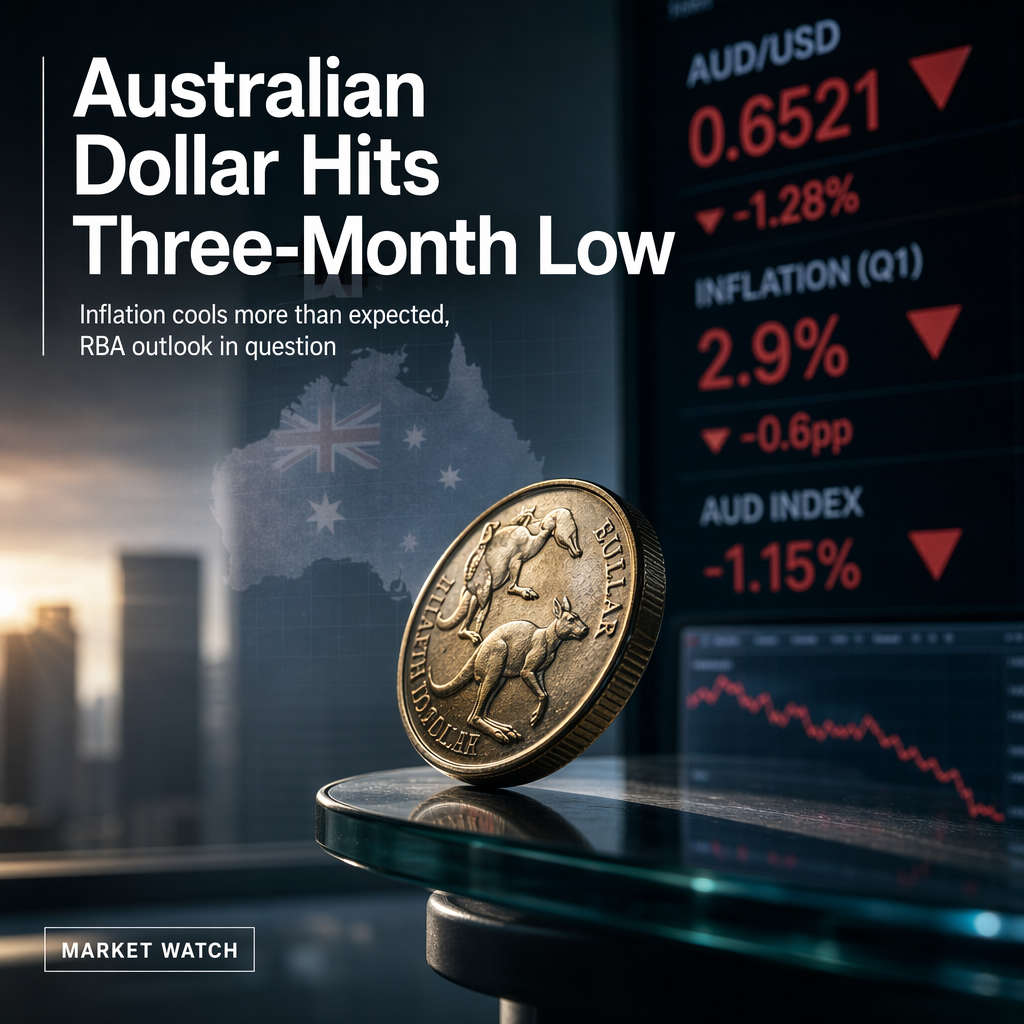
The Australian Dollar (AUD) remained under pressure, with the AUD/USD pair trading at 0.6890 near a three-month low on Wednesday, following the release of Australia's latest inflation data [1]. The pair declined by 0.4% during the American session after a sharper 1.2% drop on Tuesday, as investors digested the implications of the inflation figures and shifted their focus to the upcoming US Personal Consumption Expenditures Price Index (PCE), the Federal Reserve's preferred inflation gauge [1].
Australia's annual inflation rate eased to 4.0% in May, coming in lower than the expected 4.4% and down from 4.2% in April, with lower fuel prices contributing to the softer headline reading [1]. However, underlying inflation pressures persisted, as the Trimmed-mean Inflation rose to 3.6% from 3.4%, indicating that domestic price pressures remain sticky and could complicate the Reserve Bank of Australia's (RBA) policy decisions [1].
Market participants are now closely watching Australia's upcoming Employment Change and Unemployment Rate data, scheduled for release on Thursday, which could provide further insight into the labor market and influence the RBA's next policy steps [1]. On the US side, attention is turning to the PCE report due Thursday; the previous release showed the headline PCE price index rising 3.8% year-over-year in April, with core PCE at 3.3%, both remaining above the Federal Reserve's comfort zone [1].
From a technical perspective, AUD/USD continues to exhibit a bearish near-term bias, trading at 0.6887 and remaining below both the 20-period Simple Moving Average (SMA) at 0.6962 and the 100-period SMA at 0.7048 [1]. The Relative Strength Index (RSI) has sunk into deeply oversold territory near 16, suggesting stretched downside momentum, though a meaningful rebound has yet to materialize [1]. Immediate support is seen at 0.6885, with a break lower potentially exposing further weakness, while holding above this level could allow for a corrective bounce within the prevailing downtrend [1].
CONCLUSION
The Australian Dollar's decline reflects market disappointment with softer-than-expected inflation data, which has raised doubts about the RBA's policy trajectory. Investors are now awaiting key employment data and the US PCE report for further direction. The technical outlook remains bearish, with the AUD/USD pair vulnerable to further downside if support levels fail to hold.