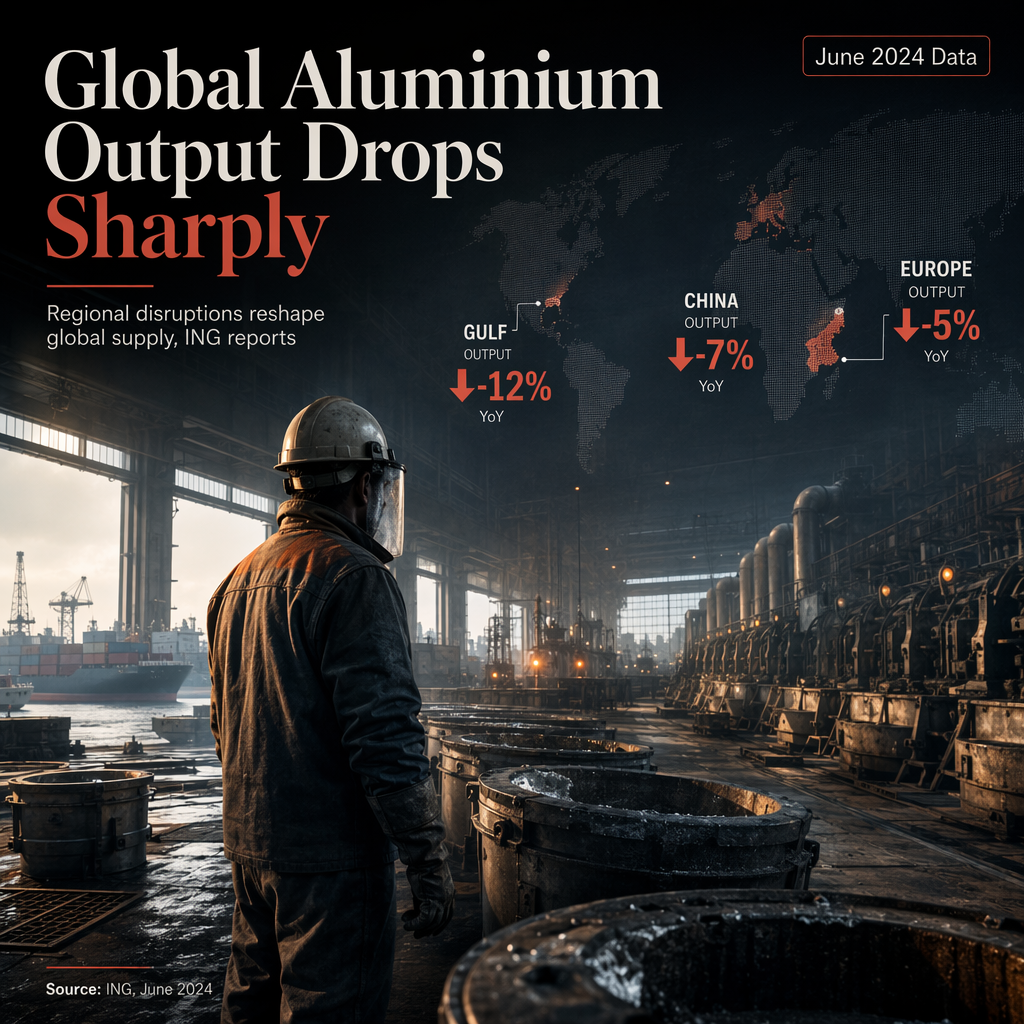
Global primary aluminium production experienced a notable decline in June, according to ING analysts Warren Patterson and Ewa Manthey, citing data from the International Aluminium Institute (IAI) [1]. Output fell by 2.9% month-on-month and 1.5% year-on-year to 5.98 million tonnes in June, although total production for the first half of the year remained broadly stable at 36.4 million tonnes [1].
China, the world's largest aluminium producer, saw its output decrease by 3.2% month-on-month to 3.7 million tonnes in June. Despite this monthly dip, China's year-to-date production was still 2.2% higher year-on-year at 22.3 million tonnes [1].
Other major regions also reported declines. European (including Russia) output dropped 1.7% month-on-month, while Asia excluding China saw a 2.9% decrease. The Gulf region experienced the most significant contraction, with production falling to 332,000 tonnes—a 34.5% year-on-year decline—attributed to disruptions linked to the Iran conflict [1].
The ING report highlights that these regional disruptions, particularly in the Gulf, have contributed to a softening global aluminium supply picture, which could have implications for market balances and pricing going forward [1].
CONCLUSION
Global aluminium production declined in June due to regional disruptions, with the Gulf region seeing the sharpest drop linked to the Iran conflict. While China's output remains higher year-to-date, the overall supply picture has softened, potentially impacting market dynamics in the coming months.