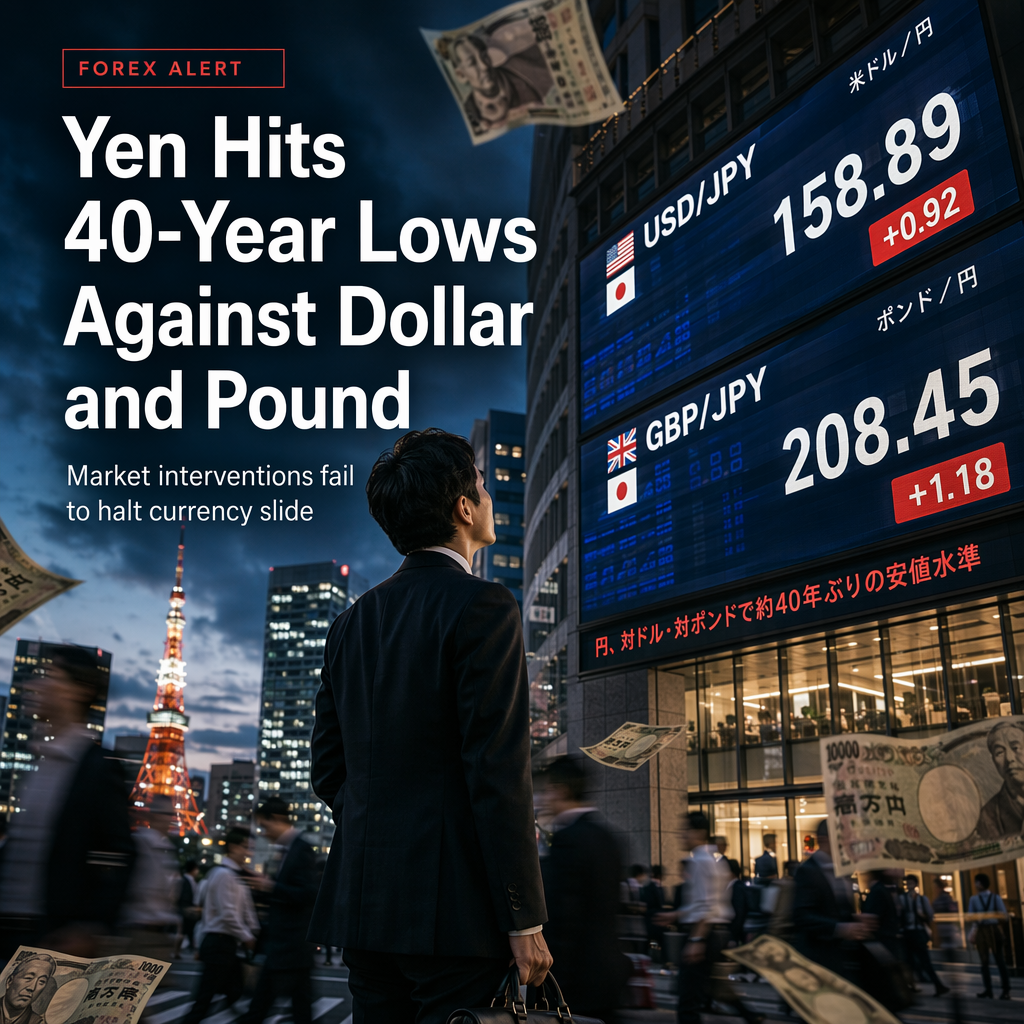
The Japanese Yen continued its decline against major currencies, with USD/JPY climbing from near 161.50 in early Asian trading to just above 162.00 by the end of Monday, remaining within one big figure of the cycle high printed last week [1]. This move occurred despite a generally soft US Dollar, highlighting that the Yen's weakness was driven by factors specific to Japan rather than broad dollar strength [1]. The Yen is now trading at levels last seen roughly 40 years ago [1].
In parallel, the British Pound surged to an 18-year high against the Japanese Yen, with GBP/JPY clearing the 217.00 mark for the first time since January 2008 and registering gains of over 0.77% as it traded at 217.11 [2]. The GBP/JPY rally was technically supported by a 'bullish harami' chart pattern and a bullish Relative Strength Index (RSI) nearing overbought territory, suggesting potential for further upside after some consolidation [2]. The next resistance levels are identified at 217.50, 218.00, and the psychological 220.00 mark, while support lies at 215.00, 214.72, and the 50- and 100-day SMAs at 214.09 and 213.17, respectively [2].
The Japanese Ministry of Finance has ceased issuing verbal warnings about Yen weakness and is reportedly favoring 'ambush tactics' for intervention, triggered by speculative short positions rather than specific price levels [1]. This follows a previous intervention in April and May, when Japan spent close to ¥12 trillion (around $73 billion) to support the Yen, but with little lasting effect [1]. The Bank of Japan recently raised its policy rate to 1.00% on June 16, the first time above that threshold in three decades, but policy remains accommodative and real rates are still negative [1]. The next rate hike is not expected until the fourth quarter, and analysts suggest that intervention while policy remains loose is ineffective [1].
Looking ahead, key data releases include Japan's Labor Cash Earnings for May, with consensus at 3.4% year-on-year, and the current account, expected to exceed ¥4 trillion [1]. Minutes from the June Federal Open Market Committee (FOMC) meeting are also due, and a hawkish tone could put further pressure on the Yen [1].
A weekly currency heat map shows the Japanese Yen was the strongest against the Canadian Dollar, but generally weaker against the US Dollar and British Pound [2].
CONCLUSION
The Japanese Yen's persistent weakness has driven USD/JPY and GBP/JPY to multi-decade highs, despite recent policy tightening by the Bank of Japan and past interventions. Market sentiment remains bearish on the Yen, with technical and fundamental factors suggesting continued pressure unless there is a significant policy shift or intervention.