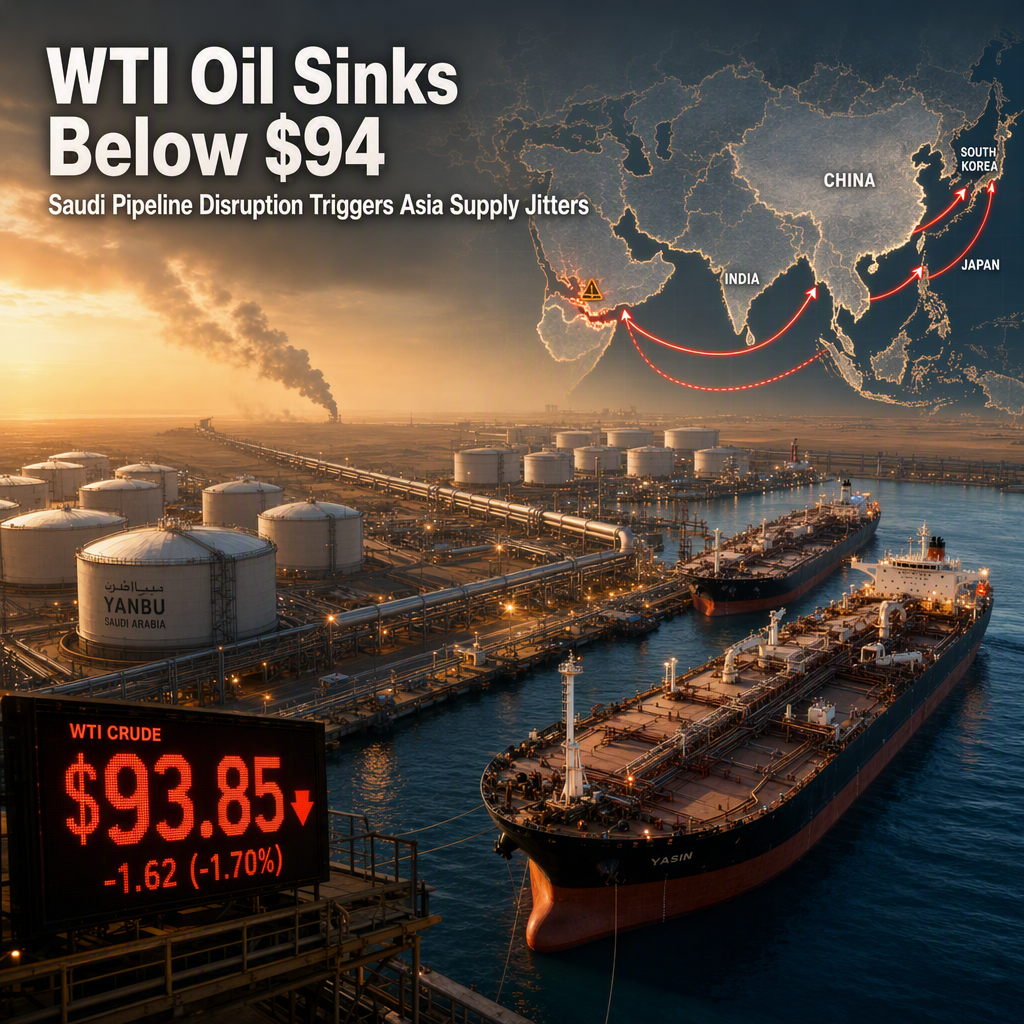
West Texas Intermediate (WTI) oil prices fell below $94.00 during the European session on Monday, marking a fourth consecutive day of declines. This drop comes amid reports of increased Saudi crude exports in September, which have pushed WTI prices nearly 8% below last week's highs, despite ongoing uncertainty in the Middle East [1]. According to CNBC, citing a JP Morgan report, Saudi crude flows have remained 'surprisingly strong' even after the disruption of the East-West pipeline, helping to ease some market concerns about supply [1]. Admiral Brad Cooper, Head of the United States Central Command, stated that oil shipments through the Strait of Hormuz reached their highest levels in the last six months over the past two weeks, attributed to US naval protection and mine clearance operations [1].
However, the closure of the Saudi East-West pipeline has significant implications for Asia's largest crude importers. South Korea is the most exposed, with Saudi crude accounting for 34.1% of its imports in July, followed by Japan (27.3%), China (14.9%), and India (10.2%) [2]. Export constraints at the Hormuz Strait have shifted a substantial volume of Saudi exports to the Yanbu port, which has now taken over the majority of exports previously shipped through Gulf terminals [2]. Analysts estimate that between 3.5 million and 4.5 million barrels per day (bpd) of Asia-bound supply are at risk, with Matt Smith of Kpler projecting a potential loss of 120 million barrels if the pipeline remains closed for a month and storage at Yanbu is depleted [2].
Despite these risks, stored crude, alternative Gulf loadings, or a partial pipeline restart could mitigate the disruption [2]. For Asian refiners, the immediate impact is being felt through higher costs rather than physical shortages, as premiums for medium-sour grades and delivered freight costs rise [2]. Morningstar's Chokwai Lee noted that the biggest near-term impact is likely to be on oil prices and freight costs, rather than on the physical availability of crude [2]. The actual impact on crude flows is expected to be felt later in the year, as stored crude at Yanbu and in Egypt could keep exports moving for one to two weeks, after which replacement cargoes from the Americas or West Africa would take over a month to arrive [2].
Market uncertainty remains high due to ongoing conflict in the Middle East, including recent missile and drone attacks on Saudi Arabia by Houthi militias, although Saudi authorities reported no fresh damage to oil infrastructure [1]. OCBC analyst Christopher Wong suggested that oil prices could see renewed support following these attacks, but further downside may be limited unless Saudi flows normalize and attacks on energy infrastructure subside [1]. Macquarie strategists believe that Asian refiners' improved feedstock flexibility could help dampen the impact of Saudi flow disruptions [2]. The duration of the pipeline disruption remains unclear, as the Kingdom has not provided a timeline for restoration [2].
CONCLUSION
WTI oil prices have declined sharply amid increased Saudi exports and ongoing Middle East tensions, but the closure of the Saudi East-West pipeline poses significant supply risks for Asia's largest crude importers. While immediate effects are being felt through higher costs, the full impact on physical supply may emerge in the coming weeks if the disruption persists. Market sentiment remains cautious, with uncertainty over both the duration of the pipeline outage and the stability of regional crude flows.