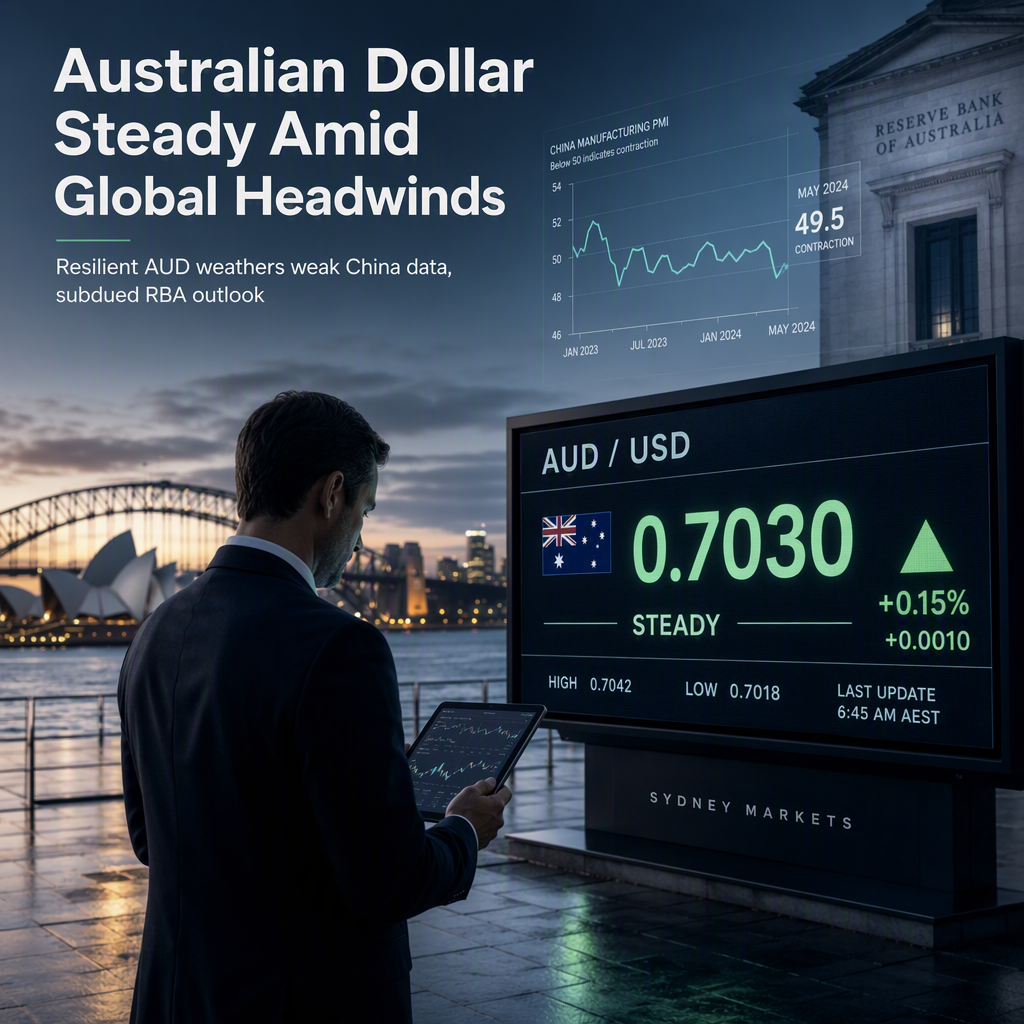
The Australian Dollar (AUD) remained stable around 0.7030 against the US Dollar (USD) on Friday, following a strong rally the previous day, despite the release of weak economic data from China and fading expectations for further interest rate hikes by the Reserve Bank of Australia (RBA) [1]. China's manufacturing sector slipped back into contraction in July, with the NBS Manufacturing Purchasing Managers Index (PMI) falling to 49.2 from 50.3, missing market expectations of 50. The Non-Manufacturing PMI also declined to 49, below forecasts, signaling slowing activity in Australia's largest trading partner—a generally negative development for the Australian Dollar [1].
Meanwhile, the US Dollar continued to face pressure after US Gross Domestic Product (GDP) data showed growth of just 1.5% in the second quarter, down from 2.1% in the first quarter and below the market consensus of 2.1% [1]. This weaker US growth reading has weighed on the Greenback, providing some support to the AUD despite headwinds from China [1].
Australia's monetary policy outlook has shifted recently. While markets had previously anticipated another RBA rate hike this year following hawkish remarks from Governor Michele Bullock, the latest second-quarter inflation data has virtually ruled out a rate increase at the August 11 meeting [1]. Deutsche Bank analysts noted that Australia's consumer price index (CPI) rose 0.6% quarter-on-quarter in Q2, below the expected 0.7% and down from 1.4% in Q1, with annual inflation moderating from 4.0% to 3.8% year-on-year [1]. Although core inflation edged up slightly from 3.5% to 3.6%, it remained below the consensus estimate of 3.7%, reducing the urgency for further rate hikes after three increases earlier this year [1].
Following the inflation data, yields on 2-year Australian government bonds fell by 8.3 basis points to 4.49%, and markets pared back the probability of a rate hike at the next RBA meeting to just 2%, down from 18% previously [1].
CONCLUSION
The Australian Dollar has shown resilience despite negative signals from China and a reassessment of RBA rate hike expectations. Softer inflation data and weaker US growth have contributed to a more cautious outlook for Australian monetary policy, with markets now seeing only a minimal chance of a rate increase in August. The overall market reaction has been moderate, with the AUD holding steady amid shifting global and domestic economic conditions.