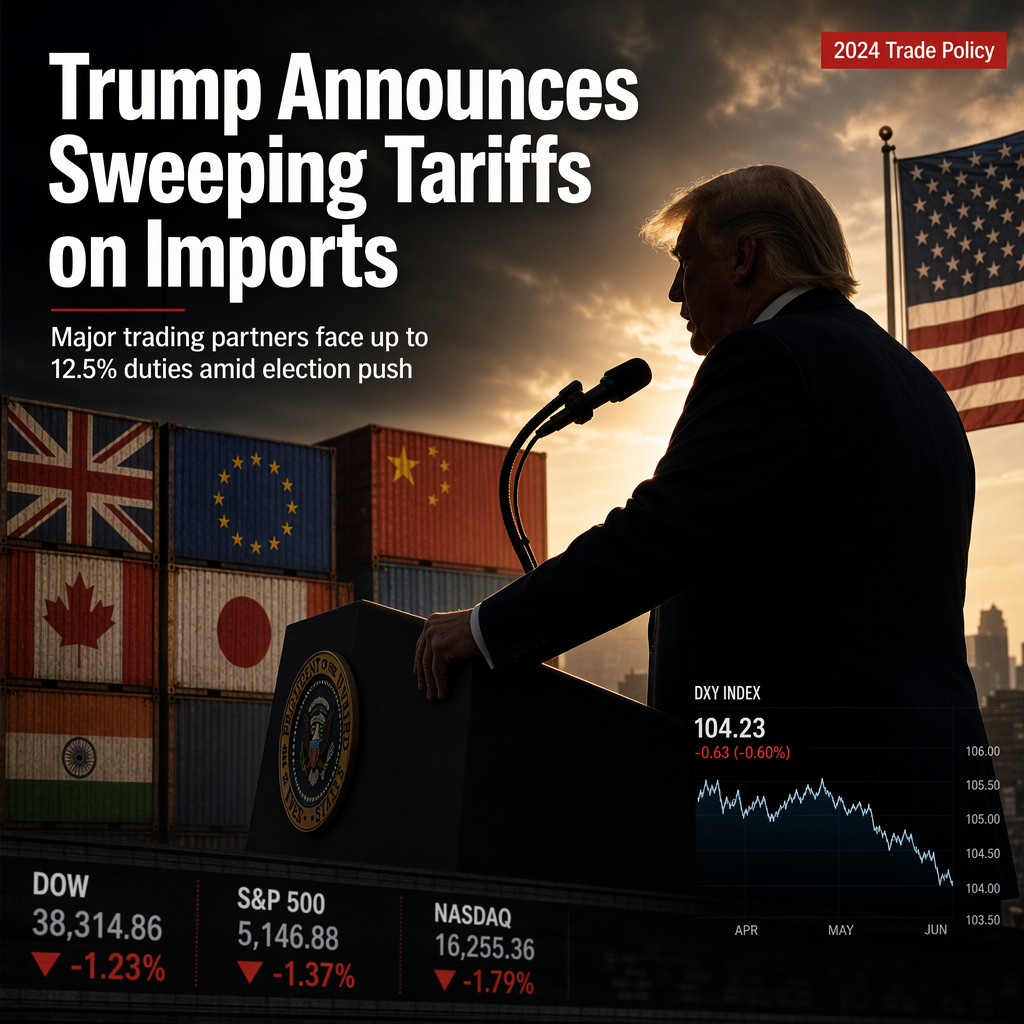
The United States has announced the imposition of new tariffs ranging from 10% to 12.5% on imports from most major trading partners, marking the largest move yet by President Donald Trump to reinforce his administration's tariff policy after a Supreme Court decision impacted previous measures [1]. These tariffs will take effect on Friday, replacing temporary 10% levies on foreign goods that were introduced earlier in the year and are now expiring [1].
The new duties target key economic partners, including the United Kingdom, China, the European Union, Canada, Japan, and India [1]. The tariffs follow an investigation into the alleged failure of approximately 60 economies to prevent forced labor in their supply chains, which the US government claims harms American workers [1]. According to the Federal Register, goods from about 10 trading partners that have adopted forced-labor restrictions, such as Mexico, the UK, Canada, and India, will be subject to 10% tariffs [1]. Items from the EU and Taiwan will face tariffs of at least 10%, while products from Japan, Switzerland, and South Korea will be taxed at a minimum of 12.5%, in accordance with their trade agreements with the US [1]. Products from dozens of other countries will also face a 12.5% charge [1].
At the time of reporting, the US Dollar Index (DXY) was down 0.02% on the day at 101.43, indicating a slight negative market reaction to the announcement [1]. The article notes that tariffs are intended to support domestic producers by making imported goods more expensive, but also acknowledges the ongoing debate among economists regarding their long-term impact, with some warning of higher prices and the risk of trade wars [1].
President Trump has made clear that tariffs are a central part of his economic strategy ahead of the November 2024 presidential election, aiming to support the US economy and American producers [1]. In 2024, Mexico, China, and Canada accounted for 42% of total US imports, with Mexico being the top exporter at $466.6 billion, according to the US Census Bureau [1]. Trump also plans to use tariff revenue to lower personal income taxes [1].
CONCLUSION
The US has implemented significant new tariffs on a wide range of trading partners, with rates up to 12.5%, as part of President Trump's strategy to bolster domestic industries and address supply chain concerns. The immediate market reaction was slightly negative, as reflected in the marginal decline of the US Dollar Index. The move signals a continued focus on protectionist trade policies ahead of the 2024 presidential election.