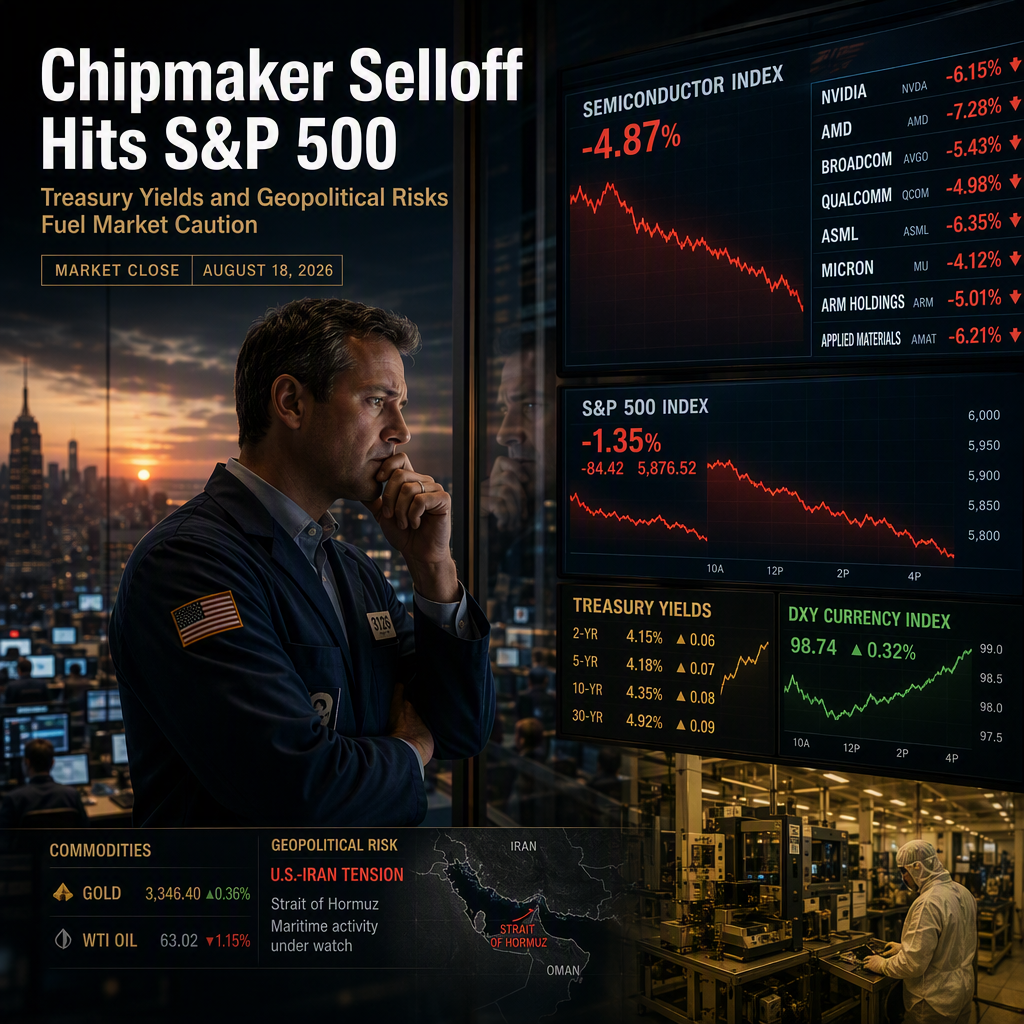
On August 18, 2026, global financial markets adopted a defensive posture as a significant selloff in semiconductor stocks led to a broad decline in equities, with the S&P 500 closing at approximately 7,694, down about 0.67% for the day. This marked the index's third consecutive session of losses. A key chipmaker index dropped around 5.5%, underscoring investor caution amid persistent concerns over higher energy and borrowing costs, as well as ongoing inflationary pressures and rising government debt levels [1].
Long-dated U.S. Treasury yields remained near multi-year highs, further dampening risk appetite. The U.S. dollar strengthened throughout the session, recovering from earlier dips to finish as the strongest major currency, while gold prices fell sharply in response to the firmer dollar. Oil prices remained volatile, trading in a range between $84.80 and $85.97 before settling near $85.00, largely unchanged on the day. The unresolved standoff between the U.S. and Iran over the Strait of Hormuz continued to support oil prices [1].
Key economic data released included a 6.0% rise in Australia's Westpac Consumer Confidence for August (versus a -2.6% forecast), a weaker-than-expected U.K. employment change for June at 83.0k (forecast: 200.0k), and a drop in U.K. claimant count by 11.0k for July. The U.K. unemployment rate held steady at 4.9%. In Germany, the ZEW Economic Sentiment Index for August rose to 34.2, beating the 28.5 forecast, while the euro area index climbed to 31.4 (forecast: 24.0). U.S. data showed ADP employment change at 9.5k, building permits at 1.44 million (above the 1.39 million forecast), and pending home sales down 2.2% year-over-year. U.S. import and export prices rose less than expected, while industrial and manufacturing production both increased by 0.2% month-over-month [1].
Bitcoin edged higher during the session, though no crypto-specific catalysts were cited. The overall market tone remained cautious, with investors responding to the combination of sector-specific weakness, elevated yields, and geopolitical uncertainty [1].
CONCLUSION
The August 18 session was marked by risk aversion as a chipmaker-led equity selloff and high Treasury yields weighed on sentiment. Despite some positive economic surprises, persistent inflation concerns and geopolitical tensions kept markets defensive. The S&P 500's continued decline and sector volatility signal ongoing caution among investors.