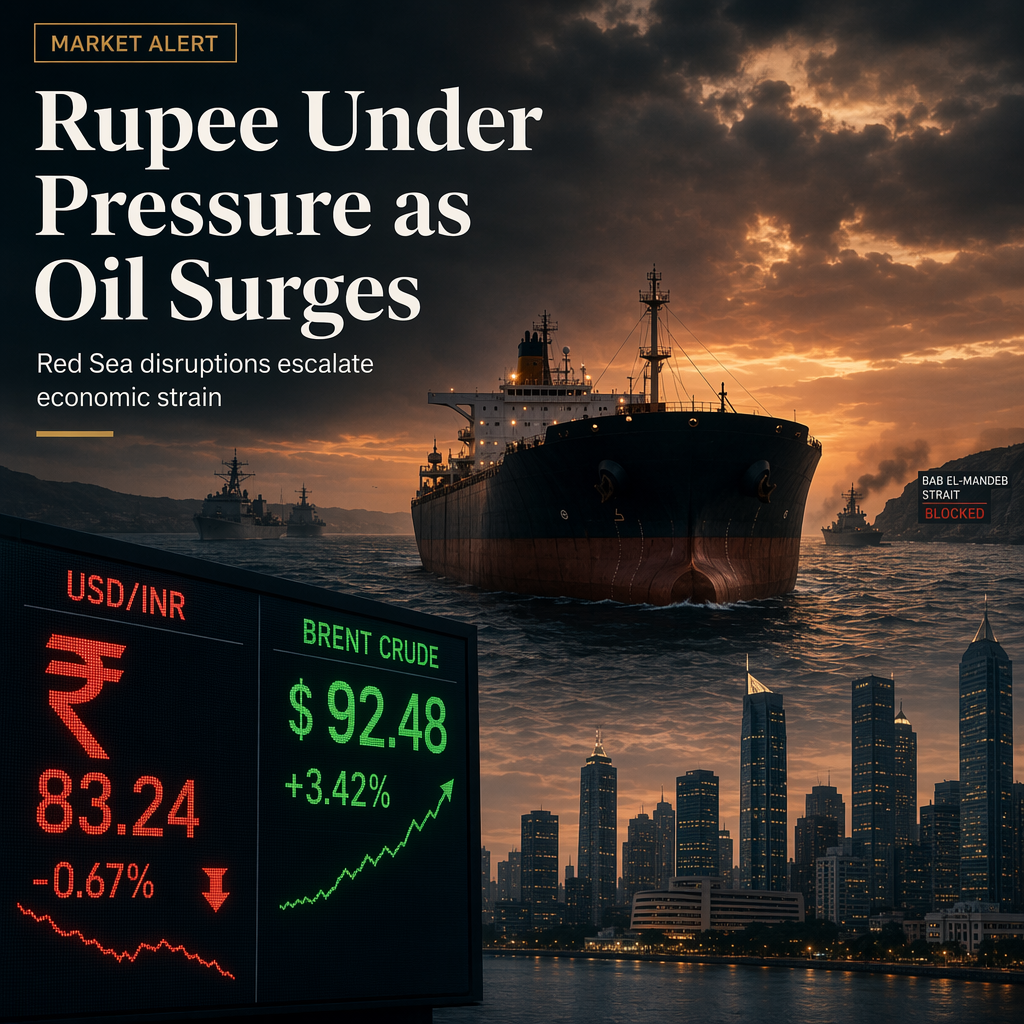
The Indian Rupee (INR) resumed its decline against the US Dollar (USD) on Wednesday, with the USD/INR pair rising to near 96.45, following a fresh surge in oil prices. This depreciation comes after a brief period of relief for the currency the previous day [1]. The MCX Crude Oil contract expiring on August 19 reached a new five-week high at Rs. 8,253 in opening trade, reflecting heightened concerns over global energy supply disruptions [1].
The immediate catalyst for the rupee's weakness is the closure of the Bab el-Mandeb Strait by Yemen's Iran-aligned Houthis, which has halted oil exports from Saudi Arabia to Asian economies. This action is in retaliation for a US blockade on Iranian sea ports and has escalated fears of further energy supply disruptions. According to a Reuters report cited in the article, the closure of the Bab el-Mandeb Strait could reduce global oil supply by 7%. This disruption compounds existing supply constraints caused by the closure of the Strait of Hormuz, which is critical to nearly 20% of global energy supply [1].
The Saudi-led coalition has condemned Iran's actions, labeling them as 'a blatant violation of international law and acts of maritime piracy,' according to Reuters. US Secretary of State Marco Rubio warned Southeast Asian foreign ministers that Iranian control of the Strait of Hormuz would set a 'dangerous precedent with repercussions beyond the Middle East' [1].
On the equity front, Foreign Institutional Investors (FIIs) became net buyers on Tuesday, investing Rs. 1,650.16 crore after six consecutive days of net selling. However, between July 13-20, FIIs had offloaded Rs. 10,240.80 crore. Despite the brief return of FII inflows, sentiment toward Indian equities is expected to remain subdued as higher oil prices are likely to increase the government's import bill, potentially limiting its capacity for infrastructure and development spending [1].
From a technical perspective, USD/INR remains firm above its 20-day exponential moving average (EMA) at 95.7889, with the Relative Strength Index (RSI) at 62.38 indicating continued buying interest. The pair is targeting a revisit of its all-time high near 97.10, with immediate support at the 20-period EMA [1].
CONCLUSION
The Indian Rupee's renewed weakness is closely tied to surging oil prices driven by major shipping disruptions in the Red Sea and the Strait of Hormuz. While there was a brief pause in foreign investor outflows, the outlook for the rupee and Indian equities remains cautious as elevated energy costs threaten to strain the country's finances and investment capacity.