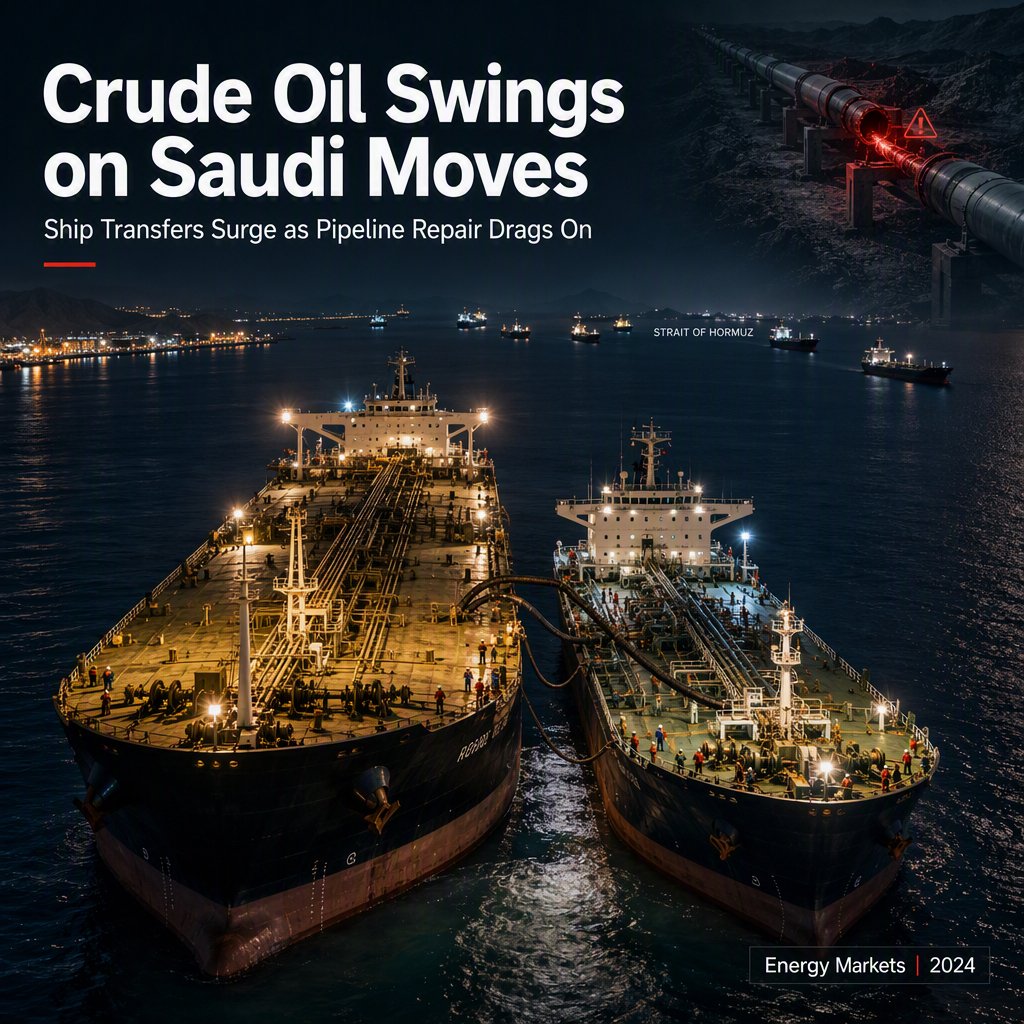
Crude oil prices experienced significant volatility, initially selling off to $94.50 before recovering to trade near $97.50, which is where the session opened [1]. The market reaction was triggered by Saudi Arabia offering Asian refiners extra cargoes delivered outside the Strait of Hormuz, which was initially interpreted as an increase in available oil supply [1]. However, the actual logistics involve ship-to-ship transfers in the Gulf of Oman, with shuttle tankers carrying Saudi crude through the Strait of Hormuz and transferring it to buyers' vessels off Sohar, Oman. This means the oil still transits the same chokepoint, and the risk is shifted rather than eliminated [1].
Transfer volumes in the Gulf of Oman have risen to approximately 2.7 million barrels per day, up from 1.5 million in August, indicating more cargo is moving through the same route rather than bypassing it [1]. The Strait of Hormuz remains a critical passage, carrying nearly 20 million barrels per day of crude and products in 2025, about a quarter of the world's seaborne oil trade. War-risk insurance for a single Hormuz transit has surged to 7.5%-12.5% of a ship's insured value, compared to 0.25% before the recent escalation [1]. Saudi Arabia has also doubled daily loadings at its Ras Tanura and Juaymah terminals to about two supertankers, or roughly 4 million barrels, all of which are inside the Gulf [1].
The only route that genuinely avoids the Strait of Hormuz is the East-West pipeline, which runs 1,200 kilometers from eastern oil fields to Yanbu on the Red Sea and is rated at 5 million barrels per day [1]. This pipeline was damaged by Houthi drones and shut down on September 11, causing crude oil prices to spike just above $102.00 on September 15 [1]. Regional officials estimate repairs will take three to five weeks, while Aramco has stated it expects to restore about half the pipeline's capacity within days [1]. Until the pipeline is operational, all Saudi barrels destined for Asia must cross Hormuz, and buyers relying on the Red Sea route have been informed of delayed loadings, with some European cargoes for the month cancelled outright [1].
The market has already reacted to these developments, with news of a meeting on a shipping arrangement for the strait causing a $4 drop in oil prices on September 11, followed by a rally to new highs two sessions later [1]. The article emphasizes that logistical changes such as ship-to-ship transfers do not equate to increased supply, and the fundamental risks and constraints remain [1].
CONCLUSION
Crude oil markets remain highly sensitive to developments around Saudi export logistics and the status of the East-West pipeline. While ship-to-ship transfers have increased, they do not bypass the critical Strait of Hormuz, and pipeline repairs are expected to take weeks. Market volatility is likely to persist until a more robust solution is implemented or the pipeline returns to full operation.